Thank you for visiting SNEWPapers!
Sign up free
Editorial
February 26, 1850
Shepherdstown Register
Shepherdstown, Jefferson County, West Virginia
What is this article about?
A Southern editorial critiques a Northern anti-slavery piece from the New York Christian Inquirer, arguing that the North should use moral suasion rather than political coercion to address slavery. It blames Northern agitation and Southern leaders like Calhoun for escalating tensions, urging constitutional respect and non-interference.
Clipping
OCR Quality
95%
Excellent
Full Text
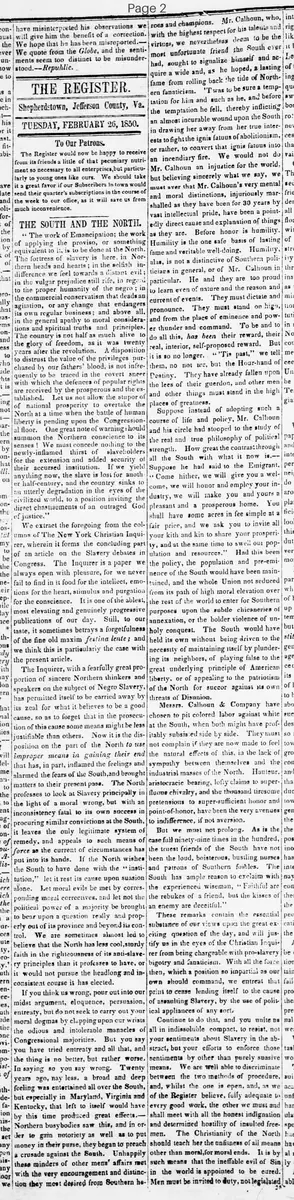
THE SOUTH AND THE NORTH.
"The work of Emancipation; the work of applying the proviso, or something equivalent to it, is to be done at the North. The fortress of slavery is here, in Northern heads and hearts; in the selfish indifference we feel towards a distant evil; in the vulgar prejudice still rife, in regard to the proper humanity of the negro; in the commercial conservatism that dreads an agitation, or any change that endangers its own regular business; and above all in the general apathy to moral considerations and spiritual truths and principles.
The country is not half as much alive to the glory of freedom, as it was twenty years after the revolution. A disposition to distrust the value of the privileges purchased by our fathers' blood, is not infrequently to be traced in the covert sneer with which the defences of popular rights are received by the prosperous and the established. Let us not allow the stupor of national prosperity to overtake the North at a time when the battle of human liberty is pending upon the Congressional floor. One great note of warning should summon the Northern conscience to its senses! We must concede nothing to the newly-inflamed thirst of slaveholders for the extension and added security of their accursed institution. If we yield anything now, the slave is lost for another half-century, and the country sinks to an utter degradation in the eyes of the civilized world, to a position inviting the direct chastisements of an outraged God of justice."
We extract the foregoing from the columns of the New York Christian Inquirer, wherein it forms the concluding part of an article on the Slavery debates in Congress. The Inquirer is a paper we always open with pleasure, for we never fail to find in it food for the intellect, emotions for the heart, stimulus and purgation for the conscience. It is one of the ablest, most elevating and genuinely progressive publications of our day. Still, to our taste, it sometimes betrays a forgetfulness of the fine old maxim festina lente; and we think this is particularly the case with the present article.
The Inquirer, with a fearfully great proportion of sincere Northern thinkers and speakers on the subject of Negro Slavery has permitted itself to be carried away by its zeal for what it believes to be a good cause, so as to forget that in the prosecution of this cause some means might be less justifiable than others. Now it is the disposition on the part of the North to use improper means in gaining their end that has, in part, inflamed the feelings and alarmed the fears of the South, and brought matters to their present pass. The North professes to look at Slavery principally in the light of a moral wrong, but with an inconsistency fatal to its own success in procuring similar convictions at the South. it leaves the only legitimate system of remedy, and appeals to such means of force as the current of circumstances has put into its hands. If the North wishes the South to have done with the "institution," let it rest its cause upon suasion alone. Let moral evils be met by corresponding moral correctives, and let not the political power of a majority be brought to bear upon a question really and properly out of its province and beyond its control. We are sometimes almost led to believe that the North has less cool, sturdy faith in the righteousness of its anti-slavery principles than it professes to have, or it would not pursue the headlong and inconsistent course it has elected.
If you think us wrong, pour out into our midst argument, eloquence, persuasion, entreaty, but do not seek to carry out your moral dogmas by clapping upon our wrists the odious and intolerable manacles of Congressional majorities. But you say you have tried entreaty and all that, and the thing is no better, but rather worse. In saying so you say wrong. Twenty years ago, nay less, a broad and deep feeling was entertained all over the South, but especially in Maryland, Virginia and Kentucky, that left to itself would have by this time produced great effects.
Northern busybodies saw this, and in order to gain notoriety as well as to put money in their purse, they began to preach a crusade against the South. Unhappily these minders of other mens' affairs met with the very encouragement and distinction they most desired from Southern forces and champions. Mr. Calhoun, who with the highest respect for his talents and virtues, we nevertheless deem to be the most unfortunate friend the South ever had, sought to signalize himself and acquire a wide and, as he hoped, a lasting fame from rolling back the tide of Northern fanaticism. 'Twas to be sure a temptation for him and such as he, and before the temptation he fell, thereby inflicting an almost incurable wound upon the South in drawing her away from her true interests to fight the ignis fatuus of abolitionism, or rather, to convert that ignis fatuus into an incendiary fire. We would not do Mr. Calhoun an injustice for the world. but believing sincerely what we say, we must aver that Mr. Calhoun's very mental and moral distinctions, injuriously marshalled as they have been for 30 years by vast intellectual pride, have been a pointedly direct cause and explanation of things as they are. Before honor is humility. Humility is the one safe basis of lasting fame and veritable well-doing. Humility, alas, is not a distinctive of Southern politicians in general, or of Mr. Calhoun in particular. He and they are too proud to learn even of nature and the reason and current of events. They must dictate and pronounce. They must stand on high, and from the place of eminence and power thunder and command. To be and to do all this, has been their reward, their real, interior, self-proposed reward. But it is so no longer. "Tis past," we tell them, no not we, but the Hour-hand of Destiny. They have already fallen upon the lees of their guerdon, and other men and other things must stand in the high places of greatness.
Suppose instead of adopting such a course of life and policy, Mr. Calhoun and his circle had stooped to the study of the real and true philosophy of political strength: How great the contrast through all the South with what it now is.
Suppose he had said to the Emigrant "Come hither, we will give you a welcome, we will honor and employ your industry, we will make you and yours a pleasant and a prosperous home. You shall have some acres in fee simple at a fair price, and we ask you to invite all your kith and kin to share your prosperity, and at the same time to swell our population and resources." Had this been the policy, the population and pre-eminence of the South would have been maintained, and the whole Union not seduced from its path of high moral elevation over the rest of the world to enter for Southern purposes upon the subtle chicaneries of annexation, or the bolder violence of unholy conquest. The South would have held its own without being driven to the necessity of maintaining itself by plundering its neighbors, of playing false to the great underlying principle of American liberty, or of appealing to the patriotism of the North for succor against its own threats of Disunion.
Messrs. Calhoun & Company have chosen to pit colored labor against white at the South, when both might have profitably subsisted side by side. They must not complain if they are now made to feel the natural effects of this, in the lack of sympathy between themselves and the industrial masses of the North. Hauteur, aristocratic bearing, lofty claims to superfluous chivalry, and the thousand tiresome pretensions to super-sufficient honor and point-of-honor, have been the very avenues to indifference, if not aversion.
But we must not prolong. As is the case full ninety-nine times in the hundred, the truest friends of the South have not been the loud, boisterous, bustling nurses and patrons of Southern foibles. The South has ample reason to exclaim with the experienced wiseman, "Faithful are the rebukes of a friend, but the kisses of an enemy are deceitful."
These remarks contain the essential substance of our views upon the great exciting question of the day, and will justify us in the eyes of the Christian Inquirer from being chargeable with pro-slavery bigotry and fanaticism. With all the force then, which a position so impartial as our own should command, we entreat that print to cease lending itself to the cause of assailing Slavery, by the use of political appliances of any sort.
Continue to do that, and you unite us all in indissoluble compact, to resist, not your sentiments about Slavery in the abstract, but your efforts to enforce those sentiments by other than purely suasive means.
We are well able to discriminate between the two methods of procedure, and, whilst the one is open, and, as we of the Register believe, fully adequate to every good work, the other we must and shall meet with all the honest indignation and determined hostility of insulted freemen.
The Christianity of the North should teach her the unfitness of all means other than moral, for moral ends. It is by such means that the ineffable evil of Sin in the world is appointed to be cured. Men must be invited to duty, not legislated into it, to the destruction of constitutional rights and sacred freedom. The North, like the South, is under temptation. Let it be alive to its privileges and position. Let it forbear to touch the compromises of the Constitution, and the South witnessing on the part of the North such a conquest of self, will relax its grasp upon the sword-hilt of Disunion, and lay open its bosom to still further impressions which the rough hand of Northern violence could never hope to effect. The quiet influences of benignant Sol will ensure results, that the rude blasts of Boreas attempt in vain.
One word more by way of postscript. The North, or a portion of it, has been seduced, we feel persuaded, into an unfriendly position towards the South by its democratic instincts. The idea, that in all cases a majority must govern, loosely floating through the popular mind, has, with thousands, induced a forgetfulness of the fact that the Constitution is yet stronger than any majority. 'The majority governs indeed, but it must govern through and under the Constitution. The instinct of the North presses for a decision as to the further extension of Slavery, but mistakes the tribunal in referring the question to Congress. As long as the Constitution acknowledges the right of property in slaves, Congress is powerless to aid Northern objects. The only legitimate course, then, for the North is an amendment to the Constitution. If it can succeed in procuring this, all sections of the Union must abide by it, but until that can be done, the subject of slavery in U. S. Territory belongs as much to the Norwegian Storthing as to Congress.
"The work of Emancipation; the work of applying the proviso, or something equivalent to it, is to be done at the North. The fortress of slavery is here, in Northern heads and hearts; in the selfish indifference we feel towards a distant evil; in the vulgar prejudice still rife, in regard to the proper humanity of the negro; in the commercial conservatism that dreads an agitation, or any change that endangers its own regular business; and above all in the general apathy to moral considerations and spiritual truths and principles.
The country is not half as much alive to the glory of freedom, as it was twenty years after the revolution. A disposition to distrust the value of the privileges purchased by our fathers' blood, is not infrequently to be traced in the covert sneer with which the defences of popular rights are received by the prosperous and the established. Let us not allow the stupor of national prosperity to overtake the North at a time when the battle of human liberty is pending upon the Congressional floor. One great note of warning should summon the Northern conscience to its senses! We must concede nothing to the newly-inflamed thirst of slaveholders for the extension and added security of their accursed institution. If we yield anything now, the slave is lost for another half-century, and the country sinks to an utter degradation in the eyes of the civilized world, to a position inviting the direct chastisements of an outraged God of justice."
We extract the foregoing from the columns of the New York Christian Inquirer, wherein it forms the concluding part of an article on the Slavery debates in Congress. The Inquirer is a paper we always open with pleasure, for we never fail to find in it food for the intellect, emotions for the heart, stimulus and purgation for the conscience. It is one of the ablest, most elevating and genuinely progressive publications of our day. Still, to our taste, it sometimes betrays a forgetfulness of the fine old maxim festina lente; and we think this is particularly the case with the present article.
The Inquirer, with a fearfully great proportion of sincere Northern thinkers and speakers on the subject of Negro Slavery has permitted itself to be carried away by its zeal for what it believes to be a good cause, so as to forget that in the prosecution of this cause some means might be less justifiable than others. Now it is the disposition on the part of the North to use improper means in gaining their end that has, in part, inflamed the feelings and alarmed the fears of the South, and brought matters to their present pass. The North professes to look at Slavery principally in the light of a moral wrong, but with an inconsistency fatal to its own success in procuring similar convictions at the South. it leaves the only legitimate system of remedy, and appeals to such means of force as the current of circumstances has put into its hands. If the North wishes the South to have done with the "institution," let it rest its cause upon suasion alone. Let moral evils be met by corresponding moral correctives, and let not the political power of a majority be brought to bear upon a question really and properly out of its province and beyond its control. We are sometimes almost led to believe that the North has less cool, sturdy faith in the righteousness of its anti-slavery principles than it professes to have, or it would not pursue the headlong and inconsistent course it has elected.
If you think us wrong, pour out into our midst argument, eloquence, persuasion, entreaty, but do not seek to carry out your moral dogmas by clapping upon our wrists the odious and intolerable manacles of Congressional majorities. But you say you have tried entreaty and all that, and the thing is no better, but rather worse. In saying so you say wrong. Twenty years ago, nay less, a broad and deep feeling was entertained all over the South, but especially in Maryland, Virginia and Kentucky, that left to itself would have by this time produced great effects.
Northern busybodies saw this, and in order to gain notoriety as well as to put money in their purse, they began to preach a crusade against the South. Unhappily these minders of other mens' affairs met with the very encouragement and distinction they most desired from Southern forces and champions. Mr. Calhoun, who with the highest respect for his talents and virtues, we nevertheless deem to be the most unfortunate friend the South ever had, sought to signalize himself and acquire a wide and, as he hoped, a lasting fame from rolling back the tide of Northern fanaticism. 'Twas to be sure a temptation for him and such as he, and before the temptation he fell, thereby inflicting an almost incurable wound upon the South in drawing her away from her true interests to fight the ignis fatuus of abolitionism, or rather, to convert that ignis fatuus into an incendiary fire. We would not do Mr. Calhoun an injustice for the world. but believing sincerely what we say, we must aver that Mr. Calhoun's very mental and moral distinctions, injuriously marshalled as they have been for 30 years by vast intellectual pride, have been a pointedly direct cause and explanation of things as they are. Before honor is humility. Humility is the one safe basis of lasting fame and veritable well-doing. Humility, alas, is not a distinctive of Southern politicians in general, or of Mr. Calhoun in particular. He and they are too proud to learn even of nature and the reason and current of events. They must dictate and pronounce. They must stand on high, and from the place of eminence and power thunder and command. To be and to do all this, has been their reward, their real, interior, self-proposed reward. But it is so no longer. "Tis past," we tell them, no not we, but the Hour-hand of Destiny. They have already fallen upon the lees of their guerdon, and other men and other things must stand in the high places of greatness.
Suppose instead of adopting such a course of life and policy, Mr. Calhoun and his circle had stooped to the study of the real and true philosophy of political strength: How great the contrast through all the South with what it now is.
Suppose he had said to the Emigrant "Come hither, we will give you a welcome, we will honor and employ your industry, we will make you and yours a pleasant and a prosperous home. You shall have some acres in fee simple at a fair price, and we ask you to invite all your kith and kin to share your prosperity, and at the same time to swell our population and resources." Had this been the policy, the population and pre-eminence of the South would have been maintained, and the whole Union not seduced from its path of high moral elevation over the rest of the world to enter for Southern purposes upon the subtle chicaneries of annexation, or the bolder violence of unholy conquest. The South would have held its own without being driven to the necessity of maintaining itself by plundering its neighbors, of playing false to the great underlying principle of American liberty, or of appealing to the patriotism of the North for succor against its own threats of Disunion.
Messrs. Calhoun & Company have chosen to pit colored labor against white at the South, when both might have profitably subsisted side by side. They must not complain if they are now made to feel the natural effects of this, in the lack of sympathy between themselves and the industrial masses of the North. Hauteur, aristocratic bearing, lofty claims to superfluous chivalry, and the thousand tiresome pretensions to super-sufficient honor and point-of-honor, have been the very avenues to indifference, if not aversion.
But we must not prolong. As is the case full ninety-nine times in the hundred, the truest friends of the South have not been the loud, boisterous, bustling nurses and patrons of Southern foibles. The South has ample reason to exclaim with the experienced wiseman, "Faithful are the rebukes of a friend, but the kisses of an enemy are deceitful."
These remarks contain the essential substance of our views upon the great exciting question of the day, and will justify us in the eyes of the Christian Inquirer from being chargeable with pro-slavery bigotry and fanaticism. With all the force then, which a position so impartial as our own should command, we entreat that print to cease lending itself to the cause of assailing Slavery, by the use of political appliances of any sort.
Continue to do that, and you unite us all in indissoluble compact, to resist, not your sentiments about Slavery in the abstract, but your efforts to enforce those sentiments by other than purely suasive means.
We are well able to discriminate between the two methods of procedure, and, whilst the one is open, and, as we of the Register believe, fully adequate to every good work, the other we must and shall meet with all the honest indignation and determined hostility of insulted freemen.
The Christianity of the North should teach her the unfitness of all means other than moral, for moral ends. It is by such means that the ineffable evil of Sin in the world is appointed to be cured. Men must be invited to duty, not legislated into it, to the destruction of constitutional rights and sacred freedom. The North, like the South, is under temptation. Let it be alive to its privileges and position. Let it forbear to touch the compromises of the Constitution, and the South witnessing on the part of the North such a conquest of self, will relax its grasp upon the sword-hilt of Disunion, and lay open its bosom to still further impressions which the rough hand of Northern violence could never hope to effect. The quiet influences of benignant Sol will ensure results, that the rude blasts of Boreas attempt in vain.
One word more by way of postscript. The North, or a portion of it, has been seduced, we feel persuaded, into an unfriendly position towards the South by its democratic instincts. The idea, that in all cases a majority must govern, loosely floating through the popular mind, has, with thousands, induced a forgetfulness of the fact that the Constitution is yet stronger than any majority. 'The majority governs indeed, but it must govern through and under the Constitution. The instinct of the North presses for a decision as to the further extension of Slavery, but mistakes the tribunal in referring the question to Congress. As long as the Constitution acknowledges the right of property in slaves, Congress is powerless to aid Northern objects. The only legitimate course, then, for the North is an amendment to the Constitution. If it can succeed in procuring this, all sections of the Union must abide by it, but until that can be done, the subject of slavery in U. S. Territory belongs as much to the Norwegian Storthing as to Congress.
What sub-type of article is it?
Slavery Abolition
Constitutional
Moral Or Religious
What keywords are associated?
Slavery Debates
Northern Interference
Moral Suasion
John Calhoun
Constitution
Wilmot Proviso
South North Relations
Abolitionism
Congressional Majorities
What entities or persons were involved?
New York Christian Inquirer
Mr. Calhoun
Slaveholders
Northern Thinkers
Congress
Editorial Details
Primary Topic
Southern Advocacy For Moral Suasion Over Political Coercion In Slavery Debates
Stance / Tone
Defensive Of Southern Interests, Critical Of Northern Interference And Calhoun's Leadership
Key Figures
New York Christian Inquirer
Mr. Calhoun
Slaveholders
Northern Thinkers
Congress
Key Arguments
Northern Apathy And Prejudice Sustain Slavery More Than Southern Actions
North Should Use Moral Suasion, Not Political Force, To Address Slavery
Improper Northern Means Have Inflamed Southern Fears
Calhoun's Pride And Resistance To Abolitionism Harmed The South
South Should Have Welcomed Immigrants To Boost Population And Economy
Pitting Colored Against White Labor Caused Northern Southern Sympathy Loss
True Friends Rebuke, Not Flatter Southern Foibles
Resist Enforcement Of Anti Slavery Views By Congressional Majorities
Christianity Demands Moral Means For Moral Ends
Constitution Trumps Majority; Amendment Needed For Slavery Changes