Thank you for visiting SNEWPapers!
Sign up free
Alexandria Daily Advertiser
Alexandria, Virginia
What is this article about?
An editorial in the New York Evening Post critiques Senator John Quincy Adams' letter on U.S.-British disputes, sarcastically highlighting inconsistencies in his dismissal of impressment and other grievances relative to British Orders in Council, while defending traditional maritime rights and past negotiations like the Monroe-Pinkney Treaty.
Merged-components note: These two components form a continuous editorial piece: 'From the New York Evening Post NO. VII. LETTER OF THE HON. SENATOR ADAMS'.
Clipping
OCR Quality
Full Text
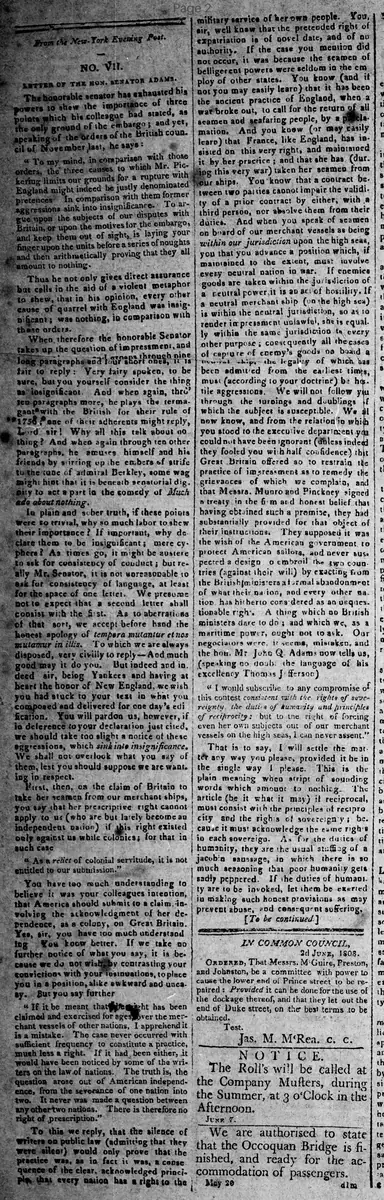
NO. VII.
LETTER OF THE HON. SENATOR ADAMS
The honorable senator has exhausted his powers to shew the importance of three points which his colleague had stated, as speaking of the orders of the British council of November last, he says:
To my mind, in comparison with those orders, the three causes to which Mr. Pickering limits our grounds for a rupture with England might indeed be justly denominated pretences. In comparison with them former aggressions sink into insignificance. To argue upon the subjects of our disputes with Britain, or upon the motives for the embargo, and then arithmetically proving that they all amount to nothing and keep them out of sight is laying your finger upon the units before a series of noughts.
Thus he not only gives direct assurance but calls in the aid of a violent metaphor to shew, that in his opinion, every other cause of quarrel with England was insignificant; was nothing, in comparison with those orders.
When therefore the honorable Senator paraphrase doctrine he takes up the question of impressment, and it is fair to reply: Very fairly spoken, to be sure, but you yourself consider the thing as insignificant. And when again, through ten paragraphs more, he plays the same game with the British for their rule of 1756, one of their adherents might reply: Lord sir! Why all this talk about nothing? And when again through ten other paragraphs, he amuses himself and his friends by stirring up the embers of grief to the tune of admiral Berkeley, some wag might hint that it is beneath senatorial dignity to act a part in the comedy of Much ado about nothing.
In plain and sober truth, if these points were so trivial, why so much labor to shew their importance? If important, why declare them to be insignificant; mere cyphers? As times go, it might be austere to ask for consistency of conduct; but really Mr. Senator, it is not unreasonable to ask for consistency of language, at least for the space of one letter. We presume not to expect that a second letter shall consist with the first. As to aberrations of that sort, we accept beforehand the honest apology of tempora mutantur et nos mutamur in illis, to which we are always disposed, very civilly to reply-- And much good may it do you. But indeed and indeed sir, being Yankees and having at heart the honor of New England, we wish you had stuck to your text in what you composed and delivered for one day's edification. You will pardon us, however, if in deference to your declaration just cited, we should take too slight a notice of these aggressions, which sink into insignificance. We shall not overlook what you say of them, lest you should suppose we are wanting in respect.
First, then, on the claim of Britain to take her seamen from our merchant ships you say that her prescriptive right cannot apply to us (who are but lately become an independent nation) if this right existed only against us while colonies; for that in such case
As a relict of colonial servitude, it is not entitled to our submission
You have too much understanding to believe it was your colleagues intention, that America should submit to a claim, involving the acknowledgment of her dependence, as a colony, on Great Britain.
Yes, sir. you have too much understanding You know better. If we take no further notice of what you say, it is because we do not wish by contrasting your convictions with your insinuations, to place you in a position, alike awkward and untenable. But you say further
" If it be meant that the right has been claimed and exercised for ages over the merchant vessels of other nations, I apprehend it is a mistake. The case never occurred with sufficient frequency to constitute a practice, much less a right. If it had been either, it would have been noticed by some of the writers on the law of nations. The truth is, the question arose out of American independence, from the severance of one nation into two. It never was made a question between any other two nations. There is therefore no right of prescription."
To this we reply, that the silence of writers on public law (admitting that they were silent) would only prove that the practice was, as in fact it was, a consequence of the clear, acknowledged principle that every nation has a right to the military service over its people. Our expatriation is of novel date, and of no authority. If the case you mention did not occur it was because the seamen of belligerent powers were seldom in the employment of other states. You know (and if not you may easily learn) that it has been the ancient practice of England, when a war broke out, to call for the return of all seamen and seafaring people, by a proclamation. And you know (or may easily learn) that France, like England, has insisted on this very right, and maintained it by her practice; and that she has (during this very war) taken her seamen from our ships. You know that a contract between two parties cannot impair the validity of a prior contract by either, with a third person, nor absolve them from their duties. And when you speak of seamen on board of our merchant vessels as being within our jurisdiction upon the high seas, you advance a position which, if maintained to the extent, must involve every neutral nation in war. If enemies goods are taken within the jurisdiction of a neutral power, it is an act of hostility. If a neutral merchant ship (on the high sea) is within the neutral jurisdiction, so as to render impressment unlawful, she is equally within the same jurisdiction in every other purpose : consequently all the cases of capture of enemy's goods on board a neutral ship the legality of which has been admitted from the earliest times, must (according to your doctrine) be hostile aggressions. We will not follow you through the turnings and doublings of which the subject is susceptible. We all now know, and from the relation in which you stood to the executive department you could not have been ignorant (unless indeed they fooled you with half confidence) that Great Britain offered so to restrain the practice of impressment as to remedy the grievances of which we complain, and that Messrs. Munro and Pinckney signed a treaty in the firm and honest belief that having obtained such a promise, they had substantially provided for that object of their instructions. They supposed it was the wish of the American government to protect American sailors, and never suspected a design to embroil the two countries (against their will) by exacting from the British ministers a formal abandonment of what their nation, and every other nation, has hitherto considered as an unquestionable right. A thing which no British ministers dare to do : and which we, as a maritime power, ought not to ask. Our negotiators were, it seems, mistaken, and the hon. Mr. John Q. Adams now tells us, (speaking no doubt the language of his excellency Thomas Jefferson)
" I would subscribe to any compromise of this contest consistent with the rights of sovereignty, the duties of humanity and principles of reciprocity: but to the right of forcing even her own subjects out of our merchant vessels on the high seas, I can never assent."
That is to say, I will settle the matter any way you please, provided it be in the single way I please. This is the plain meaning when stripped of sounding words which amount to nothing. The article (be it what it may) if reciprocal, must consist with the principles of reciprocity and the rights of sovereignty: because it must acknowledge the same rights in each sovereign. As for the duties of humanity, they are the usual stuffing of a jacobin sausage, in which there is so much seasoning that poor humanity gets sadly peppered. If the duties of humanity are to be invoked, let them be exerted in making such honest provisions as may prevent abuse, and consequent suffering.
[To be continued.]
What sub-type of article is it?
What keywords are associated?
What entities or persons were involved?
Editorial Details
Primary Topic
Critique Of Senator Adams On British Impressment And Orders In Council
Stance / Tone
Sarcastic Criticism Of Inconsistencies In Adams' Arguments
Key Figures
Key Arguments