Thank you for visiting SNEWPapers!
Sign up free
Daily National Intelligencer
Washington, District Of Columbia
What is this article about?
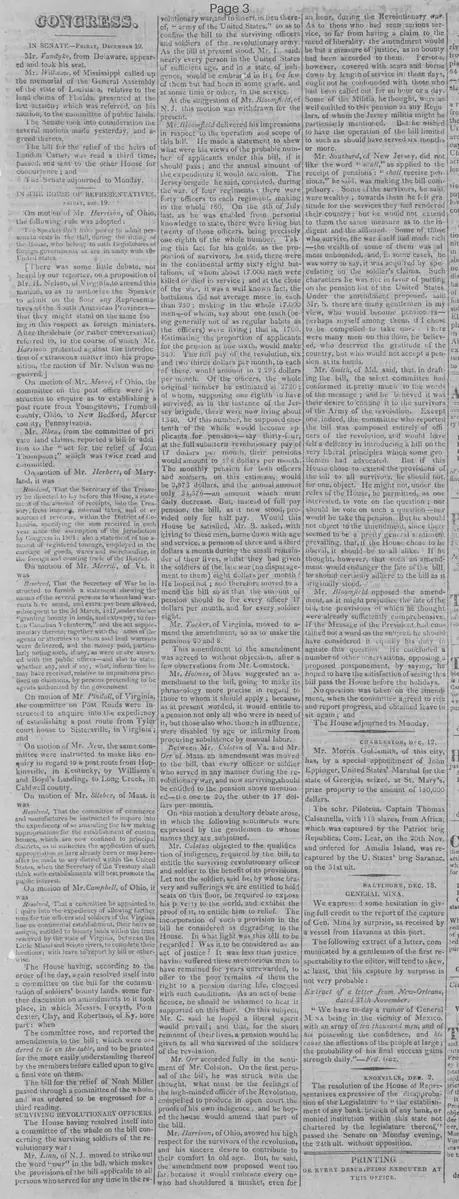
Report of U.S. congressional proceedings on Friday, December 19, covering Senate actions on land claims and bills, House adoptions of rules, resolutions for post routes, treasury reports, land warrants, and a detailed debate on a bill providing pensions to surviving Revolutionary War officers and soldiers, proposing amounts of $20 and $8 per month without indigence requirement.
Clipping
OCR Quality
Full Text
IN SENATE--FRIDAY, DECEMBER 19.
Mr. Van Dyke, from Delaware, appeared and took his seat.
Mr. Williams, of Mississippi called up the memorial of the General Assembly of the state of Louisiana, relative to the land claims of Florida, presented at the last session: which was referred, on his motion, to the committee of public lands.
The Senate took into consideration the several motions made yesterday, and agreed thereto.
The bill for the relief of the heirs of Landon Carter, was read a third time, passed, and sent to the other House for concurrence: and the Senate adjourned to Monday.
IN THE HOUSE OF REPRESENTATIVES.
FRIDAY, DEC. 19.
On motion of Mr. Harrison, of Ohio, the following rule was adopted:
The Speaker shall have power to admit persons to seats in the Hall, during the sitting of the House, who belong to such Legislatures of foreign governments as are in amity with the United States.
There was some little debate, not heard by our reporter, on a proposition of Mr. H. Nelson, of Virginia, to amend this motion, so as to authorize the Speaker to admit on the floor any Representatives of the South American Provinces--that they might stand on the same footing in this respect as foreign ministers.
After the debate (or rather conversation) referred to, in the course of which Mr. Harrison protested against the introduction of extraneous matter into his proposition, the motion of Mr. Nelson was negatived.
On motion of Mr. Moore, of Ohio, the committee on the post office were instructed to enquire as to establishing a post route from Youngstown, Trumbull county, Ohio, to New Bedford, Mercer county, Pennsylvania.
Mr. Rhea, from the committee of private land claims, reported a bill in addition to the "act for the relief of John Thompson;" which was twice read and committed.
On motion of Mr. Herbert, of Maryland, it was
Resolved, That the Secretary of the Treasury be directed to lay before this House, a statement of the amount of receipts, into the Treasury, from import, internal taxes, and other sources of revenue, within the District of Columbia, specifying the sum received in each year since the assumption of the jurisdiction by Congress in 1801; also a statement of the amount of registered tonnage, employed in the carriage of goods, wares and merchandize, in the foreign and coasting trade of the District.
On motion of Mr. Merrill, of Vt. it was
Resolved, That the Secretary of War be instructed to furnish a statement shewing the names of the several persons to whom land warrants have issued, and extra pay been allowed, subsequent to the 3d March, 1817, under the act "granting bounty in lands, and extra pay, to certain Canadian Volunteers," and the act supplementary thereto; together with the names of the agents or attornies to whom said land warrants were delivered, and the money paid, particularly noting such, if any, as were or are annexed with the public offices--and also to state whether any, and if any, what, information he may have received, relative to impositions practised on claimants, by persons pretending to be agents authorized by the government.
On motion of Mr. Pindall, of Virginia, the committee on Post Roads were instructed to enquire into the expediency of establishing a post route from Tyler court house to Sistersville, in Virginia:
and
On motion of Mr. New, the same committee were instructed to make like enquiry in regard to a post route from Hopkinsville, in Kentucky, by Williams's and Boyd's Landing, to Long Creek, in Caldwell county.
On motion of Mr. Silsbee, of Mass. it was
Resolved, That the committee of commerce and manufactures be instructed to inquire into the expediency of so amending the law making appropriations for the establishment of custom houses, which are now confined to principal districts, as to authorize the application of such appropriation as have already been or may hereafter be made to any district within the United States, when the Secretary of the Treasury shall think such establishments will best promote the public interest.
On motion of Mr. Campbell, of Ohio, it was
Resolved, That a committee be appointed to inquire into the expediency of allowing further time for the officers and soldiers of the Virginia line on continental establishment, their heirs or assigns, entitled to bounty lands within the tract reserved by the state of Virginia, between the Little Miami and Scioto rivers, to complete their locations; with leave to report by bill or otherwise.
The House having, according to the order of the day, again resolved itself into a committee on the bill for the commutation of soldiers' bounty lands, some further discussion on amendments to it took place, in which Messrs. Forsyth, Poindexter, Clay, and Robertson, of Ky. bore part: when
The committee rose, and reported the amendments to the bill; which were ordered to lie on the table, and to be printed for the more easily understanding thereof by the members before called upon to give a final vote on them.
The bill for the relief of Noah Miller passed through a committee of the whole, and was ordered to be engrossed for a third reading.
SURVIVING REVOLUTIONARY OFFICERS.
The House having resolved itself into a committee of the whole on the bill concerning the surviving soldiers of the revolutionary war:
Mr. Linn, of N. J. moved to strike out the word "war" in the bill, which makes the provisions of the bill applicable to all persons who served for any time in the revolutionary war, and to insert, in lieu thereof, "army of the United States," so as to confine the bill to the surviving officers and soldiers of the revolutionary army.
As the bill at present stood, Mr. L. said, nearly every person in the United States of sufficient age, and in a state of indigence, would be embraced in it: for few of them but had been in some grade, and at some time or other, in the service.
At the suggestion of Mr. Bloomfield, of N. J. this motion was withdrawn for the present.
Mr. Bloomfield delivered his impressions in respect to the operation and scope of this bill. He made a statement to shew what were his views of the probable number of applicants under this bill, if it should pass; and the annual amount of the expenditure it would occasion. The Jersey brigade he said, consisted, during the war, of four regiments: there were forty officers to each regiment, making in the whole 160. On the 4th of July last, as he was enabled from personal knowledge to state, there were living but twenty of those officers, being precisely one-eighth of the whole number. Taking this fact for his guide, as the proportion of survivors, he said, there were in the continental army sixty eight battalions, of whom about 17,000 men were killed or died in service; and at the close of the war, it was a well known fact, the battalions did not average more in each than 250; making in the whole 17,000 men--of whom, say about one tenth (being generally not of as regular habits as the officers) were living; that is, 1700. Estimating the proportion of applicants for the pension at one-sixth, would make 340. The full pay of the revolution, six and two thirds dollars per month, to each of these, would amount to 2295 dollars per month. Of the officers, the whole original number he estimated at 2720; of whom, supposing one eighth to have survived, as in the instance of the Jersey brigade, there were now living about 1340. Of this number, he supposed one-tenth of the whole would become applicants for pensions--say thirty-four at the full subaltern revolutionary pay of 17 dollars per month, their pensions would amount to 578 dollars per month. The monthly pension for both officers and soldiers, on this estimate, would be 2,873 dollars, and the annual amount only 34,476--an amount which must daily decrease. But, instead of full pay pension, the bill, as it now stood, provided only for half pay. Would this House be satisfied, Mr. B. asked, with giving to these men, borne down with age and service, a pension of three and a third dollars a month during the small remainder of their lives, whilst they had given the soldiers of the late war (no disparagement to them) eight dollars per month? He hoped not; and therefore moved to amend the bill so as that the amount of pension should be for every officer 17 dollars per month, and for every soldier eight.
Mr. Tucker, of Virginia, moved to amend the amendment, so as to make the pensions 20 and 8.
This amendment to the amendment was agreed to without objection, after a few observations from Mr. Comstock.
Mr. Holmes, of Mass. suggested an amendment to the bill, going to make its phraseology more precise in regard to those to whom it should apply; because, as at present worded, it would entitle to a pension not only all who were in need of it, but those also who, though in affluence, were disabled by age or infirmity from procuring subsistence by manual labor.
Between Mr. Colston of Va. and Mr. Orr of Mass. an amendment was moved to the bill, that every officer or soldier who served in any manner during the revolutionary war, and now surviving, should be entitled to the pension above mentioned--the one to 20, the other to 8 dollars per month.
On this motion a desultory debate arose, in which the following sentiments were expressed by the gentlemen to whose names they are subjoined.
Mr. Colston objected to the qualification of indigence, required by the bill, to entitle the surviving revolutionary officer and soldier to the benefit of its provisions. Let not the soldier, said he, by whose bravery and sufferings we are entitled to hold seats on this floor, be required to expose his poverty to the world, and exhibit the proof of it, to entitle him to relief. The incorporation of such a provision in the bill he considered as degrading to the House. In what light was this bill to be regarded? Was it to be considered as an act of justice? It was less than justice having suffered these meritorious men to have remained for years unrewarded, to offer to the poor remains of them the right to a pension during life, clogged with such conditions. As an act of beneficence, he should be ashamed to hear it supported on this floor. On this subject, Mr. C. said he hoped a liberal spirit would prevail; and that, for the short remnant of their lives, a pension would be given to all who survived of the soldiers of the revolution.
Mr. Orr accorded fully in the sentiment of Mr. Colston. On the first perusal of the bill, he was struck with the thought, what must be the feelings of the high-minded officer of the Revolution, compelled to produce in open court the proofs of his own indigence, and he hoped the house would amend that part of the bill.
Mr. Harrison, of Ohio, avowed his high respect for the survivors of the revolution, and his sincere desire to contribute to their comfort in old age. But, he said, the amendment now proposed went too far, because it would embrace every one who had shouldered a musket, even for an hour, during the Revolutionary war. As to those who had seen serious service, so far from having a claim to the meed of liberality, the amendment would be but a measure of justice, as no bounty had been accorded to them. Persons, however, covered with scars and borne down by length of service in those days, ought not be confounded with those who had been called out for an hour or a day. Some of the Militia, he thought, were as well entitled to this pension as any Regulars, of whom the Jersey militia might be particularly mentioned. But he wished to have the operation of the bill limited to such as should have served six months or more.
Mr. Southard, of New Jersey, did not like the word "shall," as applied to the receipt of pensions: "shall receive pensions," he said, was making the bill compulsory. Some of the survivors, he said, were wealthy; towards them he felt gratitude for the services they had rendered their country; but he would not extend to them the same measure as to the indigent and the afflicted. Some of those who survive, the war itself had made rich--the wealth of some of them was almost unbounded, and, in some cases, he was sorry to say, it was acquired by speculating on the soldier's claims. Such characters he was not in favor of putting on the pension list of the United States. Under the amendment proposed, said Mr. S. there are many gentlemen in my view, who would become pensioners--perhaps myself among them, if I chose to be compelled to take one. There were many men on this floor, he believed, who deserved the gratitude of the country, but who would not accept a pension at its hands.
Mr. Smith, of Md. said, that, in drafting the bill, the select committee had conformed it pretty much to the words of the message: and he believed it was their desire to confine it to the survivors of the Army of the revolution. Except one, indeed, the committee who reported the bill was composed entirely of officers of the revolution, and would have felt a delicacy in introducing a bill on the very liberal principles which some gentlemen had advocated. But if this House chose to extend the provisions of the bill to all survivors, he should not, for one, object. He might not, under the rules of the House, be permitted, as one interested, to vote on the question; nor should he vote on such a question--nor would he take the pension. But he should not object to the amendment, since there seemed to be a pretty general sentiment prevailing, that, if the House chose to be liberal, it should be to all alike. If he thought, however, that such an amendment would endanger the fate of the bill he should certainly adhere to the bill as it originally stood.
Mr. Bloomfield opposed the amendment, as it might prejudice the fate of the bill, the provisions of which he thought were already sufficiently comprehensive. If the Message of the President had contained not a word on the subject, he should have considered it equally his duty to agitate this question. He concluded a number of other observations, opposing a proposed postponement, by saying, he hoped to have the satisfaction of seeing this bill pass the House before the holidays.
No question was taken on the amendment, when the committee agreed to rise and report progress, and obtained leave to sit again; and
The House adjourned to Monday.
What sub-type of article is it?
What themes does it cover?
What keywords are associated?
What entities or persons were involved?
Where did it happen?
Story Details
Key Persons
Location
United States Congress, District Of Columbia
Event Date
Friday, December 19
Story Details
Congressional proceedings include Senate handling of land claims and bills; House adopts rules for admitting foreign legislators, instructs committees on post routes, treasury statements, land warrants, custom houses, and bounty lands; debates amendments to bill for Revolutionary War soldiers' bounty lands; extensive discussion on pension bill for surviving Revolutionary War officers ($20/month) and soldiers ($8/month), opposing indigence requirement and favoring broad application to all survivors regardless of service length or wealth.