Thank you for visiting SNEWPapers!
Sign up free
Editorial
November 2, 1801
Jenks's Portland Gazette
Portland, Cumberland County, Maine
What is this article about?
An editorial critiquing the U.S. President's views on the strength of republican government, arguing it is vulnerable to factions and demagogues like historical tyrants. It accuses him of inconsistency in partisan rhetoric and questions his religious stance compared to Washington and Adams.
Clipping
OCR Quality
95%
Excellent
Full Text
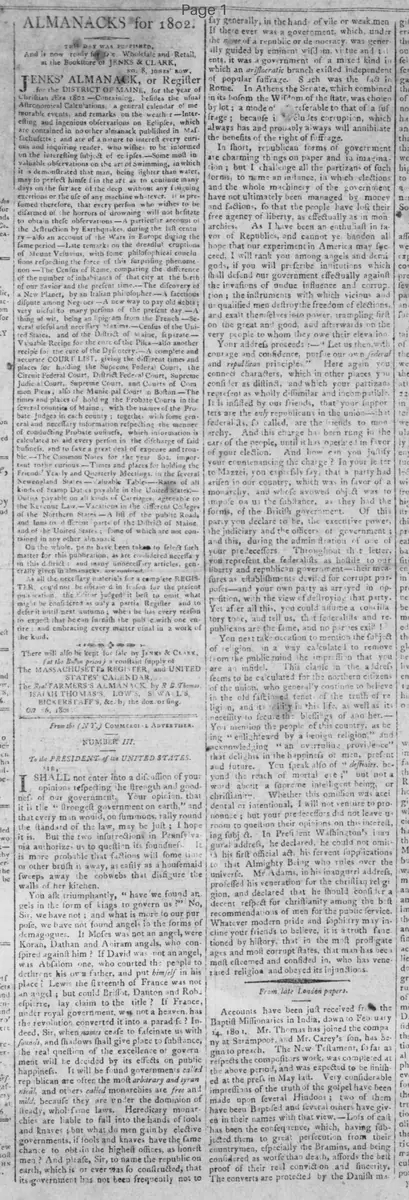
From the N. Y. Commercial Advertiser.
NUMBER III.
To the PRESIDENT of the UNITED STATES.
SIR,
I shall not enter into a discussion of your opinions respecting the strength and goodness of our government. Your opinion, that it is the "strongest government on earth," and that every man would, on summons, rally round the standard of the law, may be just; I hope it is. But the two insurrections in Pennsylvania authorize us to question its soundness. It is more probable that factions will some time or other brush it away, as easily as a housemaid sweeps away the cobwebs that disfigure the walls of her kitchen.
You ask triumphantly, "have we found angels in the form of kings to govern us?" No, Sir, we have not; and what is more to our purpose, we have not found angels in the forms of demagogues. If Moses was not an angel, were Korah, Dathan and Abiram angels, who conspired against him? If David was not an angel, was Absalom one, who courted the people to dethrone his own father, and put himself in his place? If Lewis the Sixteenth of France was not an angel; but could Brissot, Danton and Robespierre, lay claim to the title? If France, under royal government, was not a heaven, has the revolution converted it into a paradise? Indeed, Sir, when names cease to fascinate us with sounds, and shadows shall give place to substance, the real question of the excellence of government will be decided by its effects on public happiness. It will be found governments called republican are often the most arbitrary and tyrannical, and others called monarchies are free and mild, because they are under the dominion of steady, wholesome laws. Hereditary monarchies are liable to fall into the hands of fools and knaves; but what do men gain by elective governments, if fools and knaves have the same chance to obtain in the highest offices, as honest men? And please, Sir, to name the republic on earth, which is or ever was so constructed, that its government has not been frequently, not to say generally, in the hand of vile or weak men
If there ever was a government, which, under the name of a republic or democracy, was generally guided by eminent wisdom, virtue and talents, it was a government of a mixed kind in which an aristocratic branch existed independent of popular suffrage. Such was the state in Rome. In Athens the Senate, which combined in its bosom the wisdom of the state, was chosen by lot; a mode preferable to that of a suffrage; because it excludes corruption, which always has and probably always will annihilate the benefits of the right of suffrage.
In short, republican forms of government are charming things on paper and in imagination; but I challenge all the partizans of such forms, to name an instance, in which elections and the whole machinery of the government have not ultimately been managed by money and factions, so that the people have lost their free agency of liberty, as effectually as in monarchies. As I have been an enthusiast in favor of Republics, and cannot yet abandon all hope that our experiment in America may succeed, I will rank you among angels and demi-gods, if you will prescribe institutions which shall defend our government effectually against the invasions of undue influence and corruption; the instruments with which vicious and unqualified men destroy the freedom of elections, and exalt themselves into power, trampling first on the great and good, and afterwards on the very people to whom they owe their elevation
Your address proceeds:—Let us then, with courage and confidence, pursue our own federal and republican principles." Here again you connect characters, which in other places you consider as dissimilar, and which your partizans represent as wholly dissimilar and incompatible.
It is insisted by our friends, that your supporters are the only republicans in the union—that the federalists, so called, are the friends to monarchy. And this charge has been rung in the ears of the people, until it has operated in favor of your election, and how do you justify your countenancing the charge? In your letter to Mazzei, you expressly say, that a party had arisen in our country, which was in favor of a monarchy, and whose avowed object was to impose on us the substance, as they had the forms, of the British government. Of this party you declare to be, the executive power, the judiciary and the officers of government; and this, during the administration of one of your predecessors. Throughout that letter, you represent the federalists as hostile to our liberty and republican government—their measures as establishments devised for corrupt purposes—and your own party as arrayed in opposition, with the view of destroying that party.
Yet after all this, you could assume a conciliatory tone, and tell us, that federalists and republicans are the same, and no parties exist!
You next take occasion to mention the subject of religion in a way calculated to remove from the public mind the impression that you are an infidel. This clause in the address seems to be calculated for the northern citizens of the union, who generally continue to believe in the old fashioned tenet of the truth of religion, and its utility in this life, as well as its necessity to secure the blessings of another.—
You mention the people of this country, as being "enlightened by a benign religion," and acknowledging "an overruling providence" that delights in the happiness of men, present and future. You speak also of "destinies, beyond the reach of mortal eye;" but not a word about a supreme intelligent being, or christianity. Whether this omission was accidental or intentional, I will not venture to pronounce; but your predecessors did not leave us room to question their opinions on this interesting subject. In President Washington's inaugural address, he declared, he could not omit—his first official act—his fervent supplications to that Almighty Being who rules over the universe. Mr. Adams, in his inaugural address, professed his veneration for the christian religion, and declared that he should consider a decent respect for christianity among the best recommendations of men for the public service.
Whatever modern pride and sophistry may incline your friends to believe, it is a truth sanctioned by history, that in the most profligate ages and most corrupt states, that man has been most esteemed and confided in, who has venerated religion and obeyed its injunctions.
NUMBER III.
To the PRESIDENT of the UNITED STATES.
SIR,
I shall not enter into a discussion of your opinions respecting the strength and goodness of our government. Your opinion, that it is the "strongest government on earth," and that every man would, on summons, rally round the standard of the law, may be just; I hope it is. But the two insurrections in Pennsylvania authorize us to question its soundness. It is more probable that factions will some time or other brush it away, as easily as a housemaid sweeps away the cobwebs that disfigure the walls of her kitchen.
You ask triumphantly, "have we found angels in the form of kings to govern us?" No, Sir, we have not; and what is more to our purpose, we have not found angels in the forms of demagogues. If Moses was not an angel, were Korah, Dathan and Abiram angels, who conspired against him? If David was not an angel, was Absalom one, who courted the people to dethrone his own father, and put himself in his place? If Lewis the Sixteenth of France was not an angel; but could Brissot, Danton and Robespierre, lay claim to the title? If France, under royal government, was not a heaven, has the revolution converted it into a paradise? Indeed, Sir, when names cease to fascinate us with sounds, and shadows shall give place to substance, the real question of the excellence of government will be decided by its effects on public happiness. It will be found governments called republican are often the most arbitrary and tyrannical, and others called monarchies are free and mild, because they are under the dominion of steady, wholesome laws. Hereditary monarchies are liable to fall into the hands of fools and knaves; but what do men gain by elective governments, if fools and knaves have the same chance to obtain in the highest offices, as honest men? And please, Sir, to name the republic on earth, which is or ever was so constructed, that its government has not been frequently, not to say generally, in the hand of vile or weak men
If there ever was a government, which, under the name of a republic or democracy, was generally guided by eminent wisdom, virtue and talents, it was a government of a mixed kind in which an aristocratic branch existed independent of popular suffrage. Such was the state in Rome. In Athens the Senate, which combined in its bosom the wisdom of the state, was chosen by lot; a mode preferable to that of a suffrage; because it excludes corruption, which always has and probably always will annihilate the benefits of the right of suffrage.
In short, republican forms of government are charming things on paper and in imagination; but I challenge all the partizans of such forms, to name an instance, in which elections and the whole machinery of the government have not ultimately been managed by money and factions, so that the people have lost their free agency of liberty, as effectually as in monarchies. As I have been an enthusiast in favor of Republics, and cannot yet abandon all hope that our experiment in America may succeed, I will rank you among angels and demi-gods, if you will prescribe institutions which shall defend our government effectually against the invasions of undue influence and corruption; the instruments with which vicious and unqualified men destroy the freedom of elections, and exalt themselves into power, trampling first on the great and good, and afterwards on the very people to whom they owe their elevation
Your address proceeds:—Let us then, with courage and confidence, pursue our own federal and republican principles." Here again you connect characters, which in other places you consider as dissimilar, and which your partizans represent as wholly dissimilar and incompatible.
It is insisted by our friends, that your supporters are the only republicans in the union—that the federalists, so called, are the friends to monarchy. And this charge has been rung in the ears of the people, until it has operated in favor of your election, and how do you justify your countenancing the charge? In your letter to Mazzei, you expressly say, that a party had arisen in our country, which was in favor of a monarchy, and whose avowed object was to impose on us the substance, as they had the forms, of the British government. Of this party you declare to be, the executive power, the judiciary and the officers of government; and this, during the administration of one of your predecessors. Throughout that letter, you represent the federalists as hostile to our liberty and republican government—their measures as establishments devised for corrupt purposes—and your own party as arrayed in opposition, with the view of destroying that party.
Yet after all this, you could assume a conciliatory tone, and tell us, that federalists and republicans are the same, and no parties exist!
You next take occasion to mention the subject of religion in a way calculated to remove from the public mind the impression that you are an infidel. This clause in the address seems to be calculated for the northern citizens of the union, who generally continue to believe in the old fashioned tenet of the truth of religion, and its utility in this life, as well as its necessity to secure the blessings of another.—
You mention the people of this country, as being "enlightened by a benign religion," and acknowledging "an overruling providence" that delights in the happiness of men, present and future. You speak also of "destinies, beyond the reach of mortal eye;" but not a word about a supreme intelligent being, or christianity. Whether this omission was accidental or intentional, I will not venture to pronounce; but your predecessors did not leave us room to question their opinions on this interesting subject. In President Washington's inaugural address, he declared, he could not omit—his first official act—his fervent supplications to that Almighty Being who rules over the universe. Mr. Adams, in his inaugural address, professed his veneration for the christian religion, and declared that he should consider a decent respect for christianity among the best recommendations of men for the public service.
Whatever modern pride and sophistry may incline your friends to believe, it is a truth sanctioned by history, that in the most profligate ages and most corrupt states, that man has been most esteemed and confided in, who has venerated religion and obeyed its injunctions.
What sub-type of article is it?
Partisan Politics
Constitutional
Moral Or Religious
What keywords are associated?
Republican Government
Political Corruption
Federalists Vs Republicans
Presidential Address
Religion In Politics
Government Forms
What entities or persons were involved?
President Of The United States
Federalists
Republicans
George Washington
John Adams
Editorial Details
Primary Topic
Critique Of Republican Government And Presidential Address
Stance / Tone
Critical And Argumentative
Key Figures
President Of The United States
Federalists
Republicans
George Washington
John Adams
Key Arguments
Republican Governments Are Prone To Corruption By Factions And Demagogues
Historical Examples Show Republics Often Become Tyrannical
Elections Are Managed By Money And Factions, Eroding Liberty
President's Address Inconsistently Equates Federal And Republican Principles
President's Letter To Mazzei Portrays Federalists As Monarchists
Omission Of Explicit Reference To Christianity In Address Contrasts With Washington And Adams