Thank you for visiting SNEWPapers!
Sign up free
The Penn's Grove Record
Penns Grove, Salem County, New Jersey
What is this article about?
Walter A. Hunt explains the urgent need for a new $95,000 school in Penns Grove, NJ, due to overcrowding and health risks. He details how it would raise taxes from $4.07 to $4.32 per $100 valuation, versus $4.60 if state aid is lost without the school. Emphasizes education's importance and financial benefits.
Clipping
OCR Quality
Full Text
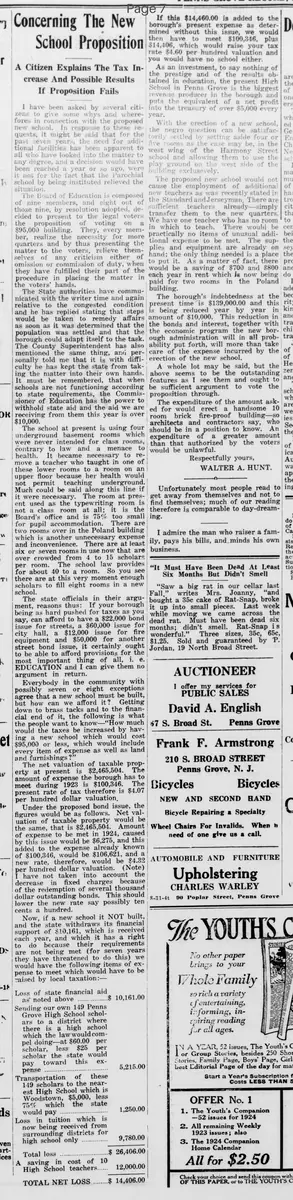
School Proposition
A Citizen Explains The Tax In-
crease And Possible Results
If Proposition Fails
I have been asked by several citizens to give some whys and wherefores in connection with the proposed new school. In response to these requests, it might be said that for the past seven years, the need for additional facilities has been apparent to all who have looked into the matter to any degree, and a decision would have been reached a year or so ago, were it not for the fact that the Parochial school by being instituted relieved the situation.
The Board of Education is composed of nine members, and eight out of those nine, by resolution adopted, decided to present to the legal voters the proposition of voting on a $95,000 building. They, every member, realize the necessity for more quarters and by thus presenting the matter to the voters, relieve themselves of any criticism either of omission or commission of duty, when they have fulfilled their part of the procedure in placing the matter in the voters' hands.
The State authorities have communicated with the writer time and again relative to the congested condition and he has replied stating that steps would be taken to remedy affairs as soon as it was determined that the population was settled and that the borough could adapt itself to the task. The County Superintendent has also mentioned the same thing, and personally told me that it is with difficulty he has kept the state from taking the matter into their own hands.
It must be remembered that when schools are not functioning according to state requirements, the Commissioner of Education has the power to withhold state aid and the aid we are receiving from them this year is over $10,000.
The school at present is using four underground basement rooms which were never intended for class rooms, contrary to law and a menace to health. It became necessary to remove a teacher who taught in one of these lower rooms to a room on an upper floor because her health would not permit teaching underground. Much could be said along this line if it were necessary. The room at present used as the typewriting room is not a class room at all; it is the Board's office and is 75% too small for pupil accommodation. There are two rooms over in the Poland building which is another unnecessary expense and inconvenience. There are at least six or seven rooms in use now that are over crowded from 4 to 15 scholars per room. The school law provides for about 40 to a room. So you see there are at this very moment enough scholars to fill eight rooms in a new school.
The state officials in their argument, reasons thus: If your borough being as hard pushed for taxes as you say, can afford to have a $22,000 bond issue for streets, a $60,000 issue for city hall, a $12,000 issue for fire equipment and $50,000 for another street bond issue, it certainly ought to be able to afford provisions for the most important thing of all, i. e. EDUCATION and I can give them no argument in return.
Everybody in the community with possibly seven or eight exceptions agree that a new school must be built, but how can we afford it? Getting down to brass tacks and to the financial end of it, the following is what the people want to know-"How much would the taxes be increased by having a new school which would cost $95,000 or less, which would include every item of expense as well as land and furnishings?"
The net valuation of taxable property at present is $2,465,504. The amount of expense the borough has to meet during 1923 is $100,346. The present rate of tax therefore is $4.07 per hundred dollar valuation.
Under the proposed bond issue, the figures would be as follows. Net valuations of taxable property would be the same, that is $2,465,504. Amount of expense to be met in 1924, caused by this issue would be $6,275, and this added to the expense already known of $100,346, would be $106,621, and a new rate, therefore, would be $4.32 per hundred dollar valuation. (Note) I have not taken into account the decrease in fixed charges because of the redemption of several thousand dollar outstanding bonds. This should lower the new rate say possibly ten cents a hundred.
Now, if a new school is NOT built, and the state withdraws its financial support of $10,161, which is received each year, and which it has a right to do because their requirements are not being met (for seven years they have threatened to do this) we would have the following items of expense to meet which would have to be raised by local taxation:-
Loss of state financial aid as noted above $10,161.00
Sending our own 149 Penns Grove High School scholars to a district where there is a high school which the law would compel doing -at $60.00 per scholar, less $25 per scholar the state would pay toward this expense 5,215.00
Transportation of these 149 scholars to the nearest High School which is Woodstown, $5,000, less 75% which the state would pay 1,250.00
Loss in tuition which is now being received from surrounding districts for high school only 9,780.00
Total loss 26,406.00
A saving in cost of 10 High School teachers 12,000.00
TOTAL NET LOSS ....$14,406.00
If this $14,406.00 is added to the borough's present expense as determined without this issue, we would then have to meet $100,346, plus $14,406, which would raise your tax rate $4.60 per hundred valuation and you would have no school either.
As an investment, to say nothing of the prestige and of the results obtained in education, the present High School in Penns Grove is the biggest revenue producer in the borough and puts the equivalent of a net profit into the treasury of over $5,000 every year.
With the erection of a new school, the negro question can be satisfactorily settled by setting aside four or five rooms as the case may be, in the west wing of the Harmony Street school and allowing them to use the play ground on the west side of the building exclusively.
The proposed new school would not cause the employment of additional new teachers as was recently stated in the Standard and Jerseyman. There are sufficient teachers already-simply transfer them to the new quarters. We have one teacher who has no room in which to teach. There would be practically no items of unusual additional expense to be met. The supplies and equipment are already on hand: the only thing needed is a place to put it. As a matter of fact, there would be a saving of $700 and $800 each year in rent which is now being paid for two rooms in the Poland building.
The borough's indebtedness at the present time is $139,000.00 and this is being reduced year by year in amount of $10,000. This reduction in the bonds and interest, together with the economic program the new borough administration will in all probability put forth, will more than take care of the expense incurred by the erection of the new school.
A whole lot may be said, but the above seems to be the outstanding features as I see them and ought to be sufficient argument to vote the proposition through.
The expenditure of the amount asked for would erect a handsome 10 room brick fire-proof building-so architects and contractors say, who should be in a position to know. An expenditure of a greater amount than that authorized by the voters would be unlawful.
Respectfully yours,
WALTER A. HUNT.
What sub-type of article is it?
What themes does it cover?
What keywords are associated?
What entities or persons were involved?
Where did it happen?
Story Details
Key Persons
Location
Penns Grove, Nj
Event Date
1923
Story Details
Walter A. Hunt argues for voter approval of a $95,000 bond issue to build a new school, citing overcrowding, health risks, and potential loss of $10,000+ in state aid if not built. Tax rate would rise minimally to $4.32 per $100, versus $4.60 without the school. Highlights financial benefits and education's priority.