Thank you for visiting SNEWPapers!
Sign up free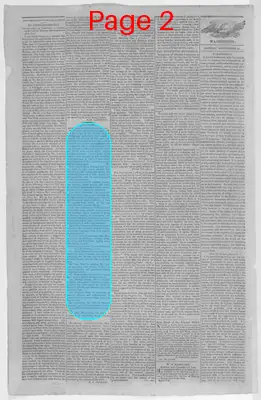
Daily National Intelligencer
Washington, District Of Columbia
What is this article about?
Article from Newburyport Herald critiques early Massachusetts laws akin to Connecticut's blue laws, listing regulations on apparel, behavior, tobacco, and drunkenness, plus historical court judgments with fines, whippings, and admonishments.
Clipping
OCR Quality
Full Text
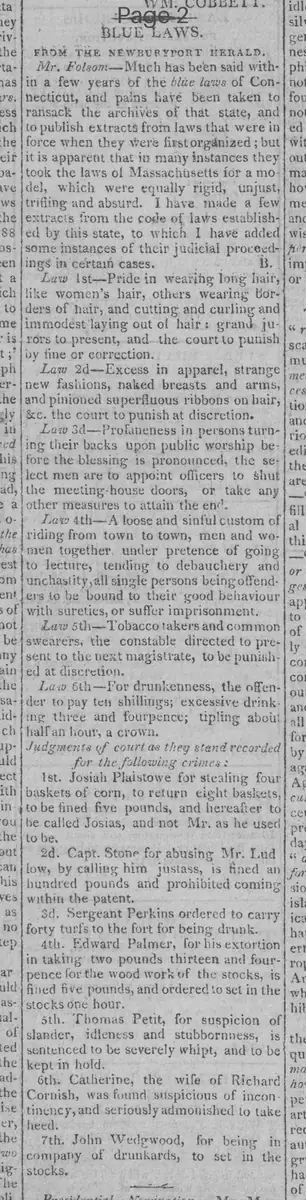
FROM THE NEWBURYPORT HERALD.
Mr. Folsom--Much has been said within a few years of the blue laws of Connecticut, and pains have been taken to ransack the archives of that state, and to publish extracts from laws that were in force when they were first organized; but it is apparent that in many instances they took the laws of Massachusetts for a model, which were equally rigid, unjust, trifling and absurd. I have made a few extracts from the code of laws established by this state, to which I have added some instances of their judicial proceedings in certain cases.
B.
Law 1st--Pride in wearing long hair, like women's hair, others wearing Borders of hair, and cutting and curling and immodest laying out of hair: grand jurors to present, and the court to punish by fine or correction.
Law 2d--Excess in apparel, strange new fashions, naked breasts and arms and pinioned superfluous ribbons on hair, &c. the court to punish at discretion.
Law 3d--Profaneness in persons turning their backs upon public worship before the blessing is pronounced, the select men are to appoint officers to shut the meeting-house doors, or take any other measures to attain the end.
Law 4th--A loose and sinful custom of riding from town to town, men and women together under pretence of going to lecture, tending to debauchery and unchastity, all single persons being offenders to be bound to their good behaviour with sureties, or suffer imprisonment.
Law 5th--Tobacco takers and common swearers, the constable directed to present to the next magistrate, to be punished at discretion.
Law 6th--For drunkenness, the offender to pay ten shillings; excessive drinking three and fourpence; tipling about half an hour, a crown.
Judgments of court as they stand recorded for the following crimes:
1st. Josiah Plaistowe for stealing four baskets of corn, to return eight baskets to be fined five pounds, and hereafter to be called Josias, and not Mr. as he used to be.
2d. Capt. Stone for abusing Mr. Ludlow, by calling him justass, is fined an hundred pounds and prohibited coming within the patent.
3d. Sergeant Perkins ordered to carry forty turfs to the fort for being drunk.
4th. Edward Palmer, or his extortion in taking two pounds thirteen and fourpence for the wood work of the stocks, is fined five pounds, and ordered to set in the stocks one hour.
5th. Thomas Petit, or suspicion of slander, idleness and stubbornness, is sentenced to be severely whipt, and to be kept in hold.
6th. Catherine, the wife of Richard Cornish, was found suspicious of incontinency, and seriously admonished to take heed.
7th. John Wedgwood, for being in company of drunkards, to set in the stocks.
What sub-type of article is it?
What keywords are associated?
What entities or persons were involved?
Where did it happen?
Domestic News Details
Primary Location
Massachusetts
Key Persons
Outcome
punishments include fines, imprisonment, whipping, admonishments, stocks, and labor for crimes like theft, abuse, drunkenness, extortion, slander, idleness, incontinency, and associating with drunkards.
Event Details
Article discusses early Massachusetts laws modeled similarly to Connecticut's blue laws, covering prohibitions on hair styles, apparel, leaving worship early, mixed travel, tobacco, swearing, and drunkenness with specified penalties; includes recorded court judgments for various offenses.