Thank you for visiting SNEWPapers!
Sign up free
Alexandria Daily Advertiser
Alexandria, Virginia
What is this article about?
Transcript from Aaron Burr's 1807 treason trial in Richmond, featuring George Poindexter's testimony on events in Mississippi Territory, seizures, and a mysterious note; followed by arguments over producing President Jefferson's letter to General Wilkinson approving actions against Burr.
Merged-components note: Merged across pages the trial transcript components, including the inserted presidential letter (Z) discussed in the testimony, into a single coherent story on the Burr trial.
Clippings
1 of 2
OCR Quality
Full Text
TRIAL
OF
COLONEL A. BURR
MOTION FOR COMMITMENT
EXAMINATION OF EVIDENCE
Thursday, October.
(Mr. Poindexter's testimony concluded.)
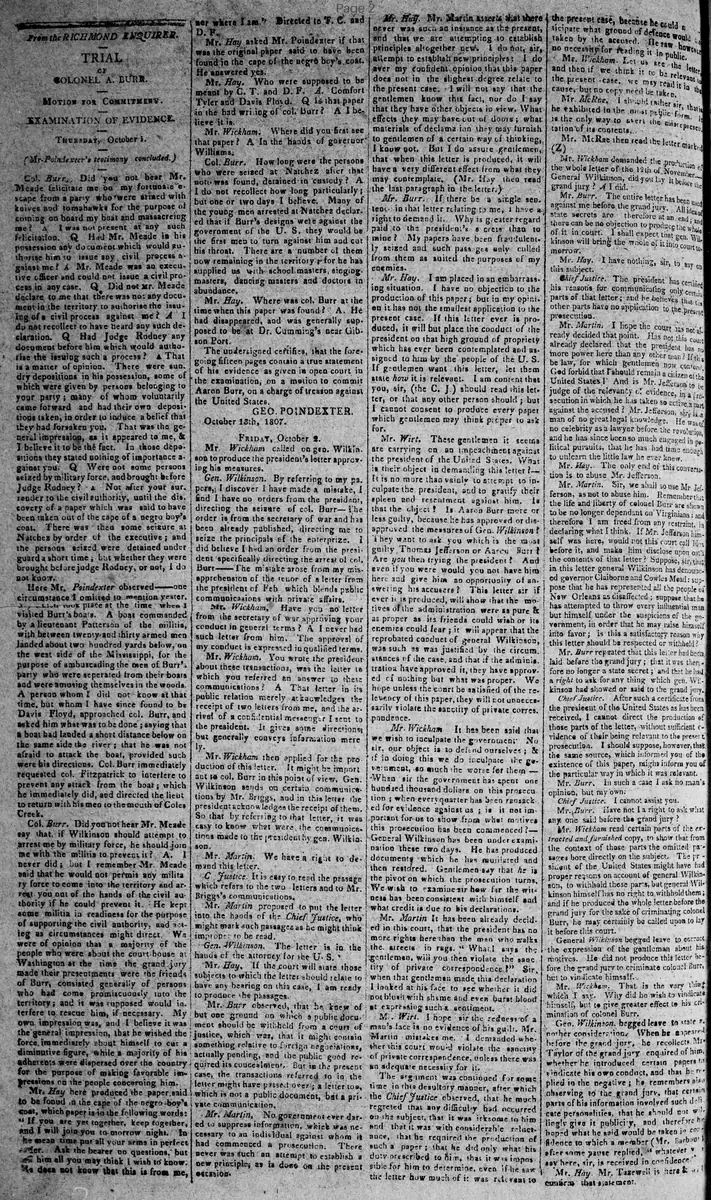
Col. Burr: Did you not hear Mr. Meade felicitate me, on my fortunate escape from a party who were armed with knives and tomahawks for the purpose of coming on board my boat and massacring me? A. I was not present at any such felicitation. Q. Had Mr. Meade in his possession any document which would authorize him to issue any civil process against me? A. Mr. Meade was an executive officer and could not issue a civil process in any case. Q. Did not Mr. Meade declare to me that there was no any document in the territory to authorize the issuing of a civil process against me? A. I do not recollect to have heard any such declaration. Q. Had Judge Rodney any document before him which would authorize the issuing such a process? A. That is a matter of opinion. There were sundry depositions in his possession, some of which were given by persons belonging to your party; many of whom voluntarily came forward and had their own depositions taken, in order to induce a belief that they had forsaken you. That was the general impression, as it appeared to me. And I believe it to be the fact. In those depositions they stated nothing of importance against you. Q. Were not some persons seized by military force, and brought before Judge Rodney? A. Not after your surrender to the civil authority, until the discovery of a paper which was said to have been taken out of the cape of a negro boy's coat. There was then some seizure at Natchez by order of the executive; and the persons seized were detained under guard a short time; but whether they were brought before Judge Rodney, or not, I do not know.
Here Mr. Poindexter observed one circumstance I omitted to mention yesterday. I left no place at the time when I visited Burr's boats. A boat commanded by Lieutenant Patterson of the militia, with between twenty and thirty armed men landed about two hundred yards below, on the west side of the Mississippi, for the purpose of ambuscading the men of Burr's party who were separated from their boats and were amusing themselves in the woods. A person whom I did not know at that time, but whom I have since found to be Davis Floyd, approached Col. Burr, and asked him what was to be done; saying that a boat had landed a short distance below on the same side the river; that he was not afraid to attack the boat, provided such were his directions. Col. Burr immediately requested Col. Fitzpatrick, to interfere to prevent any attack from the boat; which he immediately did, and directed the lieutenant to return with his men to the mouth of Coles Creek.
Col. Burr: Did you not hear Mr. Meade say that, if Wilkinson should attempt to arrest me by military force, he should join me with the militia to prevent it? A. I never did; but I remember Mr. Meade said that he would not permit any military force to come into the territory and arrest you out of the hands of the civil authority, if he could prevent it. He kept some militia in readiness for the purpose of supporting the civil authority, and acting as circumstances might direct. We were of opinion that a majority of the people who were about the court-house at Washington at the time the grand jury made their presentments were the friends of Burr, consisted generally of persons who had come promiscuously into the territory; and it was supposed would interfere to rescue him, if necessary. My own impression was, and I believe it was the general impression, that he wished the force immediately about himself to cut a diminutive figure, while a majority of his adherents were dispersed over the country for the purpose of making favorable impressions on the people concerning him.
Mr. Hay here produced the paper said to be found in the cape of the negro boy's coat, which paper is in the following words:
"If you are yet together, keep together, and I will join you tomorrow night. In the mean time put all your arms in perfect order. Ask the bearer no questions, but believe him all you may think I wish to know. He does not know that this is from me. Directed to F.C. and D.H."
nor where I am
Mr. Hay asked Mr. Poindexter if that was the original paper said to have been found in the cape of the negro boy's coat. He answered yes.
Mr. Hay: Who were supposed to be meant by F.C. and D.H.? A. Comfort Tyler and Davis Floyd. Q. Is that paper in the hand writing of Col. Burr? A. I believe it is.
Mr. Hay: Where did you first see that paper? A. In the hands of Governor Williams.
Col. Burr: How long were the persons who were seized at Natchez after that note was found, detained in custody? A. I do not recollect how long particularly; but one or two days I believe. Many of the young men arrested at Natchez declared that if Burr's designs were against the government of the U.S. they would be the first men to turn against him and cut his throat. There are a number of them now remaining in the territory for he has supplied us with school masters, singing masters, dancing masters and doctors in abundance.
Mr. Hay: Where was Col. Burr at the time when this paper was found? A. He had disappeared, and was generally supposed to be at Dr. Cumming's near Gibson Port.
The undersigned certifies, that the foregoing fifteen pages contain a true statement of his evidence as given in open court in the examination, on a motion to commit Aaron Burr, on a charge of treason against the United States.
GEO. POINDEXTER.
October 13th, 1807.
Friday, October 2.
Mr. Wickham called on Gen. Wilkinson to produce the president's letter approving his measures.
Gen. Wilkinson: By referring to my papers, I discover I have made a mistake. I find I have no orders from the president, directing the seizure of Col. Burr. The order is from the secretary of war and has been already published, directing me to seize the principals of the enterprise. I did believe I had an order from the president specifically directing the arrest of Col. Burr. The mistake arose from my misapprehension of the tenor of a letter from the president of Feb. which blends public communications with private affairs.
Mr. Wickham: Have you no letter from the secretary of war approving your conduct in general terms? A. I never had such letter from him. The approval of my conduct is expressed in qualified terms.
Mr. Wickham: You wrote the president about these transactions, was the letter to which you referred an answer to these communications? A. That letter in its public relation merely acknowledges the receipt of two letters from me, and the arrival of a confidential messenger I sent to the president. It gives some directions, but generally conveys information merely.
Mr. Wickham then applied for the production of this letter. It might be important to Col. Burr in this point of view. Gen. Wilkinson sends on certain communications by Mr. Briggs, and in this letter the president acknowledges the receipt of them. So that by referring to that letter, it was easy to know what were the communications made to the president by Gen. Wilkinson.
Mr. Martin: We have no right to demand this letter.
Chief Justice: It is easy to read the passage which refers to the two letters and to Mr. Briggs's communications.
Mr. Martin proposed to put the letter into the hands of the Chief Justice, who might mark such passages as he might think improper to be read.
Gen. Wilkinson: The letter is in the hands of the attorney for the U.S.
Mr. Hay: If the court will state those subjects to which the letter should relate to have any bearing on this case, I am ready to produce the passages.
Mr. Burr observed, that he knew of but one ground on which a public document should be withheld from a court of justice, which was, that it might contain something relative to foreign negotiations, actually pending, and the public good required its concealment. But in the present case, the transactions referred to in the letter might have passed over; a letter too, which is not a public document, but a private communication.
Mr. Martin: No government ever dared to suppress information, which was necessary to an individual against whom it had commenced a prosecution. There never was such an attempt to establish a new principle, as is done on the present occasion.
Mr. Hay: Mr. Martin asserts that there never was such an instance as the present, and that we are attempting to establish principles altogether new. I do not, at all attempt to establish new principles. I aver my confident opinion that this paper does not in the slightest degree relate to the present case. I will not say that the gentlemen know this fact, nor do I say that they have other objects to view. What effects they may have out of doors; what materials of declamation they may furnish to gentlemen of a certain way of thinking, I know not. But I do assure gentlemen, that when this letter is produced, it will have a very different effect from what they may contemplate. (Mr. Hay then read the last paragraph in the letter.)
Mr. Burr: If there be a single sentence in that letter relating to me, I have a right to demand it. Why is greater regard paid to the president's secrets than to mine? My papers have been fraudulently seized and such passages only culled from them as suited the purposes of my enemies.
Mr. Hay: I am placed in an embarrassing situation. I have no objection to the production of this paper; but in my opinion it has not the smallest application to the present case. If this letter ever is produced, it will but place the conduct of the president on that high ground of propriety which has ever been contemplated and assigned to him by the people of the U.S. If gentlemen want this letter, let them state how it is relevant. I am content that you, sir, (the C.J.) should read this letter, or that any other person should; but I cannot consent to produce every paper which gentlemen may think proper to ask for.
Mr. Wirt: These gentlemen it seems are carrying on an impeachment against the president of the United States. What is their object in demanding this letter? It is no more than vainly to attempt to inculpate the president, and to gratify their spleen and resentment against him. Is that the object? Is Aaron Burr more or less guilty, because he has approved or disapproved the measures of Gen. Wilkinson? They want to ask you which is the most guilty, Thomas Jefferson or Aaron Burr? Are you then trying the president? And even if you were would you not have him here and give him an opportunity of answering his accusers? This letter sir if ever it is produced, will show that the motives of the administration were as pure & as proper as its friends could wish or its enemies could fear; it will appear that the reprobated conduct of general Wilkinson, was such as was justified by the circumstances of the case, and that if the administration have approved it, they have approved of nothing but what was proper. We hope unless the court be satisfied of the relevancy of this paper, they will not unnecessarily violate the sanctity of private correspondence.
Mr. Wickham: It has been said that we wish to exculpate the government. No sir, our object is to defend ourselves; & if in doing this we do inculpate the government, so much the worse for them. When sir the government has spent one hundred thousand dollars on this prosecution; when every quarter has been ransacked for evidence against us; is it not important for us to show from what motives this prosecution has been commenced? General Wilkinson has been under examination these two days. He has produced documents which he has mutilated and then restored. Gentlemen say that he is the pivot on which the prosecution turns. We wish to examine sir how far the witness has been consistent with himself and what credit is due to his declarations.
Mr. Martin: It has been already decided in this court, that the president has no more rights here than the man who walks the streets in rags. What, says the gentleman, will you then violate the sanctity of private correspondence. Sir, when that gentlemen made this declaration I looked at his face to see whether it did not blush with shame and even burst blood of expressing such a sentiment.
Mr. Wirt: I hope sir the redness of a man's face is no evidence of his guilt. Mr. Martin mistakes me. I demanded whether this court would violate the sanctity of private correspondence, unless there was an adequate necessity for it.
The argument was continued for some time in a desultory manner, after which the Chief Justice observed, that he much regretted that any difficulty had occurred on the subject, that it was irksome to him and that it was with considerable reluctance, that he required the production of such a paper; that he did only what his duty prescribed to him, that it was impossible for him to determine, even if he saw the letter how much of it was relevant to the present case, because he could not anticipate what ground of defence would be taken by the accused. He saw however no necessity for reading it in public.
Mr. Wickham: Let us see the letter and then if we think it to be relevant to the present case, we may read it in the cause, but no copy need be taken.
Mr. McRae: I should rather sir, that he exhibited it in the most peevish form. It is the only way to steer the misrepresentations of indiscretions.
Mr. McRae then read the letter marked (Z).
Mr. Wickham demanded the production of the whole letter of the 12th of November.
General Wilkinson, did you lay it before the grand jury? A. I did.
Mr. Burr: The entire letter has been used against me before the grand jury. All idea of state secrets are therefore at an end; and there can be no objection to produce the whole of it in court. I shall expect that Gen. Wilkinson will bring the whole of it into court tomorrow.
Mr. Hay: I have nothing, sir, to say on this subject.
Chief Justice: The president has certain his reasons for communicating only certain parts of that letter: and he believes that the other parts have no application to the present prosecution.
Mr. Martin: I hope the court has not already decided that point. Has not this court already declared that the president has no more power here than any other man? If this be law, for which gentlemen now contend, God forbid that I should remain a citizen of the United States. And is Mr. Jefferson to be judge of the relevancy of evidence, in a prosecution in which he has taken so active a part against the accused? Mr. Jefferson, sir, is a man of no great legal knowledge. He was of no celebrity as a lawyer before the revolution, and he has since been so much engaged in political pursuits, that he has had time enough to unlearn the little law he ever knew.
Mr. Hay: The only end of this conversation is to abuse Mr. Jefferson.
Mr. Martin: Sir, we shall so use Mr. Jefferson, as not to abuse him. Remember that the life and liberty of Colonel Burr are shown to be no longer dependant on Virginians: and therefore I am freed from any restraint, in declaring what I think. If Mr. Jefferson himself was here, would not this court call him before it, and make him disclose upon oath the contents of that letter? Suppose, sir, that in this letter general Wilkinson has denounced governor Claiborne and Cowles Mead: suppose that he has represented all the people of New Orleans as disaffected; suppose that he has attempted to throw every influential man but himself under the suspicions of the government, in order that he may raise himself into favor; is this a satisfactory reason why this letter should be respected or withheld?
Mr. Burr repeated that this letter had been laid before the grand jury; that it was therefore no longer a state secret; and that he had a right to ask for any thing which Gen. Wilkinson had showed or said to the grand jury.
Chief Justice: After such a certificate from the president of the United States as has been received, I cannot direct the production of those parts of the letter, without sufficient evidence of their being relevant to the present prosecution. I should suppose, however, that the same source, which informed you of the existence of this paper, might inform you of the particular way in which it was relevant.
Mr. Burr: In such a case I ask no man's opinion, but my own.
Chief Justice: I cannot assist you.
Mr. Burr: Have not I a right to ask what any one said before the grand jury?
Mr. Wickham read certain parts of the extracted and furnished copy, to show that from the context of those parts the omitted passages bore directly on the subject. The president of the United States might have had proper reasons on account of general Wilkinson, to withhold those parts, but general Wilkinson himself has no right to withhold them; and if he produced the whole letter before the grand jury for the sake of criminating colonel Burr, he may certainly be called upon to lay it before this court.
General Wilkinson begged leave to correct the expression of the gentleman about his motives. He did not produce this letter before the grand jury to criminate Colonel Burr, but to vindicate himself.
Mr. Wickham: That is the very thing which I say. Why did he wish to vindicate himself, but to give greater effect to his crimination of Colonel Burr.
Gen. Wilkinson begged leave to state another consideration. When he appeared before the grand jury; he recollects Mr. Taylor of the grand jury enquired of him, whether he introduced certain papers to vindicate his own conduct, and that he replied in the affirmative; he remembers also observing to the grand jury, that certain parts of his information involved such delicate personalities, that he should not willingly give it publicity. and, therefore he hoped what he said would be taken in confidence to which a member (Mr. Barboutier some pause replied. whatever you say here, sir, is received in confidence.
Mr. Hay: Mr. Tazewell is here & will confirm that statement.
Burr. The jury they did very im couotebance gach a procceding. The thing aad I hope fhis court will. The jory could not thus receive secret j. pmation. dvery precipirately in cundemaing the Hay obscrved wiat gentiemen act- rreli for what he khew on the subjeci. djury unbeard; and appsaied to Mr. luce a wisncas now, when we have oue un. Burr. They have i rrightto hiniro. det cramina:ion. iy war jhus charged br tho accused or Mir. Hirt suppoeed tha: irbeo the grand crbnseh, iacy had -a right to appeario lgtion of their own conduct. Air. Burr. That may b: a pleaaant oc- ithsp to rhe court heresfier But at pre- nt we bare a witness under cxamina- TH er a long and desultory argument. The Justice determined toat the correct parse wa5. to leave the accused all the ad- gatiges which he might derire from the rrs sothaliy produced ; andi to aliow him all teairantiges of auhfosing that the omitted bns related to any particular point. The ac- loey avail himsclf as mueh of them, as her were actualiy produced. Gmeral Wr ilkinson's testimony centinued.
(Z) DUPLICATE. WAsHinGTon, Jan. 3, 07 Dear Sir I had intended yesterday to re- pamend to geo Dearbornetha writng yod reekly by post, to convcy intermation of cn Wcsitin afairt as long as ther are io Geting; because it is possible, though not probable jrou might souerimes get tue boinstiou qoicker this way theo down the dret, but the generel received yesterday wrmatiou of the death of his soo in the Lit lodies, and ol course cannot por ao Rodjo bosinesv. I cherefore writo. you a hor linc lor the preaent week, and send kinnuplicas by Ihe Athens and Nashville Lurea. The infor:nation in the enclosed paper neproecedings. in the state of Ohio, is mrrect. Blenderhasset's dotilin of i5 boats adeco barreis of provisians is scized, & tere can ho uo doubr thss Tyler's otilis iaso reken, because én the IYth of Dec. ie toow that there wes & cusicieut force txmbled ne Cincinpacti to jotercent it tee, aod aoother party was in parsuit of tooihe Rivcr above. We are assured da these rwo notillas composed the whole Khe boats provided. Bieanernaseet and yer had ded dowa the nivet. I do oot kire that the pumber of persons cogag Wfor Burr cver amounted to 5oo, tho mme have carried thc 1o 1000, or 1500 Apart of tnege were cogaged as eeetlers Baitrop's land, but the grcater part were rgiged under the exprces assorance that Ie prejecied cnterprise was against Mexi- oand secreily authoriscd by this govern- tot. Many were expressly eahsted in name of the United Srares. The pro- cheation which reached Pittoburg Dec. 2 ndhe other paris of the river successive- ordecqived bola these classes abd of ke drew them off: aod I heve never eemadr preof of their having nssembled ore thanid0 mch in cwo boats. from Beat doid Tyler's flotilla, and the boatmen Bleuncrmasser's I believe thercfore ithe enrerprize may be -coosidered as rashed, but we are not to relax io our at- dibouill we hear wha: has passed at Lou If every ching rom that place up. ds be guccegsfully arrested the a: is no- g trombelow that is to bo feared, Bc bured. hat Tennessse and particplarly Jacksnn are faithtol. The orders Aee a Massac and ihe Chickasaw Aimil probably secure the jorerceptioa duchuguires fromjustice as may escape aisville so thar I thiuk you will never one of them. Still I would not wish We hear from Louisville; that this ition hould relax your preparations h lesr except so far as to dispense the mili of Mississippi and Orieaus aing their homes, under 0. 25. Only let them cousider them- our orders of ed ander requisitioo, aud bs io a alate dieadidess, should any force, too great yourregulard cocape down the nver. willhave been sensiblc that those or- were giveu while we supposed you on bine, and the rupposed crisis did oot the formality of their beiog passed you· We had considered Fort ia the place to make a srand, be- cadst it coyared the-mouth of Red River You have prcierred New Orleans on the apprehension cf a icet from the W. Indics. Bc assured there ia not any foundation for such an c pectation bnt (he lyiog cx oggcrationg.of these-traitors to. jo pose on othets and swell their prcteoded means. The very man whomr ihey represented to you es gone to jaroaica to bring the lleet, bas never beeo from homs aod has regu- larie communicated to me evety thing which had passed between Burr and him.: No such propeeition was ever hazarded to him. France or Spain would not send a fleet mo iakr Vere Cruz; and tho one of the capeditioos now. near arriving from Eog laod is prcbabiy for Vcra Cruzr aod per haps already there, yet-the stale of things betveen us reoders it impossible they should countepance an enierprizcunauihor. ised by us. Sill Irepeat- that these grounds of securiy must not stop our pro. ceedinga or preparatioos, until-they are Further confirmed, Go no thcrefore with your works for the defence of N. Orleans. because they wilf alwars be useful, only lookiog to what shouid be permanent rather then means merey temparary. You may expect urther ioformation as wc re- ceive it: and tho I expece it will bs such as will placc, us at our casc, yer we must not place oursclves so, until wc be certain, but act on hc possibiliry that the reseurces of our enamy may be greater aod decper than we are yet infarmed. Your two confidential messengers deli- vered their charges salely. Ooc arrived yestctdlay ooiy with your letter of Nov. 12. The oral communications he made me are iruiy important. I beseech you to take the most special care of the two let ters which he meotioned to me, tho one io cypher, the othor from another of the con- spiratort of high staoding. and send them to me by. the hrst conveyance vou can irust. I:is necesrary that all important reatimony should be brought to one centre, in order that the guilty may be convicted & the innocent iest uotroubled, Accept my friendiy salstations and assurances of grcat esteein and respect. TH: JEFFERSON.
What sub-type of article is it?
What themes does it cover?
What keywords are associated?
What entities or persons were involved?
Where did it happen?
Story Details
Key Persons
Location
Richmond, Virginia; Mississippi Territory; Natchez
Event Date
October 1807
Story Details
In Aaron Burr's treason trial, witness George Poindexter testifies about Burr's activities on the Mississippi, a suspicious note attributed to Burr, and arrests; defense argues for production of President Jefferson's letter to Wilkinson, debating relevance, secrecy, and executive privilege amid heated exchanges.