Thank you for visiting SNEWPapers!
Sign up free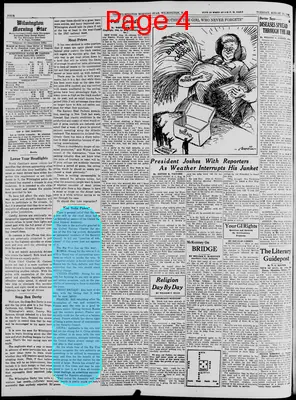
Editorial
August 20, 1946
The Wilmington Morning Star
Wilmington, New Hanover County, North Carolina
What is this article about?
Editorial previews September UN General Assembly debate on veto power, detailing stances of permanent Security Council members: Russia firm supporter, US/UK/France for limited use, China open to atomic exceptions. Predicts uncertain outcome.
Clipping
OCR Quality
98%
Excellent
Full Text
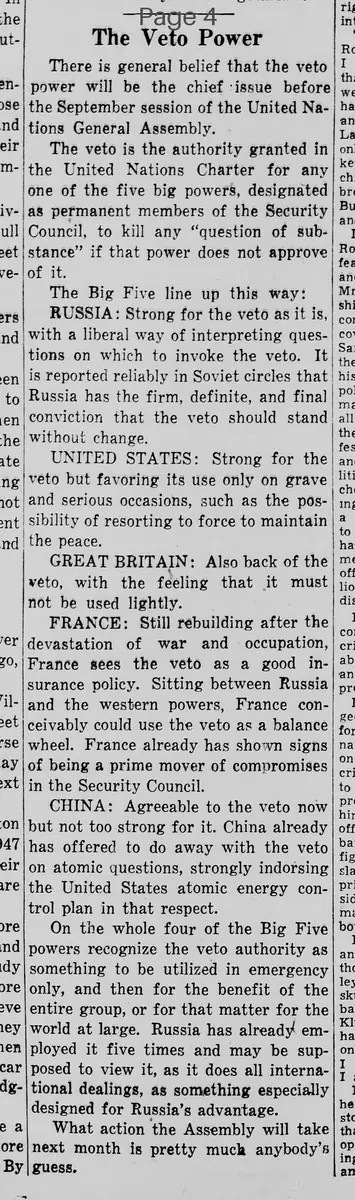
The Veto Power
There is general belief that the veto power will be the chief issue before the September session of the United Nations General Assembly.
The veto is the authority granted in the United Nations Charter for any one of the five big powers, designated as permanent members of the Security Council, to kill any "question of substance" if that power does not approve of it.
The Big Five line up this way:
RUSSIA: Strong for the veto as it is, with a liberal way of interpreting questions on which to invoke the veto. It is reported reliably in Soviet circles that Russia has the firm, definite, and final conviction that the veto should stand without change.
UNITED STATES: Strong for the veto but favoring its use only on grave and serious occasions, such as the possibility of resorting to force to maintain the peace.
GREAT BRITAIN: Also back of the veto, with the feeling that it must not be used lightly.
FRANCE: Still rebuilding after the devastation of war and occupation, France sees the veto as a good insurance policy. Sitting between Russia and the western powers, France conceivably could use the veto as a balance wheel. France already has shown signs of being a prime mover of compromises in the Security Council.
CHINA: Agreeable to the veto now but not too strong for it. China already has offered to do away with the veto on atomic questions, strongly indorsing the United States atomic energy control plan in that respect.
On the whole four of the Big Five powers recognize the veto authority as something to be utilized in emergency only, and then for the benefit of the entire group, or for that matter for the world at large. Russia has already employed it five times and may be supposed to view it, as it does all international dealings, as something especially designed for Russia's advantage.
What action the Assembly will take next month is pretty much anybody's guess.
There is general belief that the veto power will be the chief issue before the September session of the United Nations General Assembly.
The veto is the authority granted in the United Nations Charter for any one of the five big powers, designated as permanent members of the Security Council, to kill any "question of substance" if that power does not approve of it.
The Big Five line up this way:
RUSSIA: Strong for the veto as it is, with a liberal way of interpreting questions on which to invoke the veto. It is reported reliably in Soviet circles that Russia has the firm, definite, and final conviction that the veto should stand without change.
UNITED STATES: Strong for the veto but favoring its use only on grave and serious occasions, such as the possibility of resorting to force to maintain the peace.
GREAT BRITAIN: Also back of the veto, with the feeling that it must not be used lightly.
FRANCE: Still rebuilding after the devastation of war and occupation, France sees the veto as a good insurance policy. Sitting between Russia and the western powers, France conceivably could use the veto as a balance wheel. France already has shown signs of being a prime mover of compromises in the Security Council.
CHINA: Agreeable to the veto now but not too strong for it. China already has offered to do away with the veto on atomic questions, strongly indorsing the United States atomic energy control plan in that respect.
On the whole four of the Big Five powers recognize the veto authority as something to be utilized in emergency only, and then for the benefit of the entire group, or for that matter for the world at large. Russia has already employed it five times and may be supposed to view it, as it does all international dealings, as something especially designed for Russia's advantage.
What action the Assembly will take next month is pretty much anybody's guess.
What sub-type of article is it?
Foreign Affairs
What keywords are associated?
Un Veto Power
Security Council
Big Five
Russia Stance
Us Position
France Balance
China Atomic Compromise
What entities or persons were involved?
United Nations General Assembly
Security Council
Russia
United States
Great Britain
France
China
Editorial Details
Primary Topic
Debate On Un Veto Power
Stance / Tone
Neutral Overview Of Positions
Key Figures
United Nations General Assembly
Security Council
Russia
United States
Great Britain
France
China
Key Arguments
Veto Power Allows Any Of Five Permanent Security Council Members To Block Substantive Questions
Russia Strongly Supports Veto Without Change And Has Used It Five Times
United States Supports Veto For Grave Occasions Like Maintaining Peace
Great Britain Supports Veto But Not Lightly
France Views Veto As Insurance And Balance Wheel
China Agrees To Veto But Offers To Remove It On Atomic Questions
Four Powers See Veto For Emergency Use Benefiting All; Action In September Session Uncertain