Thank you for visiting SNEWPapers!
Sign up free
Literary
December 3, 1846
Herald Of The Times, And Rhode Islander
Newport, Newport County, Rhode Island
What is this article about?
After family misfortunes including fire and slander leading to the father's death, young Edgar Preston moves with his widowed mother and sisters to Philadelphia seeking work. Facing poverty and rejections, Edgar secures a clerk position through a kind stranger's intervention, discovers his employer is his long-lost uncle, and the family thrives. Moral tale emphasizing kindness to the needy.
Merged-components note: Continuation of the same serialized story 'Edgar Preston' across pages.
Clippings
1 of 2
OCR Quality
92%
Excellent
Full Text
Selected
Tales.
From the American Citizen.
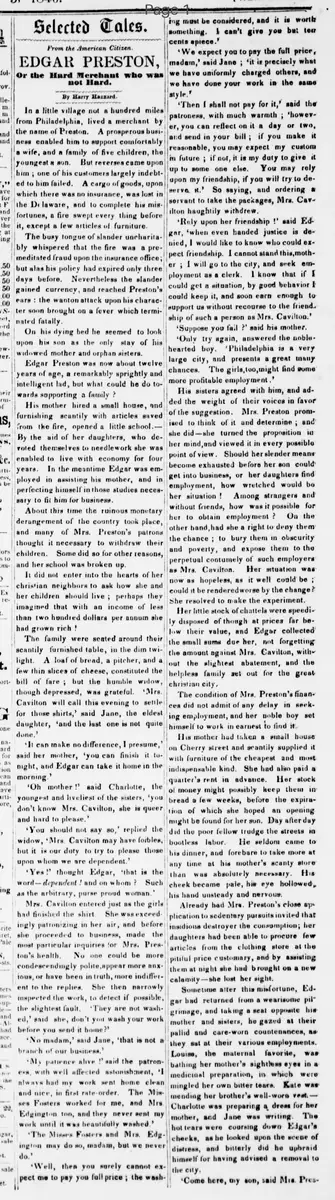
EDGAR PRESTON.
Or the Hard Merchant who was
not Hard.
By Harry Hazzard.
In a little village not a hundred miles
from Philadelphia, lived a merchant by
the name of Preston.
A prosperous business
enabled him to support comfortably
a wife, and a family of five children, the
youngest a son. But reverses came upon
him; one of his customers largely indebted
to him failed. A cargo of goods, upon
which there was no insurance, was lost in
the Delaware, and to complete his mis-
fortunes, a fire swept every thing before
it, except a few articles of furniture.
The busy tongue of slander uncharita-
bly whispered that the fire was a pre-
meditated fraud upon the insurance office;
but alas his policy had expired only three
days before. Nevertheless the slander
gained currency, and reached Preston's
ears: the wanton attack upon his charac-
ter soon brought on a fever which termi-
nated fatally.
On his dying bed he seemed to look
upon his son as the only stay of his
widowed mother and orphan sisters.
Edgar Preston was now about twelve
years of age, a remarkably sprightly and
intelligent lad, but what could he do to-
wards supporting a family?
His mother hired a small house, and
furnishing scantily with articles saved
from the fire, opened a little school.—
By the aid of her daughters, who de-
voted themselves to needlework she was
enabled to live with economy for four
years. In the meantime Edgar was em-
ployed in assisting his mother, and in
perfecting himself in those studies neces-
sary to fit him for business.
About this time the ruinous monetary
derangement of the country took place,
and many of Mrs. Preston's patrons
thought it necessary to withdraw their
children. Some did so for other reasons,
and her school was broken up.
It did not enter into the hearts of her
christian neighbors to ask how she and
her children should live; perhaps they
imagined that with an income of less
than two hundred dollars per annum she
had grown rich!
The family were seated around their
scantily furnished table, in the dim twi-
light. A loaf of bread, a pitcher, and a
few thin slices of cheese, constituted the
bill of fare: but the humble widow,
though depressed, was grateful. 'Mrs.
Cavilton will call this evening to settle
for those shirts,' said Jane, the eldest
daughter, 'and the last one is not quite
done.'
'It can make no difference, I presume,'
said her mother, 'you can finish it to-
night, and Edgar can take it home in the
morning.'
'Oh mother!' said Charlotte, the
youngest and liveliest of the sisters, 'you
don't know Mrs. Cavilton, she is queer
and hard to please.'
'You should not say so,' replied the
widow, 'Mrs. Cavilton may have foibles,
but it is our duty to try to please those
upon whom we are dependent.'
Yes! thought Edgar, that is the
word—dependent! and on whom? Such
as the arbitrary, purse proud woman.'
Mrs. Cavilton entered just as the girls
had finished the shirt She was exceed-
ingly patronizing in her air, and before
she proceeded to business, made the
most particular inquiries for Mrs. Pres-
ton's health. No one could be more
condescendingly polite, appear more anx-
ious, or have been in truth, more indifferent
to the replies. She then narrowly
inspected the work, to detect if possible.
the slightest fault. 'They are not wash-
ing.' said she, 'don't you wash your work
before you send it home?'
'No madam,' said Jane, 'that is not a
branch of our business.'
'My patience give !' said the patron-
ess, with well affected astonishment, 'I
always had my work sent home clean
and nice. in first rate-order. The Misses
Fosters worked for me, and Mrs
Edgington too, and they never sent my
work until it was beautifully washed.'
'The Misses Fosters and Mrs. Edgington
may do so, madam, but we never
do.'
'Well, then you surely cannot ex-
pect me to pay you full price ; the wash-
ing must be considered, and it is worth
something. I can't give you but fif-
teen cents apiece.'
'We expect you to pay the full price,
Madam,' said Jane ; 'it is precisely what
we have uniformly charged others, and
we have done your work in the same
style.'
'Then I shall not pay for it,' said the
patroness, with much warmth ; 'howev-
er, you can reflect on it a day or two,
and send in your bill; if you make it
reasonable, you may expect my custom
in future ; if not, it is my duty to give it
up to some one else. You may rely
upon my friendship, if you will try to de-
serve it.' So saying, and ordering a
servant to take the packages, Mrs. Cav-
ilton haughtily withdrew.
'Rely upon her friendship !' said Ed-
gar, 'when even handed justice is de-
nied, I would like to know who could ex-
pect friendship. I cannot stand this, moth-
er ; I will go to the city, and seek em-
ployment as a clerk. I know that if I
could get a situation, by good behavior I
could keep it, and soon earn enough to
support us without recourse to the friend-
ship of such a person as Mrs. Cavilton.'
'Suppose you fail?' said his mother.
'Only try again, answered the noble-
hearted boy. 'Philadelphia is a very
large city, and presents a great many
chances. The girls, too, might find some
more profitable employment.'
His sisters agreed with him, and ad-
ded the weight of their voices in favor
of the suggestion. Mrs. Preston prom-
ised to think of it and determine ; and
she did—she turned the proposition in
her mind, and viewed it in every possible
point of view. Should her slender means
become exhausted before her son could
get into business, or her daughters find
employment, how wretched would be
her situation! Among strangers and
without friends, how was it possible for
her to obtain employment ? On the
other hand, had she a right to deny them
the chance ; to bury them in obscurity
and poverty, and expose them to the
perpetual contumely of such employers
as Mrs. Cavilton. Her situation was
now as hopeless, as it well could be ;
could it be rendered worse by the change?
She resolved to make the experiment.
Her little stock of chattels were speedi-
ly disposed of though at prices far be-
low their value, and Edgar collected
the small sums due her, not forgetting
the amount against Mrs. Cavilton, with-
out the slightest abatement, and the
helpless family set out for the great
christian city.
The condition of Mrs. Preston's finan-
ces did not admit of any delay in seek-
ing employment, and her noble boy set
himself to work in earnest to find it.
His mother had taken a small house
on Cherry street and scantily supplied it
with furniture of the cheapest and most
indispensable kind. She had also paid a
quarter's rent in advance. Her stock
of money might possibly keep them in
bread a few weeks, before the expira-
tion of which she hoped an opening
might be found for her son. Day after day
did the poor fellow trudge the streets in
bootless labor. He seldom came to
his dinner, and forbore to take more at
any time at his mother's scanty store
than was absolutely necessary. His
cheek became pale, his eye hollowed,
his hand unsteady and nervous.
Already had Mrs. Preston's close ap-
plication to sedentary pursuits invited that
insidious destroyer the consumption; her
daughters had been able to procure few
articles from the clothing store at the
pitiful price customary, and by assisting
them at night she had brought on a new
calamity—she lost her sight.
Some time after this misfortune, Ed-
gar had returned from a wearisome pil-
grimage, and taking a seat opposite his
mother and sisters, he gazed at their
pallid and care-worn countenances, as
they sat at their various employments.
Louise, the maternal favorite,
was
bathing her mother's sightless eyes in a
medicinal preparation, in which were
mingled her own bitter tears. Kate was
mending her brother's well-worn vest.—
Charlotte was preparing a dress for her
mother, and Jane was writing. The
hot tears were coursing down Edgar's
cheeks, as he looked upon the scene of
distress, and bitterly did he upbraid
himself for having advised a removal to
the city.
'Come here, my son, said Mrs. Pres-
ton, 'and let me kiss you; let me feel of your warm hand, and bless your noble heart.' Edgar obeyed his mother, and fondly she dwelt upon the meagre gratification. Edgar picked up a paper, and saw an advertisement offering a desirable situation to a young man of his age, who could write a good hand, and was willing to make himself generally useful.' The best city references were required. 'Ah! there is the difficulty,' thought he; 'how can I, whom nobody knows, give city references, good or bad?' But it was a case of desperation. He resolved to offer. Entering the place designated, he inquired of the proprietor if he was yet suited in a boy. The merchant fixed his eye steadfast upon him as though taking his admeasurement with mathematical precision, and after a painful survey asked him if he could write. 'Yes sir,' said the lad, his heart beginning to bound with hope. A pen was given him and he wrote a business script: it was not done as well as usual: how could it when every nerve was agitated with intense excitement? But no exception was taken; it appeared satisfactory. 'Do you know what you are required to do?' said the merchant. 'Not exactly, sir,' said Edgar, 'but I am willing to do anything I can.' 'Very good,' said Mr. Chandler, the merchant, and he gave a comprehensive definition of 'generally useful;' it meant doing anything and everything required of him, from weighing an ounce of pepper to wheeling a load of soap through the streets. 'Have you been in any business before?' asked Chandler. 'No, sir,' replied the youth. 'I came from the country.' 'Umph! can't give any references then I presume?' 'No, sir, but if you would give me a trial, I would do my best to please you.' 'What do you expect to get,' asked the merchant. 'Only what is customary, sir,' answered Edgar. 'It has been customary with me,' returned Chandler, 'to give nothing the first year.' 'I am seeking employment, sir,' replied Edgar, 'to support a mother and four sisters, and it would be impossible to do it without some compensation.' A smile passed over the rigid countenance of the merchant, expressive of scorn, mingled with pity—not pity for the situation of the poor boy, but for his understanding. To suppose that he could support himself, a mother and four sisters, by a green clerk's salary according to his ideas of support, indicated a degree of 'verdancy' truly ridiculous. 'If such are your expectations, you won't suit me,' said Mr. Chandler, who was a pious Churchman, resuming the reading of his paper with as much self-complacency, as though he had just returned from a visit to the fatherless and widow. It was not the first disappointment young Preston had received, but it pressed him with peculiar weight; the scanty hoard of money was nearly exhausted; the 'busy season' was over, and the supplies brought in by his sisters' industry was no longer available; his mother's condition required, more urgently, medical aid, and those delicacies which tend to mitigate the slow decay of life; starvation was staring them in the face; their rent had been called for, and they were liable to be turned out without a rude shelter, and he could make no provision! He turned away from Mr. Chandler with a heart too full for utterance, the tears coursed down his cheek. Oh, poverty! thou art a dreadful scourge, even when thy victim is the debased, obtuse and sensual animal: but when thy ruthless fangs are fastened deep in the feeling heart, and the noble-minded, the refined and keenly sensitive: when thy rude and iron-like trammels are fastened upon those whose lofty intelligence and virtuous purity fit them to adorn the highest circles, from which they are excluded by thee, how are thy horrors enhanced, how are thy stings aggravated in their intensity and acuteness. Preston had heard much of the kindness and open-hearted benevolence of the people called Friends; although they were very numerous in Philadelphia, he had not hitherto applied to them. As he left Mr. Chandler's store he observed a man at the door of a hardware establishment. The mild and placid expression of his countenance encouraged him to address him. 'Can you give me any kind of employment?' asked he of the man. Without the slightest change of countenance the social friend answered 'No!' We remember a chapter written upon the importance of being able to use the significant monosyllable, and doubtless, when the allurements of vice are spread before us, and the syren voice of illicit and hurtful pleasures invites us; when avarice prompts the use of doubtful means for the advancement of our interests; when heartless lust, lucre, or the spirit of family aggrandizement, seeks the hand of beauty and the heart's affections; 'no!' may be a very useful word, but in the present instance, it fell upon the heart in all its round emphatic frigidity, with bullet-like power. So perfectly decisive and unequivocal—admitting of no explanation, no rejoinder—it hardly leaves room for a civil 'good bye.' It is summary verbal guillotine. The equivocal 'no!' from which there was no appeal, crushed the last germ of hope, his heart seemed then to sink within him. Faintness came over him and he was obliged to lean against the awning for support. Hope deferred maketh the heart sick' Reader, hast thou ever felt this sickness of the heart? Then canst thou sympathize with the poor fatherless boy. 'Tis well that all men are not selfish, but amid the mighty multitude who throng our marts, and hurry through our streets in mad eagerness to gain the 'almighty dollar,' there are yet found some Samaritans whose hearts are not entirely barren of human sympathies; whose eyes are not utterly closed at the sight of suffering; whose ears are not hermetically stopped at the cry of distress. Such an one passed at this moment—his eyes fell upon the wretched boy as he leaned against the post, holding in his hand a time-honored hapless hat which he had removed to catch the grateful zephyr that gently fanned his marble brow, and sported with his manly locks. Mr. N. paused to look upon the boy. So young, so fair, and yet a mendicant! Yet it may have been the result of misfortune or accident, and the possibility that his own fair-haired boy might, in the mutations of fortune, yet veiled in the impenetrable future, be brought to the same low estate, shot through his mind. N. was an impulsive man, when his heart was touched, but very cautious when the appeal was to his judgment. On the present occasion he did not stop to enquire whether this case of youthful mendicancy originated in misfortune or crime, or whether it was an artificial imposture. He had long since settled in his mind, that if begging was not the proper remedy; if imposture, better that ninety-nine practice deception than that one perish from want. He dropped a piece of money in the hat and hurried on. Preston was aroused to a consciousness of his degradation; he hastily pursued the stranger and returned the money. 'Excuse me, sir,' said he, 'but you made a mistake; I am not a beggar,' and his eye fell upon the threadbare apparel, and he felt disposed to recall his words. 'I am not as you suppose, sir, a beggar—but yet—that is—may be you can tell me where I can get something to do.' N. could readily discover traces of suffering; the boy's conduct gave proof of honesty, and the most touching delicacy and sensibility. He asked him some questions, and as they slowly walked on, drew from him his short history. They reached the corner of the street leading to N.'s residence and were about to part. 'Can you tell me,' asked Edgar again, 'who wants a boy?' He hardly dared to hope for a favorable reply, and as N. paused to think, the poor child thought he was stopping to gather words to mitigate the severity of the dreadful 'no!' 'Yes!' said N.; 'you can get employment; give me your name and number, and be at home about three o'clock this afternoon,' and he left him. Edgar returned home, and but for the balmy influence of that gentle yes, might have gone out no more, so like the fatal stroke of the dagger was the short and irrevocable 'no!' of the ironmonger, as it fell upon the ear as hard as the wares in which he dealt. Let us follow the lively Charlotte, for a few moments. Soon after her brother had gone out, with the manuscript, she donned her bonnet, and stealing out unobserved, hastened down to Chestnut street, and rang the bell of the first 'marble front she came to. She had prepared a moving speech, intending to use it in procuring work to feed her poor mother. A servant answered the summons, and she inquired for the lady of the house; she modestly stated her object, but Mrs. G.'s speech was more moving than hers—she ordered her out in double quick time, applying such gentle epithets as trollop, vagrant, and thief. She tried another but thought it better to make the application by a single interrogation, rather than the verbal flourishes she meditated. 'Have you any work you can give me?' she asked of a bland and smiling lady who met her on her second trial. The reply was a brief and chilling one—'no!' It is needless to say how that simple word fell like a load of despair upon her heart; she returned home fatigued and disappointed. 'What a beautiful girl that is?' said George G. to his mother, as that lady closed her long tirade and her door upon the humble Charlotte Preston. He had but a glimpse of her beautiful features as she passed under the window, but that single impression, momentary as it was like the concentration of the solar rays upon the daguerrean plate, was life-like, and for life. N. took his dinner, and glancing over the wants in the newspaper, proceeded to the store of Mr. Chandler. 'Are you supplied with a boy?' he asked of Chandler, to whom he was well known. 'Not yet,' said the merchant. 'Then do not be in a hurry,' said N., 'for I will bring you one, and I think you will be pleased with him.' He went for Edgar, and returned with him to the store. Great was Chandler's surprise to see his friend N. bringing in the very same boy whom he had repulsed in the morning. N. had a little private conversation with the merchant. 'This young man,' said he, 'is very poor, but he has many good qualities; he is struggling to help a feeble, blind mother, and a number of sisters, and it is much better to make him an honest man, than it will be to reform him when poverty has driven him to crime.' 'Is he honest now?' interrupted Chandler. 'Perfectly; I will vouch for him.' 'I generally give boys nothing, in the capacity I want him,' said Chandler; 'but under the circumstances, I suppose I must give him fifteen dollars a month.' 'Very well,' said N., 'here is my check for fifty dollars to be added to it, and the benefit would be greatly enhanced if he could receive it weekly in advance, and let it appear to come from you as a reward for his fidelity and attention.' Soon after N. had taken his departure, a lady entered the store. She was dressed in the full extreme of fashion, and carried herself with the pompous hauteur which the mere possession of wealth or accident can give, and all the airs such persons know how to assume. Mr. Chandler himself waited upon her, but his patience gave way—it was impossible to please her; he called his new clerk, who was in a back room, taking his preliminary lessons in being 'generally useful.' Edgar made his appearance and immediately recognized Mrs. Cavilton. The recognition and surprise were mutual, and Mrs. Cavilton inquired, as tenderly as ever, for the health of his mother. She seemed to have forgotten the pique about the shirts, or perhaps the information of Mrs. Preston's loss of sight might have mollified the acerbity of her feelings; at all events she made a heavy bill, which, she assured Mr. Chandler, was a compliment to her young friend the clerk. Mr. Chandler began to think he had drawn a prize in the great lottery of human nature, and drew Edgar into a detail of his history. 'Do you know your father's name?' asked Chandler, with apparent interest. 'His name was George.' 'And your mother's?' hastily asked the merchant. 'Maria,' replied the clerk. A sudden change passed over the countenance of the merchant, indicative of some hidden fluctuation of feeling. Edgar observed it, but knew not how to interpret it. Could there be any harm in having a father named George, or a mother named Maria? 'Why did you not refer to Mr. N. this morning?' asked the merchant, as if desirous to give another direction to the conversation. 'I was not then acquainted with him sir,' said the clerk. 'How then did you become acquainted with him?' Edgar thought his employer unnecessarily inquisitive; but his situation demanded a spirit of humility and self-denial, and he was compelled to relate what he wished to bury in oblivion. 'Strange!' said Chandler, who was busily engaged in looking over an old file of papers. 'If I am not mistaken, I have a letter from your father or mother.' He found it, read it, and handed it to his nephew! Edgar read the letter which began 'My dear brother,' and closed with the well known signature of his mother—'M. L. Preston.' 'Then it seems you are my mother's brother, sir,' said Edgar. 'I have often heard her speak of a brother who went to sea when he was quite young, but was reported to have been lost in a wreck: but if I mistake not, she always called him Holbrook.' 'Ah! yes, my middle name; and she often speaks of me?' asked the merchant, brushing away a truant tear. 'Often, sir, but more frequently of late.' 'I must see her,' said Chandler; and thrusting the letter into his pocket, he directed his clerk to close up; and, attended by Edgar, he proceeded to the dwelling of his sister. 'Oh that I could see you!' said the poor blind widow, as she held the hand of her sobbing brother. 'Surely,' she said, as a shadow of doubt crossed her fine features, 'surely no one could be so cruel as to deceive me.' Chandler bid Edgar read her own letter, written soon after her marriage, and mailed to him at New Orleans. She remembered it well. 'Thank the Lord, oh my soul, and forget not all his benefits,' said the widow devoutly; and she gave her whole confidence, and the cherished affections of a sister's pure love, to a long lamented brother. Chandler explained the story of the wreck: he sailed in the barque 'Quadroon,' from New Orleans to Rio Janeiro; he engaged in profitable business there. The barque was wrecked on her homeward voyage, but he was not in her. He remained in South America several years, but on his return was unable to trace Mr. Preston. A rap at the door interrupted the conversation, and Mrs. Preston's landlord entered. 'Do you always require your rent in advance, Mr. Scrublow?' asked Edgar. 'Why, yes,' replied the worthy, 'particularly where they are strangers.' 'Mother is not prepared to pay in advance,' said Edgar, 'but—' 'Call at my store to-morrow,' said Mr. Chandler, 'and we will settle it.' Mr. Scrublow withdrew. Edgar was the best of clerks, and, by successful speculation during his uncle's temporary absence, so added to his means that the old gentleman gave him an interest in the stock of equal amount, and associated him with himself in business. In an elegantly furnished parlor are seated two young persons in earnest conversation. One is George G., and he is waiting to hear Charlotte Preston pronounce the gentle 'yes.' She did and he was happy—even the haughty mother did not object to a little 'thief' stealing her son's heart. There again, in the comfortable parlor of Mr. N., is Edgar Preston. He has made a pretty little fortune, and now he wants a pretty little wife, and is gently whispering to Agnes N.—'Your dear father once said 'yes' to me, dear Agnes, and saved me, even when my heart was withering with despair and dejection—saved me from unimaginable misery; do not crush a flower that kindness has nourished into maturity and vigor. Do not say 'no'—will you be mine?' Agnes timidly whispered 'yes,' and Preston, as well as herself, was happy. The best medical skill was exerted for the widow, and her fervent prayer, that she might live and behold her children, was not denied. She lived to see them and her brother, and the good N., the friend of the fatherless and the widow. Edgar had frequent dealings with the iron-monger, but the old gentleman never knew he was the boy he had so nearly murdered with a cold, laconic 'no!' Reader, our little history is finished. Learn now the lesson: when honesty seeks the means of support—when misery appeals to thy heart—when poverty asks for pity—do not say 'no!'
Tales.
From the American Citizen.
EDGAR PRESTON.
Or the Hard Merchant who was
not Hard.
By Harry Hazzard.
In a little village not a hundred miles
from Philadelphia, lived a merchant by
the name of Preston.
A prosperous business
enabled him to support comfortably
a wife, and a family of five children, the
youngest a son. But reverses came upon
him; one of his customers largely indebted
to him failed. A cargo of goods, upon
which there was no insurance, was lost in
the Delaware, and to complete his mis-
fortunes, a fire swept every thing before
it, except a few articles of furniture.
The busy tongue of slander uncharita-
bly whispered that the fire was a pre-
meditated fraud upon the insurance office;
but alas his policy had expired only three
days before. Nevertheless the slander
gained currency, and reached Preston's
ears: the wanton attack upon his charac-
ter soon brought on a fever which termi-
nated fatally.
On his dying bed he seemed to look
upon his son as the only stay of his
widowed mother and orphan sisters.
Edgar Preston was now about twelve
years of age, a remarkably sprightly and
intelligent lad, but what could he do to-
wards supporting a family?
His mother hired a small house, and
furnishing scantily with articles saved
from the fire, opened a little school.—
By the aid of her daughters, who de-
voted themselves to needlework she was
enabled to live with economy for four
years. In the meantime Edgar was em-
ployed in assisting his mother, and in
perfecting himself in those studies neces-
sary to fit him for business.
About this time the ruinous monetary
derangement of the country took place,
and many of Mrs. Preston's patrons
thought it necessary to withdraw their
children. Some did so for other reasons,
and her school was broken up.
It did not enter into the hearts of her
christian neighbors to ask how she and
her children should live; perhaps they
imagined that with an income of less
than two hundred dollars per annum she
had grown rich!
The family were seated around their
scantily furnished table, in the dim twi-
light. A loaf of bread, a pitcher, and a
few thin slices of cheese, constituted the
bill of fare: but the humble widow,
though depressed, was grateful. 'Mrs.
Cavilton will call this evening to settle
for those shirts,' said Jane, the eldest
daughter, 'and the last one is not quite
done.'
'It can make no difference, I presume,'
said her mother, 'you can finish it to-
night, and Edgar can take it home in the
morning.'
'Oh mother!' said Charlotte, the
youngest and liveliest of the sisters, 'you
don't know Mrs. Cavilton, she is queer
and hard to please.'
'You should not say so,' replied the
widow, 'Mrs. Cavilton may have foibles,
but it is our duty to try to please those
upon whom we are dependent.'
Yes! thought Edgar, that is the
word—dependent! and on whom? Such
as the arbitrary, purse proud woman.'
Mrs. Cavilton entered just as the girls
had finished the shirt She was exceed-
ingly patronizing in her air, and before
she proceeded to business, made the
most particular inquiries for Mrs. Pres-
ton's health. No one could be more
condescendingly polite, appear more anx-
ious, or have been in truth, more indifferent
to the replies. She then narrowly
inspected the work, to detect if possible.
the slightest fault. 'They are not wash-
ing.' said she, 'don't you wash your work
before you send it home?'
'No madam,' said Jane, 'that is not a
branch of our business.'
'My patience give !' said the patron-
ess, with well affected astonishment, 'I
always had my work sent home clean
and nice. in first rate-order. The Misses
Fosters worked for me, and Mrs
Edgington too, and they never sent my
work until it was beautifully washed.'
'The Misses Fosters and Mrs. Edgington
may do so, madam, but we never
do.'
'Well, then you surely cannot ex-
pect me to pay you full price ; the wash-
ing must be considered, and it is worth
something. I can't give you but fif-
teen cents apiece.'
'We expect you to pay the full price,
Madam,' said Jane ; 'it is precisely what
we have uniformly charged others, and
we have done your work in the same
style.'
'Then I shall not pay for it,' said the
patroness, with much warmth ; 'howev-
er, you can reflect on it a day or two,
and send in your bill; if you make it
reasonable, you may expect my custom
in future ; if not, it is my duty to give it
up to some one else. You may rely
upon my friendship, if you will try to de-
serve it.' So saying, and ordering a
servant to take the packages, Mrs. Cav-
ilton haughtily withdrew.
'Rely upon her friendship !' said Ed-
gar, 'when even handed justice is de-
nied, I would like to know who could ex-
pect friendship. I cannot stand this, moth-
er ; I will go to the city, and seek em-
ployment as a clerk. I know that if I
could get a situation, by good behavior I
could keep it, and soon earn enough to
support us without recourse to the friend-
ship of such a person as Mrs. Cavilton.'
'Suppose you fail?' said his mother.
'Only try again, answered the noble-
hearted boy. 'Philadelphia is a very
large city, and presents a great many
chances. The girls, too, might find some
more profitable employment.'
His sisters agreed with him, and ad-
ded the weight of their voices in favor
of the suggestion. Mrs. Preston prom-
ised to think of it and determine ; and
she did—she turned the proposition in
her mind, and viewed it in every possible
point of view. Should her slender means
become exhausted before her son could
get into business, or her daughters find
employment, how wretched would be
her situation! Among strangers and
without friends, how was it possible for
her to obtain employment ? On the
other hand, had she a right to deny them
the chance ; to bury them in obscurity
and poverty, and expose them to the
perpetual contumely of such employers
as Mrs. Cavilton. Her situation was
now as hopeless, as it well could be ;
could it be rendered worse by the change?
She resolved to make the experiment.
Her little stock of chattels were speedi-
ly disposed of though at prices far be-
low their value, and Edgar collected
the small sums due her, not forgetting
the amount against Mrs. Cavilton, with-
out the slightest abatement, and the
helpless family set out for the great
christian city.
The condition of Mrs. Preston's finan-
ces did not admit of any delay in seek-
ing employment, and her noble boy set
himself to work in earnest to find it.
His mother had taken a small house
on Cherry street and scantily supplied it
with furniture of the cheapest and most
indispensable kind. She had also paid a
quarter's rent in advance. Her stock
of money might possibly keep them in
bread a few weeks, before the expira-
tion of which she hoped an opening
might be found for her son. Day after day
did the poor fellow trudge the streets in
bootless labor. He seldom came to
his dinner, and forbore to take more at
any time at his mother's scanty store
than was absolutely necessary. His
cheek became pale, his eye hollowed,
his hand unsteady and nervous.
Already had Mrs. Preston's close ap-
plication to sedentary pursuits invited that
insidious destroyer the consumption; her
daughters had been able to procure few
articles from the clothing store at the
pitiful price customary, and by assisting
them at night she had brought on a new
calamity—she lost her sight.
Some time after this misfortune, Ed-
gar had returned from a wearisome pil-
grimage, and taking a seat opposite his
mother and sisters, he gazed at their
pallid and care-worn countenances, as
they sat at their various employments.
Louise, the maternal favorite,
was
bathing her mother's sightless eyes in a
medicinal preparation, in which were
mingled her own bitter tears. Kate was
mending her brother's well-worn vest.—
Charlotte was preparing a dress for her
mother, and Jane was writing. The
hot tears were coursing down Edgar's
cheeks, as he looked upon the scene of
distress, and bitterly did he upbraid
himself for having advised a removal to
the city.
'Come here, my son, said Mrs. Pres-
ton, 'and let me kiss you; let me feel of your warm hand, and bless your noble heart.' Edgar obeyed his mother, and fondly she dwelt upon the meagre gratification. Edgar picked up a paper, and saw an advertisement offering a desirable situation to a young man of his age, who could write a good hand, and was willing to make himself generally useful.' The best city references were required. 'Ah! there is the difficulty,' thought he; 'how can I, whom nobody knows, give city references, good or bad?' But it was a case of desperation. He resolved to offer. Entering the place designated, he inquired of the proprietor if he was yet suited in a boy. The merchant fixed his eye steadfast upon him as though taking his admeasurement with mathematical precision, and after a painful survey asked him if he could write. 'Yes sir,' said the lad, his heart beginning to bound with hope. A pen was given him and he wrote a business script: it was not done as well as usual: how could it when every nerve was agitated with intense excitement? But no exception was taken; it appeared satisfactory. 'Do you know what you are required to do?' said the merchant. 'Not exactly, sir,' said Edgar, 'but I am willing to do anything I can.' 'Very good,' said Mr. Chandler, the merchant, and he gave a comprehensive definition of 'generally useful;' it meant doing anything and everything required of him, from weighing an ounce of pepper to wheeling a load of soap through the streets. 'Have you been in any business before?' asked Chandler. 'No, sir,' replied the youth. 'I came from the country.' 'Umph! can't give any references then I presume?' 'No, sir, but if you would give me a trial, I would do my best to please you.' 'What do you expect to get,' asked the merchant. 'Only what is customary, sir,' answered Edgar. 'It has been customary with me,' returned Chandler, 'to give nothing the first year.' 'I am seeking employment, sir,' replied Edgar, 'to support a mother and four sisters, and it would be impossible to do it without some compensation.' A smile passed over the rigid countenance of the merchant, expressive of scorn, mingled with pity—not pity for the situation of the poor boy, but for his understanding. To suppose that he could support himself, a mother and four sisters, by a green clerk's salary according to his ideas of support, indicated a degree of 'verdancy' truly ridiculous. 'If such are your expectations, you won't suit me,' said Mr. Chandler, who was a pious Churchman, resuming the reading of his paper with as much self-complacency, as though he had just returned from a visit to the fatherless and widow. It was not the first disappointment young Preston had received, but it pressed him with peculiar weight; the scanty hoard of money was nearly exhausted; the 'busy season' was over, and the supplies brought in by his sisters' industry was no longer available; his mother's condition required, more urgently, medical aid, and those delicacies which tend to mitigate the slow decay of life; starvation was staring them in the face; their rent had been called for, and they were liable to be turned out without a rude shelter, and he could make no provision! He turned away from Mr. Chandler with a heart too full for utterance, the tears coursed down his cheek. Oh, poverty! thou art a dreadful scourge, even when thy victim is the debased, obtuse and sensual animal: but when thy ruthless fangs are fastened deep in the feeling heart, and the noble-minded, the refined and keenly sensitive: when thy rude and iron-like trammels are fastened upon those whose lofty intelligence and virtuous purity fit them to adorn the highest circles, from which they are excluded by thee, how are thy horrors enhanced, how are thy stings aggravated in their intensity and acuteness. Preston had heard much of the kindness and open-hearted benevolence of the people called Friends; although they were very numerous in Philadelphia, he had not hitherto applied to them. As he left Mr. Chandler's store he observed a man at the door of a hardware establishment. The mild and placid expression of his countenance encouraged him to address him. 'Can you give me any kind of employment?' asked he of the man. Without the slightest change of countenance the social friend answered 'No!' We remember a chapter written upon the importance of being able to use the significant monosyllable, and doubtless, when the allurements of vice are spread before us, and the syren voice of illicit and hurtful pleasures invites us; when avarice prompts the use of doubtful means for the advancement of our interests; when heartless lust, lucre, or the spirit of family aggrandizement, seeks the hand of beauty and the heart's affections; 'no!' may be a very useful word, but in the present instance, it fell upon the heart in all its round emphatic frigidity, with bullet-like power. So perfectly decisive and unequivocal—admitting of no explanation, no rejoinder—it hardly leaves room for a civil 'good bye.' It is summary verbal guillotine. The equivocal 'no!' from which there was no appeal, crushed the last germ of hope, his heart seemed then to sink within him. Faintness came over him and he was obliged to lean against the awning for support. Hope deferred maketh the heart sick' Reader, hast thou ever felt this sickness of the heart? Then canst thou sympathize with the poor fatherless boy. 'Tis well that all men are not selfish, but amid the mighty multitude who throng our marts, and hurry through our streets in mad eagerness to gain the 'almighty dollar,' there are yet found some Samaritans whose hearts are not entirely barren of human sympathies; whose eyes are not utterly closed at the sight of suffering; whose ears are not hermetically stopped at the cry of distress. Such an one passed at this moment—his eyes fell upon the wretched boy as he leaned against the post, holding in his hand a time-honored hapless hat which he had removed to catch the grateful zephyr that gently fanned his marble brow, and sported with his manly locks. Mr. N. paused to look upon the boy. So young, so fair, and yet a mendicant! Yet it may have been the result of misfortune or accident, and the possibility that his own fair-haired boy might, in the mutations of fortune, yet veiled in the impenetrable future, be brought to the same low estate, shot through his mind. N. was an impulsive man, when his heart was touched, but very cautious when the appeal was to his judgment. On the present occasion he did not stop to enquire whether this case of youthful mendicancy originated in misfortune or crime, or whether it was an artificial imposture. He had long since settled in his mind, that if begging was not the proper remedy; if imposture, better that ninety-nine practice deception than that one perish from want. He dropped a piece of money in the hat and hurried on. Preston was aroused to a consciousness of his degradation; he hastily pursued the stranger and returned the money. 'Excuse me, sir,' said he, 'but you made a mistake; I am not a beggar,' and his eye fell upon the threadbare apparel, and he felt disposed to recall his words. 'I am not as you suppose, sir, a beggar—but yet—that is—may be you can tell me where I can get something to do.' N. could readily discover traces of suffering; the boy's conduct gave proof of honesty, and the most touching delicacy and sensibility. He asked him some questions, and as they slowly walked on, drew from him his short history. They reached the corner of the street leading to N.'s residence and were about to part. 'Can you tell me,' asked Edgar again, 'who wants a boy?' He hardly dared to hope for a favorable reply, and as N. paused to think, the poor child thought he was stopping to gather words to mitigate the severity of the dreadful 'no!' 'Yes!' said N.; 'you can get employment; give me your name and number, and be at home about three o'clock this afternoon,' and he left him. Edgar returned home, and but for the balmy influence of that gentle yes, might have gone out no more, so like the fatal stroke of the dagger was the short and irrevocable 'no!' of the ironmonger, as it fell upon the ear as hard as the wares in which he dealt. Let us follow the lively Charlotte, for a few moments. Soon after her brother had gone out, with the manuscript, she donned her bonnet, and stealing out unobserved, hastened down to Chestnut street, and rang the bell of the first 'marble front she came to. She had prepared a moving speech, intending to use it in procuring work to feed her poor mother. A servant answered the summons, and she inquired for the lady of the house; she modestly stated her object, but Mrs. G.'s speech was more moving than hers—she ordered her out in double quick time, applying such gentle epithets as trollop, vagrant, and thief. She tried another but thought it better to make the application by a single interrogation, rather than the verbal flourishes she meditated. 'Have you any work you can give me?' she asked of a bland and smiling lady who met her on her second trial. The reply was a brief and chilling one—'no!' It is needless to say how that simple word fell like a load of despair upon her heart; she returned home fatigued and disappointed. 'What a beautiful girl that is?' said George G. to his mother, as that lady closed her long tirade and her door upon the humble Charlotte Preston. He had but a glimpse of her beautiful features as she passed under the window, but that single impression, momentary as it was like the concentration of the solar rays upon the daguerrean plate, was life-like, and for life. N. took his dinner, and glancing over the wants in the newspaper, proceeded to the store of Mr. Chandler. 'Are you supplied with a boy?' he asked of Chandler, to whom he was well known. 'Not yet,' said the merchant. 'Then do not be in a hurry,' said N., 'for I will bring you one, and I think you will be pleased with him.' He went for Edgar, and returned with him to the store. Great was Chandler's surprise to see his friend N. bringing in the very same boy whom he had repulsed in the morning. N. had a little private conversation with the merchant. 'This young man,' said he, 'is very poor, but he has many good qualities; he is struggling to help a feeble, blind mother, and a number of sisters, and it is much better to make him an honest man, than it will be to reform him when poverty has driven him to crime.' 'Is he honest now?' interrupted Chandler. 'Perfectly; I will vouch for him.' 'I generally give boys nothing, in the capacity I want him,' said Chandler; 'but under the circumstances, I suppose I must give him fifteen dollars a month.' 'Very well,' said N., 'here is my check for fifty dollars to be added to it, and the benefit would be greatly enhanced if he could receive it weekly in advance, and let it appear to come from you as a reward for his fidelity and attention.' Soon after N. had taken his departure, a lady entered the store. She was dressed in the full extreme of fashion, and carried herself with the pompous hauteur which the mere possession of wealth or accident can give, and all the airs such persons know how to assume. Mr. Chandler himself waited upon her, but his patience gave way—it was impossible to please her; he called his new clerk, who was in a back room, taking his preliminary lessons in being 'generally useful.' Edgar made his appearance and immediately recognized Mrs. Cavilton. The recognition and surprise were mutual, and Mrs. Cavilton inquired, as tenderly as ever, for the health of his mother. She seemed to have forgotten the pique about the shirts, or perhaps the information of Mrs. Preston's loss of sight might have mollified the acerbity of her feelings; at all events she made a heavy bill, which, she assured Mr. Chandler, was a compliment to her young friend the clerk. Mr. Chandler began to think he had drawn a prize in the great lottery of human nature, and drew Edgar into a detail of his history. 'Do you know your father's name?' asked Chandler, with apparent interest. 'His name was George.' 'And your mother's?' hastily asked the merchant. 'Maria,' replied the clerk. A sudden change passed over the countenance of the merchant, indicative of some hidden fluctuation of feeling. Edgar observed it, but knew not how to interpret it. Could there be any harm in having a father named George, or a mother named Maria? 'Why did you not refer to Mr. N. this morning?' asked the merchant, as if desirous to give another direction to the conversation. 'I was not then acquainted with him sir,' said the clerk. 'How then did you become acquainted with him?' Edgar thought his employer unnecessarily inquisitive; but his situation demanded a spirit of humility and self-denial, and he was compelled to relate what he wished to bury in oblivion. 'Strange!' said Chandler, who was busily engaged in looking over an old file of papers. 'If I am not mistaken, I have a letter from your father or mother.' He found it, read it, and handed it to his nephew! Edgar read the letter which began 'My dear brother,' and closed with the well known signature of his mother—'M. L. Preston.' 'Then it seems you are my mother's brother, sir,' said Edgar. 'I have often heard her speak of a brother who went to sea when he was quite young, but was reported to have been lost in a wreck: but if I mistake not, she always called him Holbrook.' 'Ah! yes, my middle name; and she often speaks of me?' asked the merchant, brushing away a truant tear. 'Often, sir, but more frequently of late.' 'I must see her,' said Chandler; and thrusting the letter into his pocket, he directed his clerk to close up; and, attended by Edgar, he proceeded to the dwelling of his sister. 'Oh that I could see you!' said the poor blind widow, as she held the hand of her sobbing brother. 'Surely,' she said, as a shadow of doubt crossed her fine features, 'surely no one could be so cruel as to deceive me.' Chandler bid Edgar read her own letter, written soon after her marriage, and mailed to him at New Orleans. She remembered it well. 'Thank the Lord, oh my soul, and forget not all his benefits,' said the widow devoutly; and she gave her whole confidence, and the cherished affections of a sister's pure love, to a long lamented brother. Chandler explained the story of the wreck: he sailed in the barque 'Quadroon,' from New Orleans to Rio Janeiro; he engaged in profitable business there. The barque was wrecked on her homeward voyage, but he was not in her. He remained in South America several years, but on his return was unable to trace Mr. Preston. A rap at the door interrupted the conversation, and Mrs. Preston's landlord entered. 'Do you always require your rent in advance, Mr. Scrublow?' asked Edgar. 'Why, yes,' replied the worthy, 'particularly where they are strangers.' 'Mother is not prepared to pay in advance,' said Edgar, 'but—' 'Call at my store to-morrow,' said Mr. Chandler, 'and we will settle it.' Mr. Scrublow withdrew. Edgar was the best of clerks, and, by successful speculation during his uncle's temporary absence, so added to his means that the old gentleman gave him an interest in the stock of equal amount, and associated him with himself in business. In an elegantly furnished parlor are seated two young persons in earnest conversation. One is George G., and he is waiting to hear Charlotte Preston pronounce the gentle 'yes.' She did and he was happy—even the haughty mother did not object to a little 'thief' stealing her son's heart. There again, in the comfortable parlor of Mr. N., is Edgar Preston. He has made a pretty little fortune, and now he wants a pretty little wife, and is gently whispering to Agnes N.—'Your dear father once said 'yes' to me, dear Agnes, and saved me, even when my heart was withering with despair and dejection—saved me from unimaginable misery; do not crush a flower that kindness has nourished into maturity and vigor. Do not say 'no'—will you be mine?' Agnes timidly whispered 'yes,' and Preston, as well as herself, was happy. The best medical skill was exerted for the widow, and her fervent prayer, that she might live and behold her children, was not denied. She lived to see them and her brother, and the good N., the friend of the fatherless and the widow. Edgar had frequent dealings with the iron-monger, but the old gentleman never knew he was the boy he had so nearly murdered with a cold, laconic 'no!' Reader, our little history is finished. Learn now the lesson: when honesty seeks the means of support—when misery appeals to thy heart—when poverty asks for pity—do not say 'no!'
What sub-type of article is it?
Prose Fiction
What themes does it cover?
Moral Virtue
Commerce Trade
Social Manners
What keywords are associated?
Moral Tale
Poverty
Kindness
Family Support
Merchant Life
Honesty
Philanthropy
Rejection
Redemption
19th Century Fiction
What entities or persons were involved?
By Harry Hazzard.
Literary Details
Title
Edgar Preston. Or The Hard Merchant Who Was Not Hard.
Author
By Harry Hazzard.
Key Lines
'Rely Upon Her Friendship !' Said Edgar, 'When Even Handed Justice Is Denied, I Would Like To Know Who Could Expect Friendship.'
Oh, Poverty! Thou Art A Dreadful Scourge... How Are Thy Stings Aggravated In Their Intensity And Acuteness.
'Yes!' Said N.; 'You Can Get Employment; Give Me Your Name And Number, And Be At Home About Three O'clock This Afternoon.'
Learn Now The Lesson: When Honesty Seeks The Means Of Support—When Misery Appeals To Thy Heart—When Poverty Asks For Pity—Do Not Say 'No!'
Your Dear Father Once Said 'Yes' To Me, Dear Agnes, And Saved Me... Do Not Say 'No'—Will You Be Mine?'