Thank you for visiting SNEWPapers!
Sign up free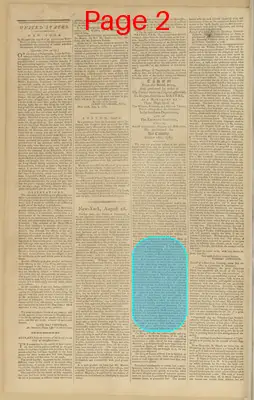
The New York Packet
New York, New York County, New York
What is this article about?
A significant legal case, Stoddard against Penhallow, was argued in Philadelphia's Common Pleas court on Saturday the 18th inst., concerning a 1777 vessel capture by a New Hampshire citizen, subsequent court reversals, and objections to an attachment on the captors' property regarding jurisdiction and prior proceedings.
Clipping
OCR Quality
Full Text
What sub-type of article is it?
What keywords are associated?
What entities or persons were involved?
Where did it happen?
Domestic News Details
Primary Location
Philadelphia
Event Date
Saturday The 18th Inst.
Key Persons
Outcome
the court has taken time to consider of the judgement.
Event Details
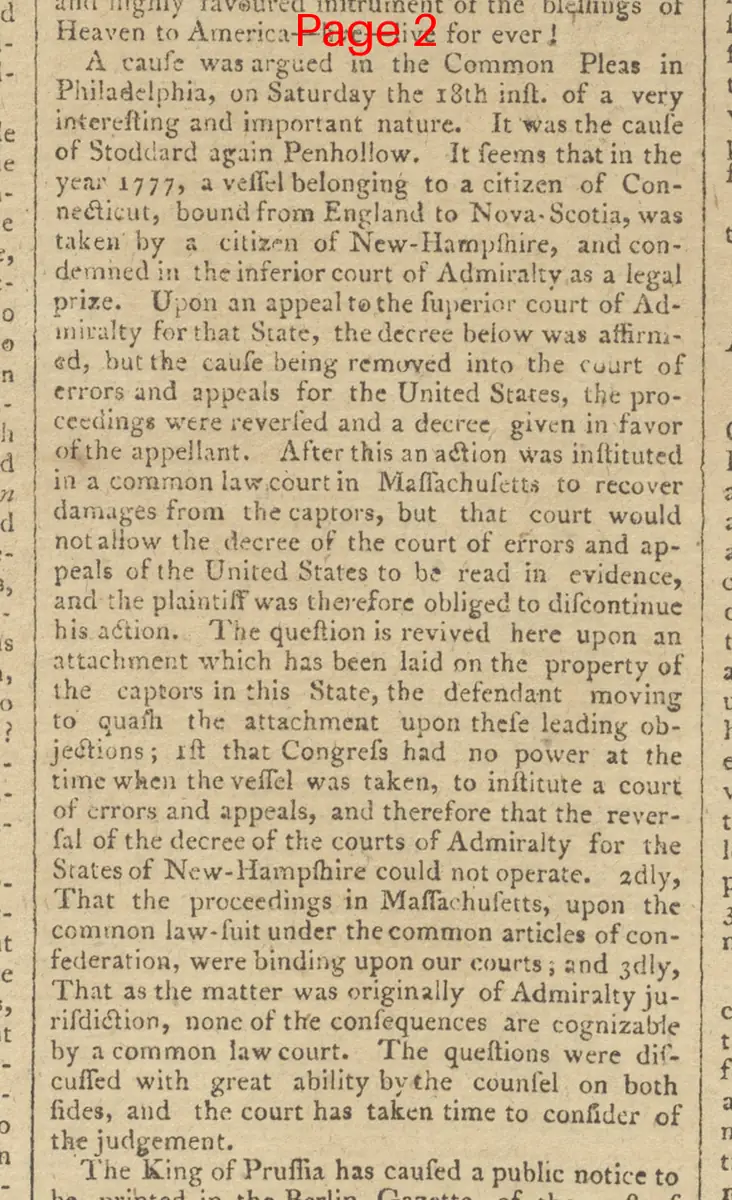
A cause was argued in the Common Pleas in Philadelphia, on Saturday the 18th inst. of a very interesting and important nature. It was the cause of Stoddard against Penhallow. It seems that in the year 1777, a vessel belonging to a citizen of Connecticut, bound from England to Nova-Scotia, was taken by a citizen of New-Hampshire, and condemned in the inferior court of Admiralty as a legal prize. Upon an appeal to the superior court of Admiralty for that State, the decree below was affirmed, but the cause being removed into the court of errors and appeals for the United States, the proceedings were reversed and a decree given in favor of the appellant. After this an action was instituted in a common law court in Massachusetts to recover damages from the captors, but that court would not allow the decree of the court of errors and appeals of the United States to be read in evidence, and the plaintiff was therefore obliged to discontinue his action. The question is revived here upon an attachment which has been laid on the property of the captors in this State, the defendant moving to quash the attachment upon these leading objections; 1st that Congress had no power at the time when the vessel was taken, to institute a court of errors and appeals, and therefore that the reversal of the decree of the courts of Admiralty for the States of New-Hampshire could not operate. 2dly, That the proceedings in Massachusetts, upon the common law-suit under the common articles of confederation, were binding upon our courts; and 3dly, That as the matter was originally of Admiralty jurisdiction, none of the consequences are cognizable by a common law court. The questions were discussed with great ability by the counsel on both sides.