Thank you for visiting SNEWPapers!
Sign up free
Daily Kennebec Journal
Augusta, Kennebec County, Maine
What is this article about?
Fire at Manhattan State Hospital on Ward's Island kills 25, including 22 shell-shocked patients and 3 heroic attendants rescuing homicidal ward inmates amid chaos; a maniac patient leads evacuations. Blast may have caused electrical short. Cold hampers firefighters.
Merged-components note: Continuation of the hospital fire story from page 1 to page 5, indicated by '(Continued on Page 5-Col. 1)' in the text.
Clippings
1 of 2
OCR Quality
Full Text
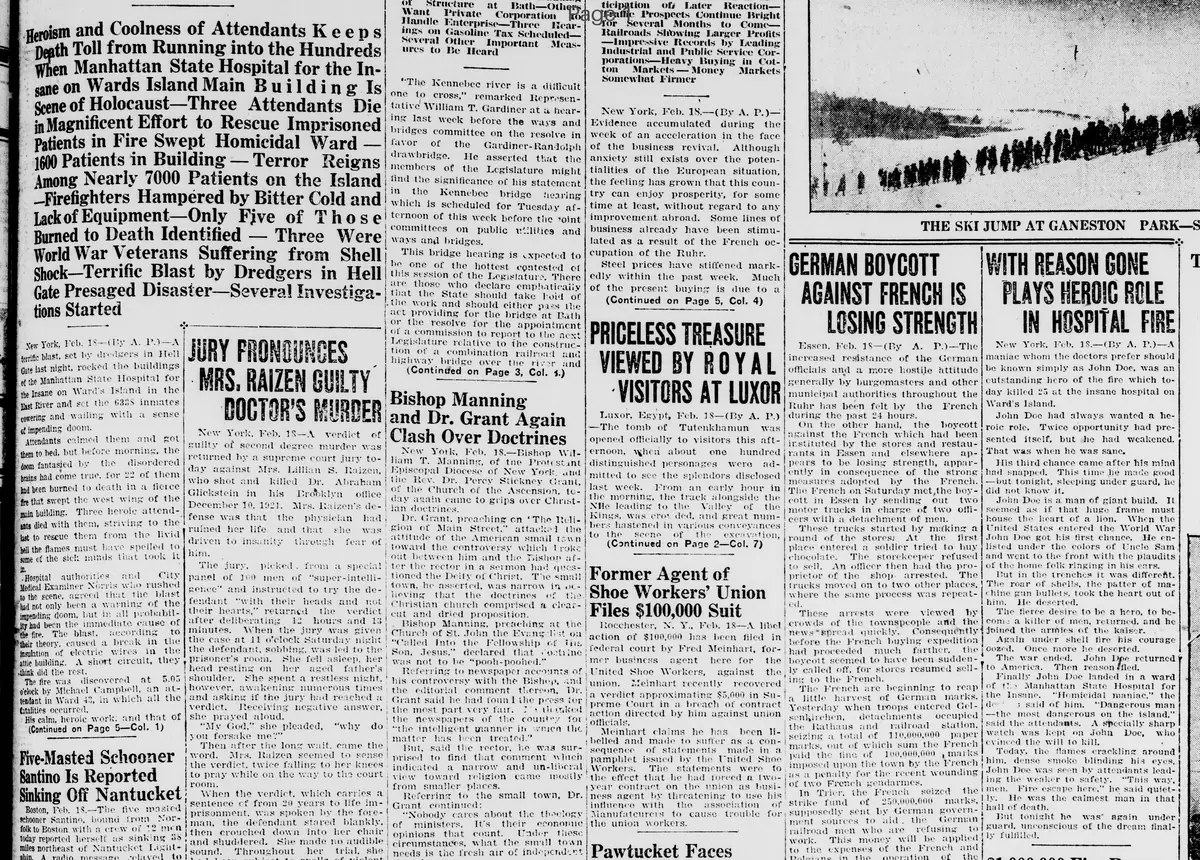
When Manhattan State Hospital for the Insane on Ward's Island Main Building Is Scene of Holocaust—Three Attendants Die in Magnificent Effort to Rescue Imprisoned Patients in Fire Swept Homicidal Ward—1600 Patients in Building—Terror Reigns Among Nearly 7000 Patients on the Island—Firefighters Hampered by Bitter Cold and Lack of Equipment—Only Five of Those Burned to Death Identified—Three Were World War Veterans Suffering from Shell Shock—Terrific Blast by Dredgers in Hell Gate Presaged Disaster—Several Investigations Started
New York, Feb. 18—(By A. P.)—A terrific blast, set by dredgers in Hell Gate last night, rocked the buildings of the Manhattan State Hospital for the Insane on Ward's Island in the East River and set the 6358 inmates cowering and wailing with a sense of impending doom.
Attendants calmed them and got them to bed, but before morning the doom fantasied by the disordered brains had come true, for 22 of them had been burned to death in a fierce fire that swept the west wing of the main building. Three heroic attendants died with them, striving to the last to rescue them from the livid hell the flames must have spelled to some of the sick minds that took it in.
Hospital authorities and City Medical Examiner Norris who rushed to the scene, agreed that the blast had not only been a warning of the impending doom, but in all probability had been the immediate cause of the fire. The blast, according to their theory, caused a break in the insulation of electric wires in the attic building. A short circuit, they think did the rest.
The fire was discovered at 5:05 o'clock by Michael Campbell, an attendant in Ward 43, in which all the fatalities occurred.
His calm, heroic work, and that of (Continued on Page 5-Col. 1)
PARK WITH REASON GONE PLAYS HEROIC ROLE IN HOSPITAL FIRE
New York, Feb. 18—(By A. P.)—A maniac whom the doctors prefer should be known simply as John Doe, was an outstanding hero of the fire which today killed 25 at the insane hospital on Ward's Island.
John Doe had always wanted a heroic role. Twice opportunity had presented itself, but he had weakened. That was when he was sane.
His third chance came after his mind had snapped. This time he made good—but tonight, sleeping under guard, he did not know it.
John Doe is a man of giant build. It seemed as if that huge frame must house the heart of a lion. When the United States entered the World War John Doe got his first chance. He enlisted under the colors of Uncle Sam and went to the front with the plaudits of the home folk ringing in his ears.
But in the trenches it was different. The roar of shells, the patter of machine gun bullets, took the heart out of him. He deserted.
The fierce desire to be a hero, to become a killer of men, returned, and he joined the armies of the Kaiser.
Again under shell fire his courage oozed. Once more he deserted.
The war ended. John Doe returned to America. Then reason fled.
Finally John Doe landed in a ward of the Manhattan State Hospital for the Insane. "Homicidal maniac," the doctors said of him. "Dangerous man—the most dangerous on the island," said the attendants. A specially sharp watch was kept on John Doe, who evinced the will to kill.
Today, the flames crackling around him, dense smoke blinding his eyes, John Doe was seen by attendants leading the weaker to safety. "This way, men. Fire escape here," he said quietly. He was the calmest man in that hall of death.
But tonight he was again under guard, unconscious of the dream finally fulfilled.
Twenty-five Perish
(Continued from Page One)
Trick Billigan, of Hartford, Conn. is Hill attendant in charge, and A. De Emo and George F. were the three attendants who were burned to death,
prevented a far ters directed by Hill, ran up and Campbell manned a hose line and wht back the flames, while the ater holocaust.
an the 200 feet top floor corridor asing the patients with the cool Wer:
All up for breakfast. fist as the maniacs-declared n to have been the most dangerous Marcus Hey- the island-could be marshalled wing hall, far from the scene of the Ierderly procession to the fire proof rooms had been led or carried to safety then huge water tank in the blaz- Serenty of the 92 inmates of Ward attic crashed through the ceil- for that led to safety and filling the completely blocking the corri- temen fighting their way past the with flames and smoke. City wing barrier, brought out several raggling screaming maniacs, and woke while dressing for the "break- weral who had been overcome by and in the rooms and corridor be- t" call Most of the dead were dhered to have been carried down rnd the fallen tank. Several were ad burned to death in the debris then the floor gave way. Et had been recovered tonight. In ebellered to be that of an attend- serenteen bodies of inmates and Mition, a few charred bones had kill that was left o fsome of those which were believed meccounted for. Among the five bodies which had e world war veterans who had kn identified tonight were those of agand James R. Hincs. all of New ere Vincent Del Bene, Frank From- an suffering from shell shock. They Solomon Applebaum, _ and Nathan others identified were mhen, also of New York. Attempt ight. Most of the remuining bidentify the others was abindoned e were badly charred and it was dered many of them never would positively identified. arred-the so-called "maine build- The building in which the fire oc- is an ancient brick and wood Tacture, shaped like the le tter E. ammodations for a maximum of 2.- is three stories, high, and had ac- patients. There were about 1,600 Sin this morning, when the fire was xotered, and of these, about 300 mes. They were the patients in mre seriously endangered by the Hugh West wing. aman as "violent, homcidally- M its toll, were described by Dr. o the third floor, where the fire The 92 patients imprisoned in Ward selined men," any one of whom ght suddenly have turncd, with ding fury in his eyes, upon his ecuers. But so coolly did the attendants mik that only in a half dozen cases the most were there instances of inggles against, or attacks on, the rendants and firemen. The rescuers did manifiicent k" said Dr. Norris. after he had n conducted through the burning ig and been told of how the in- tes were handled. "It was little batof a miracle that the death toll m kept from lunning into the hun- reds. While the rescue work was being mred forwerd. the flames burnt srough the loof of the building and Eed up the cntire island. Screams Ithe territied patients nearest the ames roused the entire ponulation the madman's isle, and in a inkling every window framed a emac's face. The battle against the fiames was ampered by the near-zero weather which the fremen worked. and the treme difficuity in getting appar- ts to the scene. Ward's Island, that pathetic litule t of land in the East River. just gosite East licth strcet. and just dow its famous sister. Blackwell's dand. has a tiny fire department of sown. But the ferry boats which to and from it are too small to ar heavy equipment from the ef- kent Manhattan force. The city force. forsaking its en- es, fire towers. hook and ladder mcks and hose vagons. went to the y with no equipment but a few s of hose which could be trans- rted on the tiny ferry. Fire boats dich responded to the alarm, had ly hose lines nearly a half mile g before they could pump water the fire. But despite their handicaps, the force and the island force suc- aded in confining the fire to the oper flocs of the west wing. when apital officials werc fearing the cole main buiiding would go up in mes. Dr. Heyman declared he had re- atedly sought from the state au- brities additional fire protection for hospital. and that he had called rain asain and again on the city thorities to station ripment there. additional The island's fire department con- sted of ten men and a chief. he said, the equipment. aside from hose s in the various buildings. was aited to one ancient horse-drawn gine and a hose cart, loaned by city. Michael Campbell, the attendant who povered the blaze, told Superinten- at Heyman the first warning ent 5 celock when an clectric light ddenly went out an an investigation. and while he searching for the cause of the able another brace of lights flickered Glancing upward he discovered in one spot the metal ceiling was hot. The trapped men might have been red but for the dense smoke. Dr. yman said. the extreme end of the corridor. the victims-attendants There is a fire escape and pa- ats alike-apparently were trope their way to it through the T:. unable Leutenant MeDonough of the city fire force and Hoseman Burns plunged down the smoke-filled corridor and brought out two or three inmates. But soon they were compelled to withdraw from the road furnace which the corri- dor had become and abandon the trap- ped to their fate. Meantime firemen outside in the freezing weather were pouring ton after ton of water on the blaze, while others taking their stations in the cor- ridors of the west wing, fought the blaze. yiclding foot by foot as it raced toward them. A dozen of those outside suffered frozen ears, fingers andtocs, while all were covered with icicles. The top floor of the threc-story wing had bcen laid waste and the second floor badly damaged before the fire- men, aided by fire walls with which the building is divlded, were able to check the advancing flames. The fire wot not completely extinguished until noon. when it had raged for more than seven hours. The debris is so thoroughly frozen to- gether by the mass of water poured on the blaze that it will be a slow and difficult task removing it in a search for bodies. Meanwhile several official investiga- tions are being pressed. The first-one by the board of man- agers--was bcgun this morning. whilc the fire still burned Others are expectcd by various state agencies. The Ward Island hospital. with its c33s inmatcs. is said to be the largest institution for the insane in the world. The main building. a huge. rambling structuie of Gothic architecture. was occupidd in 1s72, and hence is 50 years old. Its woodwork fed the flames like tinder. and the marvel, according to Dr. Heyman, was that the damage was not much greater. The superintendent. who workcd like a Trojan once the fire had been discovered, was layish in his praise of the personncl. both of the hos- pital and the city fire fighters. But he was caustic in his comments on his ability to obtain adcquate fire protection from state or city for the nearly 7ooo imprisoned souls in his charge. The heroism of anotbcr attendant came to light tonight. when Attend- ant MeIntosh, told his story to Dr. Heyman. Mclntosh, one of the day force, was sleeping in his quarters at tihe end of the corridor. Overlooked by the attendants who weie hustling rt- tients out. he did not awake until just before part of the leiling teli on a large table in his rocm. Crawling under the table, he rushcd to the fire escape at the end of the hall. There he found nearly a score of paticnts bewildered, nesi- tating. He marshallcd thein into line, marchcd them down the fi e cs- cape and led thcm to an adgoining building. Two of them must have eluded him. however. for when Dr. Heymanl arrived. he found the two wanderins about the frozcn grounds in thei night shirts. He hustled then inside and turned them over to an attend- ant. rushing on then :o aid in the reseuc work. Attendants Campbeil and Hill. fiest to discover the fire. gave tieir stories to The Associatcd Press 'onight af- ter they had been refreshed by a lit- the slecp: The matter of fact caim- ness with which they nad gore about the work of rescue was "eflected in their dispassionate tones in telling what they had done. "I was sitting in the corridor." Campbell said. "uhen I oti,ed one of the electric lights fickered and then went out. "I looked up and thought. what's that?" By that time another ligut went out and. looking up in the d :ik: ened corridor. I could sce littlo wisps of flame eating through he celias. I called out to Hill. who was near mne, and he said. Jump for the ose' I jumped for it and started to wo'ik. while he ran to wake the patients. The fire wcnt like lightning. "Do you think it could have hren set by a patient?" Dr. Heyman ask:ed pim. "No sir. not a chance. It started in the ceiling. Crossed cloctiie wires must have done it." Campbell was a member of (he New York fire dcpartment F ten vears before he became an attendant at the hospital. He said it was cne of the worst fires he had ever seen. (hief Attendant Hll was eaualiy matter-of-fact in the recital of his resoue work. "After I had gotten Campbell work- ing on the hiosc. I began to run froin rooun to room waking the patients, shaking them and telling them to get out." he said. "John Curry. an at- tendant from another ward, ran to my aid and helped me wake tem. I didn't sce anvthing of the thuce attendants who lost their ti,es. I think they must have been traoped in their rooms. They were all off duty and sleeping. The fire went so guick thcy had no more ciance than the patients. "We had gotten the most of the paticnts out when the tank fell through the ceiling. We couldn't do much more for the poor -vils after that. for the corridor was blocked." ('urry was the only one of the attendants who reported ditticulty in handling patients. He worked among those .'heat down the corridor. getting oat with a group of them just belore the ceil. ing fell. "There were about s dozon that fought with me and ran back into their room when I led them ous.' be said. "They didn't make mang out- crics. Thcy were too te-ror-stricken, I guess." Dr. Heyman said he had dimedlty in handling one patient hone he was trying to get out of the danger zonc. "This fellow was a lmge cnap. and particularly dangerous." he said. "When I caught him oy the arm and told him to come on. he turncd on me and said: " 'Let go, you---you've got me full of electricity now.' "A burly guard took charge o, him while I went further down he cor- ridor rounding up other pat onts."
What sub-type of article is it?
What themes does it cover?
What keywords are associated?
What entities or persons were involved?
Where did it happen?
Story Details
Key Persons
Location
Manhattan State Hospital For The Insane On Ward's Island, East River, New York
Event Date
Feb. 18
Story Details
A fire, possibly caused by a dredger blast short-circuiting wires, sweeps the homicidal ward of the hospital, killing 22 patients and 3 attendants who heroically rescue inmates. A homicidal maniac known as John Doe calmly leads patients to safety, fulfilling his heroic aspirations. Attendants like Michael Campbell and Hill manage evacuations despite chaos and obstacles like a falling water tank.