Thank you for visiting SNEWPapers!
Sign up free
Gazette Of The United States
New York, New York County, New York
What is this article about?
Reports from West-India Islands describe a massive slave revolt at Cape-Francois, with 70,000 Negro insurgents killing all whites and burning plantations for 60 miles. An address from Nantes to French National Assembly on May 20, 1791, warns against a decree of May 15 that could spark civil war and ruin the colonies.
Merged-components note: Continuation of West Indies/Haiti insurrection news, same topic and sequential reading order.
Clipping
OCR Quality
Full Text
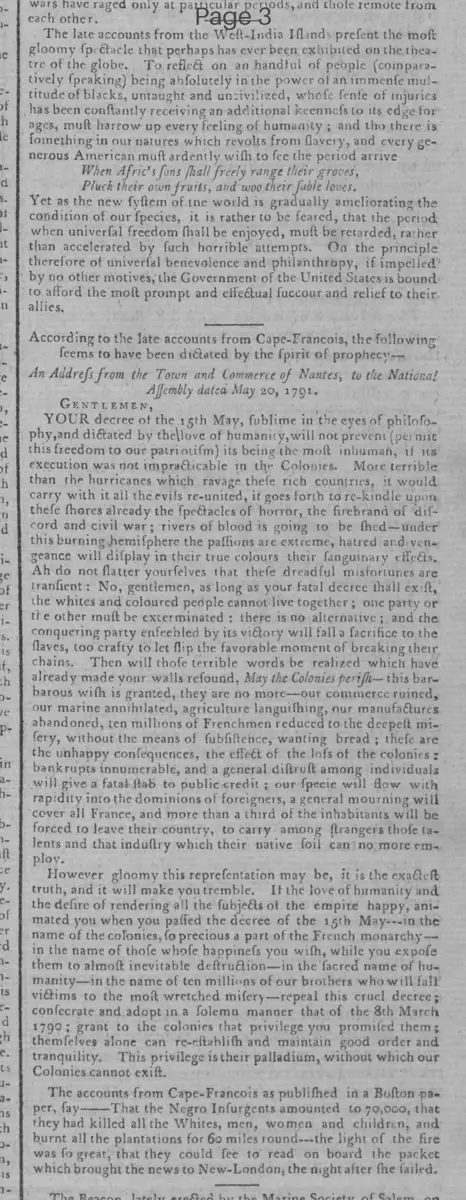
When Afric's sons shall freely range their groves,
Pluck their own fruits, and woo their sable loves.
Yet as the new system of the world is gradually ameliorating the condition of our species, it is rather to be feared, that the period when universal freedom shall be enjoyed, must be retarded, rather than accelerated by such horrible attempts. On the principle therefore of universal benevolence and philanthropy, if impelled by no other motives, the Government of the United States is bound to afford the most prompt and effectual succour and relief to their allies.
According to the late accounts from Cape-Francois, the following seems to have been dictated by the spirit of prophecy'—
An Address from the Town and Commerce of Nantes, to the National Assembly dated May 20, 1791.
Gentlemen,
YOUR decree of the 15th May, sublime in the eyes of philosophy, and dictated by the love of humanity, will not prevent (permit this freedom to our patriotism) its being the most inhuman, if its execution was not impracticable in the Colonies. More terrible than the hurricanes which ravage these rich countries, 't would carry with it all the evils re-united, it goes forth to re-kindle upon these shores already the spectacles of horror, the firebrand of discord and civil war; rivers of blood is going to be shed—under this burning hemisphere the passions are extreme, hatred and vengeance will display in their true colours their sanguinary effects. Ah do not flatter yourselves that these dreadful misfortunes are transient: No, gentlemen, as long as your fatal decree shall exist, the whites and coloured people cannot live together; one party or the other must be exterminated: there is no alternative; and the conquering party enfeebled by its victory will fall a sacrifice to the slaves, too crafty to let slip the favorable moment of breaking their chains. Then will those terrible words be realized which have already made your walls resound, May the Colonies perish— this barbarous wish is granted, they are no more—our commerce ruined, our marine annihilated, agriculture languishing, our manufactures abandoned, ten millions of Frenchmen reduced to the deepest misery, without the means of subsistence, wanting bread; these are the unhappy consequences, the effect of the loss of the colonies: bankrupts innumerable, and a general distrust among individuals will give a fatal stab to public credit; our specie will flow with rapidity into the dominions of foreigners, a general mourning will cover all France, and more than a third of the inhabitants will be forced to leave their country, to carry among strangers those talents and that industry which their native soil can no more employ.
However gloomy this representation may be, it is the exactest truth, and it will make you tremble. If the love of humanity and the desire of rendering all the subjects of the empire happy, animated you when you passed the decree of the 15th May---in the name of the colonies, so precious a part of the French monarchy—in the name of those whose happiness you wish, while you expose them to almost inevitable destruction—in the sacred name of humanity—in the name of ten millions of our brothers who will fall victims to the most wretched misery—repeal this cruel decree; consecrate and adopt in a solemn manner that of the 8th March 1790: grant to the colonies that privilege you promised them; themselves alone can re-establish and maintain good order and tranquility. This privilege is their palladium, without which our Colonies cannot exist.
The accounts from Cape-Francois as published in a Boston paper, say—That the Negro Insurgents amounted to 70,000, that they had killed all the Whites, men, women and children, and burnt all the plantations for 60 miles round---the light of the fire was so great, that they could see to read on board the packet which brought the news to New-London, the night after she sailed.
What sub-type of article is it?
What keywords are associated?
Where did it happen?
Foreign News Details
Primary Location
Cape Francois
Event Date
May 1791
Outcome
negro insurgents amounted to 70,000, killed all the whites, men, women and children, burnt all the plantations for 60 miles round
Event Details
Late accounts from West-India Islands describe a slave revolt where blacks overpower whites; an address from Nantes dated May 20, 1791, warns National Assembly's decree of May 15 will cause civil war, extermination, and ruin French commerce; specific reports state insurgents killed all whites and burned plantations, visible from sea.