Thank you for visiting SNEWPapers!
Sign up free
Lynchburg Virginian
Lynchburg, Virginia
What is this article about?
A letter to the editors of the Virginian responding to 'A Republican,' defending resolutions from a Lynchburg meeting that assert state sovereignty is indivisible and not granted to the federal government, which acts as an agent for limited powers. It draws on historical, philosophical, and legal arguments to affirm sovereignty resides in the people.
Clipping
OCR Quality
Full Text
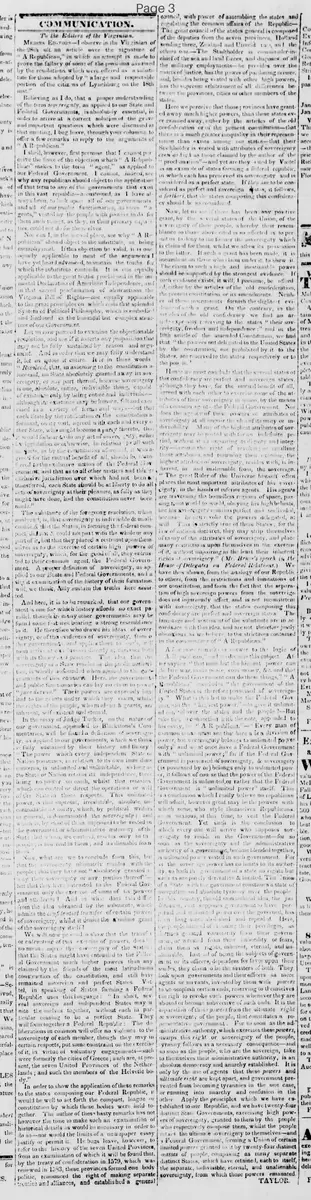
To the Editors of the Virginian.
Messrs. Editors—I observe in the Virginian of the 25th ult. an article over the signature of 'A Republican,' in which an attempt is made to prove the fallacy of some of the positions assumed by the resolutions which were offered as a substitute for those adopted by 'a large and respectable portion of the citizens of Lynchburg on the 18th Inst.'
Believing as I do, that a proper understanding of the term sovereignty, as applied to our State and Federal Governments, is absolutely essential, in order to arrive at a correct solution of the grave and important questions which were discussed at that meeting, I beg leave, through your columns, to offer a few remarks in reply to the arguments of 'A Republican.'
I shall, however, first premise that I cannot perceive the force of the objection which 'A Republican' makes to the term 'agent,' as applied to our Federal Government. I cannot, indeed, see why any republican should object to the application of that term to any of the governments that exist in this vast republic—accustomed, as I have always been, to look upon all of our governments and all of our public functionaries, as mere 'agents,' vested by the people with powers to do for them such things, as they, in their primary capacity, could not do for themselves.
Nor can I, in the second place, see why 'A Republican' should object to the substitute, as being metaphysical. If this objection be valid, it is one equally applicable to most of the arguments I have yet heard advanced, to sustain the truths for which the substitute contends. It is one equally applicable to the great truths proclaimed in the immortal Declaration of American Independence, and in that sacred proclamation of abstractions the Virginia Bill of Rights—one equally applicable to the great principles on which rests that splendid System of Political Philosophy, which is embodied and disclosed in the beautiful but complex structure of our Government.
Let us now proceed to examine the objectionable resolution, and see if it asserts any proposition that may not be fully sustained by reason and argument. And in order that we may fully understand it, let us quote it entire. It is in these words:
'Resolved, that in assenting to the constitution aforesaid, no State absolutely granted away its sovereignty, or any part thereof, because sovereignty is one, absolute, entire, indivisible thing, capable of existence only by being entire and indivisible—although its existence may be known, felt and exercised in a variety of forms and ways—but that each state by the ratification of the constitution aforesaid, on its part, agreed with each and every other State, who might become a party thereto, that it would forbear to do any act of sovereignty, either in legislation or otherwise, in relation to all such subjects, as by the constitution aforesaid it was agreed for the mutual benefit of all, should be transferred to the exclusive action of the Federal government, and that as to all other matters and things exclusive jurisdiction over which had not been transferred, each State should be at liberty to do all acts of sovereignty at their pleasure, as fully as they might have done, had the constitution never been made.'
The substance of the foregoing resolution, when analyzed, is, that sovereignty is indivisible & unalienable, & that the States, in forming the federal compact, did not & could not part with the whole or any part of it, but that they placed a restraint upon themselves as to the exercise of certain high powers of sovereignty, which, for the good of all, they entrusted to their common agent, the Federal Government. A proper definition of sovereignty, as applied to our State and Federal Governments, and a slight examination of the history of their formation, will, we think, fully sustain the truths here asserted.
And here, it is to be remarked, that our government is one for which history affords no exact parallel, though in many other governments may be found some features bearing a strong resemblance to it. He therefore who draws his ideas of sovereignty, or of the evidences of sovereignty, from other governments and applies them to ours, will arrive at conclusions as widely at variance with our theory as with our practice. The idea that the sovereignty of a State resides in the political authorities, is wholly unfounded when applied to the governments of this country. Here, the governments and public functionaries can lay no claim to power 'jure divino.' Their powers are expressly limited to the grants under which they claim, whilst the rights of the people, in whom such grants originate, are inherent, self-existent and eternal.
In the essay of Judge Tucker, on the nature of our government, appended to Blackstone's Commentaries, will be found a definition of sovereignty, as applied to our governments, which we think fully sustained by our history and theory. 'The power which every independent State or Nation possesses, in relation to its own immediate concerns, is unlimited and unlimitable, so long as the State or Nation retains its independence, there being no power on earth, whilst that remains, which can control or direct the operations or will of the state in those respects.' 'This unlimited power, is that supreme, irresistible, absolute, uncontrolled authority, which, by political writers in general, is denominated the sovereignty; and which is, by most of them supposed to be vested in the government or administrative authority of the State but where, we contend, resides only in the people themselves, and unalienable from...'
Now, what are we to conclude from this, but that the sovereignty ultimately resides with the people; that they have not 'absolutely granted away their sovereignty or any portion thereof;' but that they have entrusted to the Federal Government only the exercise of some of its powers and attributes? And how does this differ from the idea advanced by the substitute, which admits the conditional transfer of certain powers of sovereignty, whilst it denies the absolute grant of the sovereignty itself?
We will now proceed to show that the transfer or entrusting of the exercise of powers, does no more impair the sovereignty of the States than the States might have entrusted to the Federal Government much higher powers than any claimed by the friends of the most latitudinous construction of the constitution, and still have remained sovereign and perfect States. Vattel, in speaking of States forming a Federal Republic uses this language: 'In short, several sovereign and independent States may unite themselves together, without each in particular ceasing to be a perfect State. They will form together a Federal Republic: The deliberations in common will offer no violence to the sovereignty of each member, though they may in certain respects, put some constraint on the exercise of it, in virtue of voluntary engagements—such were formerly the cities of Greece; such are, at present, the seven United Provinces of the Netherlands; and such the members of the Helvetic body.'
In order to show the application of these remarks to the states composing our Federal Republic, it would be well to set forth the compact, league or constitution by which these bodies were held together. The author of these hasty remarks has not, however, the time to make such an examination of historical details as would be necessary in order to do so—nor would the limits of a newspaper essay justify or permit it. He begs leave, however, to refer to the history of the seven United Provinces, from an examination of which it will be found that, by the treaty of confederation in 1579, which was renewed in 1593, these provinces formed one body politic, renounced the right of making separate treaties and alliances, and established a general council, with power of assembling the states and regulating the common affairs of the Republic—
The great council of the states general is composed of the deputies from the seven provinces. Holland sending three, Zealand and Utrecht two, and the others one—The Stadtholder is commander-in-chief of the sea and land forces, and disposes of all the military employments—he presides over the courts of justice, has the power of pardoning crimes, and, besides being vested with other high powers, has the supreme arbitrament of all differences between the provinces, cities or other members of the states.
Here we perceive that those provinces have granted away much higher powers, than these states ever granted away, either by the articles of the old confederation or of the present constitution—that there is a much greater inequality in their representation than exists among our states—that their Stadtholder is vested with attributes of sovereignty even as high as those claimed by the author of the 'proclamation'—and yet are they cited by Vattel as an example of states forming a federal republic, in which each has preserved its sovereignty and is considered as a perfect state. If they are to be considered as perfect and sovereign states, it follows, a fortiori, that the states composing this confederacy should be so considered.
Now, let us see if there has been any positive grant, by the several states of the Union, of the sovereignty of their people, whereby their resemblance to those above cited is so affected as to permit us to deny to the former the sovereignty which is claimed for them whilst we allow its possession to the latter. If such a grant has been made, it is incumbent on those who claim under it, to show it. The claim to such a high and inestimable power should be supported by the strongest evidence. If such evidence exists, it will, I presume, be afforded, either by the articles of the old confederation, the present constitution or its amendments. Neither of those instruments furnish the slightest evidence of such a grant. On the contrary, in the articles of the old confederacy we find an article expressly reserving to the states 'their sovereignty, freedom and independence:' and in the 10th article of the amended Constitution, we find that 'the powers not delegated to the United States by the constitution, nor prohibited by it to the States, are reserved to the states respectively or to the people.'
Hence we must conclude that the several states of this confederacy are perfect and sovereign states, although they may, for the mutual benefit of all, have agreed with each other to exercise some of the attributes of their sovereignty in union, by the means of a common agent—the Federal Government. Nor does the array of these powers or attributes of sovereignty at all impair the idea of its unity or indivisibility. Many of the highest attributes of sovereignty may be intrusted with others for an indefinite period, without at all impairing its integrity—because, the right of revoking or recalling these attributes, and resuming their exercise, the highest attribute of sovereignty, resides with, is inherent in and inalienable from, the sovereign.
'The great Ruler of the Universe himself often places the most important attributes of his sovereignty, in the hands of inferior agents. His agents are traversing the boundless regions of space, passing from world to world, obeying his high behests—but his sovereignty remains perfect and undivided because he can revoke the powers delegated, at will. This is strictly true of these States, for the law of nations declares, they may strip themselves of many of the attributes of sovereignty, and place many restrictions upon themselves in the exercise of it, without impairing in the least their inherent rights of sovereignty.' (Mr. Bruce's speech in the House of Delegates on Federal Relations.) We have thus shown, from the analogy of our Republic to others, from the restrictions and limitations of our constitution, and from the fact that the separation of high sovereign powers from the sovereign does not injuriously affect, and is not inconsistent with sovereignty, that the states composing this confederacy are perfect and sovereign states. The language and sentiment of the substitute are in accordance with this idea, and are not therefore justly obnoxious, as we conceive, to the strictures contained in the commentary of 'A Republican.'
A word in reply to the logic of 'A Republican' on this subject. After saying 'that none but the highest power can declare war, make peace, coin money, &c, and that the Federal Government can do these things.' 'A Republican' concludes 'the government of the United States is therefore possessed of sovereignty.' What is this but to make the Federal Government nothing less than sovereign power.'—to give it unlimited control over the states and the people?—But take this remark in connection with the note appended to his essay, 'A Republican.'—'Every man of common sense must see that here is a division of power, but sovereignty belongs to unlimited power only;' and we at once have a Federal Government with 'unlimited power;' for if the Federal Government is possessed of sovereignty, & sovereignty (is possessed by or) belongs only to unlimited power, it follows of course that the power of the Federal Government is unlimited, or rather that the Federal Government is 'unlimited power' itself. This is a conclusion which I really believe no republican will admit, however great may be the powers with which some, who style themselves Republicans are anxious, at this time, to vest the Federal Government. Yet such is the conclusion to which every one will arrive who supposes sovereignty to reside in the Government—for so soon as the sovereignty and the administrative authority of a government, become blended together is unlimited power vested in such government. For if the sovereign power has no limits to its authority, so hath the government of a state no rights but such as are purely derivative & limited. The union of a state with the government constitutes a state of usurpation and absolute tyranny over the people. In his country, the old monarchical idea, the jus divinum, supposed to have been derived from heaven to give actual and unlimited power over the governed, has long since been abolished and repealed. Here, the people, instead of obtaining their privileges, as princes' grants voluntarily for their government, or wrested from their necessity or fears, claim them as rights, inherent, eternal, and unalienable. Instead of being the subjects of government or its officers, dependent for favor upon their smiles, they claim to be the masters of both. They look upon governments and their officers as mere agents or servants, invested by them with powers to accomplish certain ends, reserving to themselves the right to revoke such powers whenever they are abused or become subversive of such ends. It is the separation of these powers from the ultimate right or sovereignty of the people, that constitutes a representative government: For so soon as the administrative authority, which exercises these powers, usurps this right or sovereignty of the people, tyranny follows as a necessary consequence—and so soon as the people, who are the sovereign, take to themselves their administrative authority, is an absolute democracy and anarchy established. It is only by the use of agents that these powers and ultimate right are kept apart, and government prevented from becoming tyrannies in the one case, or running into anarchy and confusion in the other. Apply the principles which we have established to our Republic, and we have twenty-four distinct State Governments, exercising high powers of sovereignty, granted to them by the people who respectively compose them, whilst the people retain the ultimate sovereignty to themselves—and a Federal Government, forming a Union of certain limited powers granted to it by twenty-four distinct masses of people, composing as many separate distinct States, which have retained, each to itself, the separate, indivisible, eternal, and unalienable sovereignty, from which those powers emanated.
TAYLOR.
What sub-type of article is it?
What themes does it cover?
What keywords are associated?
What entities or persons were involved?
Letter to Editor Details
Author
Taylor
Recipient
To The Editors Of The Virginian
Main Argument
the states did not absolutely grant away their sovereignty upon ratifying the constitution, as sovereignty is indivisible and resides inherently in the people; instead, they agreed to forbear exercising certain sovereign powers, entrusting them to the federal government as a common agent for mutual benefit, while retaining full sovereignty in all other matters.
Notable Details