Thank you for visiting SNEWPapers!
Sign up free
Story
July 1, 1888
Wichita Eagle
Wichita, Sedgwick County, Kansas
What is this article about?
Overview of provisional American flags during the early Revolutionary War (1775-1777), including pine tree, rattlesnake, and crescent designs with mottos, used before the official Stars and Stripes adoption.
Clipping
OCR Quality
95%
Excellent
Full Text
THE NATIONAL EMBLEM
MORE THAN TWO YEARS OF WARFARE WITHOUT A FLAG.
Banners Carried by the American Armies Prior to 1777-Various Military and Naval Devices-The Pine Tree, the Rattlesnake, the Crescent.
The struggle which resulted in the independence of the American colonies commenced at Lexington in April, 1775, and independence was not assumed for more than a year afterward.
In the meanwhile the colonies were fighting a sort of civil war. The British were usually called the "Regulars," and the Colonists were simply in rebellion against what they deemed oppression. There was no nation of colonies, consequently there was no national emblems. The Stars and Stripes which the Americans fought under afterward was unknown. A national ensign was not adopted till June, 1777. A glance at the promiscuous banners under which the different American forces campaigned during the first two years of the Revolution will be found of interest at this anniversary of the birth of the nation.
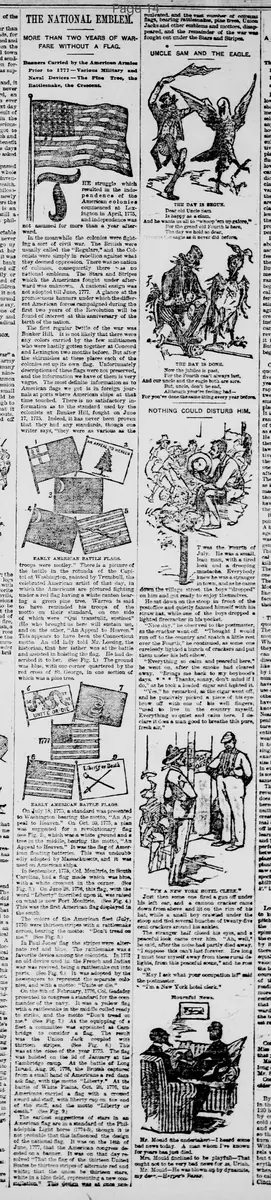
The first regular battle of the war was Bunker Hill. It is not likely that there were any colors carried by the few militiamen who were hastily gotten together at Concord and Lexington two months before. But after the skirmishes at these places each of the colonies set up its own flag. Unfortunately descriptions of these flags were not preserved, and the information we have of them is very vague. The most definite information as to American flags we get is in foreign journals at ports where American ships at that time touched. There is no satisfactory information as to the standard used by the colonists at Bunker Hill, fought on June 17, 1775. Indeed, it has never been proven that they had any standards, though one writer says, "they were as various as the troops were motley." There is a picture of the battle in the rotunda of the Capitol at Washington, painted by Trumbull, the celebrated American artist of that day, in which the Americans are pictured fighting under a red flag having a white canton bearing a green pine tree. Warren is said to have reminded his troops of the motto on their standard, on one side of which were "Qui transtulit, sustinet" (He who brought us here will sustain us), and on the other, "An Appeal to Heaven."
This appears to have been the Connecticut motto. An old lady told Mr. Lossing, the historian, that her father was at the battle and assisted in hoisting the flag. He had described it to her. (See Fig. 1.) The ground was blue, with one corner quartered by the red cross of St. George, in one section of which was a pine tree.
On July 18, 1775, a standard was presented to Washington bearing the motto, "An Appeal to Heaven." On Oct. 20, 1775, a plan was suggested for a revolutionary flag (see Fig. 2), which was a white ground and tree in the middle, bearing the motto, "An Appeal to Heaven." It was the flag of American floating batteries. This was undoubtedly adopted by Massachusetts, and it was used on American ships.
In September, 1775, Col. Moultrie, in South Carolina, had a flag made which was blue with a white crescent in the corner. (See Fig. 3.) On June 28, 1776, this flag, with the word "Liberty" inscribed upon it, was raised on what is now Fort Moultrie. (See Fig. 4.) This was the first American flag displayed in the south.
The colors of the American fleet (July, 1776) were thirteen stripes with a rattlesnake across, bearing the motto: "Don't tread on me." (See Fig. 5.)
In Paul Jones' flag the stripes were alternate red and blue. The rattlesnake was a favorite device among the colonists. In 1775 an old device used in the French and Indian war was revived, being a rattlesnake cut into parts. (See Fig. 6.) It was adopted by the newspapers to represent the separate colonies, and with a motto: "Unite or die."
On the 8th of February, 1776, Col. Gadsden presented to congress a standard for the commander of the navy. It was a yellow flag with a rattlesnake in the middle coiled ready to strike, and the motto "Don't tread on me." (See Fig. 7.) At the equipping of a fleet a committee was appointed at Cambridge to consider a flag.
The result was the Union Jack coupled with thirteen stripes. (See Fig. 8.) This was at the close of the year 1775. The flag was hoisted on the 2d of January at the Cambridge camp. At the battle of Long Island, Aug. 26, 1776, the British captured from a small band of Americans a red damask flag, with the motto "Liberty." At the battle of White Plains, Oct. 28, 1776, the Americans carried a flag with a crossed sword and staff, with liberty cap on the end of the staff, and the motto "Liberty or death." (See Fig. 9.)
The earliest suggestions of stars in an American flag are in a standard of the Philadelphia Light Horse (1774-5), though it is not probable that this influenced the design of the national flag. It was on the 14th of June, 1777, that the American congress decided on a banner. It was on that day resolved "That the flag of the thirteen United States be thirteen stripes of alternate red and white; that the union be thirteen stars, white in a blue field, representing a new constellation." This design was at once mutilated, and the vast number of colonial flags, bearing rattlesnakes, pine trees, Union Jacks and other emblems and mottoes, disappeared, and the remainder of the war was fought out under the Stars and Stripes.
MORE THAN TWO YEARS OF WARFARE WITHOUT A FLAG.
Banners Carried by the American Armies Prior to 1777-Various Military and Naval Devices-The Pine Tree, the Rattlesnake, the Crescent.
The struggle which resulted in the independence of the American colonies commenced at Lexington in April, 1775, and independence was not assumed for more than a year afterward.
In the meanwhile the colonies were fighting a sort of civil war. The British were usually called the "Regulars," and the Colonists were simply in rebellion against what they deemed oppression. There was no nation of colonies, consequently there was no national emblems. The Stars and Stripes which the Americans fought under afterward was unknown. A national ensign was not adopted till June, 1777. A glance at the promiscuous banners under which the different American forces campaigned during the first two years of the Revolution will be found of interest at this anniversary of the birth of the nation.
The first regular battle of the war was Bunker Hill. It is not likely that there were any colors carried by the few militiamen who were hastily gotten together at Concord and Lexington two months before. But after the skirmishes at these places each of the colonies set up its own flag. Unfortunately descriptions of these flags were not preserved, and the information we have of them is very vague. The most definite information as to American flags we get is in foreign journals at ports where American ships at that time touched. There is no satisfactory information as to the standard used by the colonists at Bunker Hill, fought on June 17, 1775. Indeed, it has never been proven that they had any standards, though one writer says, "they were as various as the troops were motley." There is a picture of the battle in the rotunda of the Capitol at Washington, painted by Trumbull, the celebrated American artist of that day, in which the Americans are pictured fighting under a red flag having a white canton bearing a green pine tree. Warren is said to have reminded his troops of the motto on their standard, on one side of which were "Qui transtulit, sustinet" (He who brought us here will sustain us), and on the other, "An Appeal to Heaven."
This appears to have been the Connecticut motto. An old lady told Mr. Lossing, the historian, that her father was at the battle and assisted in hoisting the flag. He had described it to her. (See Fig. 1.) The ground was blue, with one corner quartered by the red cross of St. George, in one section of which was a pine tree.
On July 18, 1775, a standard was presented to Washington bearing the motto, "An Appeal to Heaven." On Oct. 20, 1775, a plan was suggested for a revolutionary flag (see Fig. 2), which was a white ground and tree in the middle, bearing the motto, "An Appeal to Heaven." It was the flag of American floating batteries. This was undoubtedly adopted by Massachusetts, and it was used on American ships.
In September, 1775, Col. Moultrie, in South Carolina, had a flag made which was blue with a white crescent in the corner. (See Fig. 3.) On June 28, 1776, this flag, with the word "Liberty" inscribed upon it, was raised on what is now Fort Moultrie. (See Fig. 4.) This was the first American flag displayed in the south.
The colors of the American fleet (July, 1776) were thirteen stripes with a rattlesnake across, bearing the motto: "Don't tread on me." (See Fig. 5.)
In Paul Jones' flag the stripes were alternate red and blue. The rattlesnake was a favorite device among the colonists. In 1775 an old device used in the French and Indian war was revived, being a rattlesnake cut into parts. (See Fig. 6.) It was adopted by the newspapers to represent the separate colonies, and with a motto: "Unite or die."
On the 8th of February, 1776, Col. Gadsden presented to congress a standard for the commander of the navy. It was a yellow flag with a rattlesnake in the middle coiled ready to strike, and the motto "Don't tread on me." (See Fig. 7.) At the equipping of a fleet a committee was appointed at Cambridge to consider a flag.
The result was the Union Jack coupled with thirteen stripes. (See Fig. 8.) This was at the close of the year 1775. The flag was hoisted on the 2d of January at the Cambridge camp. At the battle of Long Island, Aug. 26, 1776, the British captured from a small band of Americans a red damask flag, with the motto "Liberty." At the battle of White Plains, Oct. 28, 1776, the Americans carried a flag with a crossed sword and staff, with liberty cap on the end of the staff, and the motto "Liberty or death." (See Fig. 9.)
The earliest suggestions of stars in an American flag are in a standard of the Philadelphia Light Horse (1774-5), though it is not probable that this influenced the design of the national flag. It was on the 14th of June, 1777, that the American congress decided on a banner. It was on that day resolved "That the flag of the thirteen United States be thirteen stripes of alternate red and white; that the union be thirteen stars, white in a blue field, representing a new constellation." This design was at once mutilated, and the vast number of colonial flags, bearing rattlesnakes, pine trees, Union Jacks and other emblems and mottoes, disappeared, and the remainder of the war was fought out under the Stars and Stripes.
What sub-type of article is it?
Historical Event
Curiosity
What themes does it cover?
Triumph
Justice
What keywords are associated?
American Flags
Revolutionary War
Pine Tree Flag
Rattlesnake Flag
National Emblem
What entities or persons were involved?
Washington
Col. Moultrie
Paul Jones
Col. Gadsden
Warren
Trumbull
Lossing
Where did it happen?
American Colonies
Story Details
Key Persons
Washington
Col. Moultrie
Paul Jones
Col. Gadsden
Warren
Trumbull
Lossing
Location
American Colonies
Event Date
April 1775 To June 1777
Story Details
The article details the various flags and banners used by American forces during the first two years of the Revolutionary War, before the adoption of the Stars and Stripes in 1777, including pine tree flags, rattlesnake designs, and crescents, with mottos like 'An Appeal to Heaven' and 'Don't Tread on Me'.