Thank you for visiting SNEWPapers!
Sign up free
Alexandria Daily Advertiser
Alexandria, Virginia
What is this article about?
American claimants, represented by J.M. de la Grange and Du Pont, argue to the U.S. minister for full restitution of their claim from the Louisiana fund, citing conventions of 1800/1803, the ship New Jersey case, and Madison's letter affirming underwriters' equal footing, against partial payment and rejection of eight-elevenths due to misconceptions.
Merged-components note: Continuation of the same diplomatic letter regarding a claim; text flows directly from one component to the next; relabel to letter_to_editor as it is addressed to 'your excellency' and signed by individuals.
Clippings
1 of 2
OCR Quality
Full Text
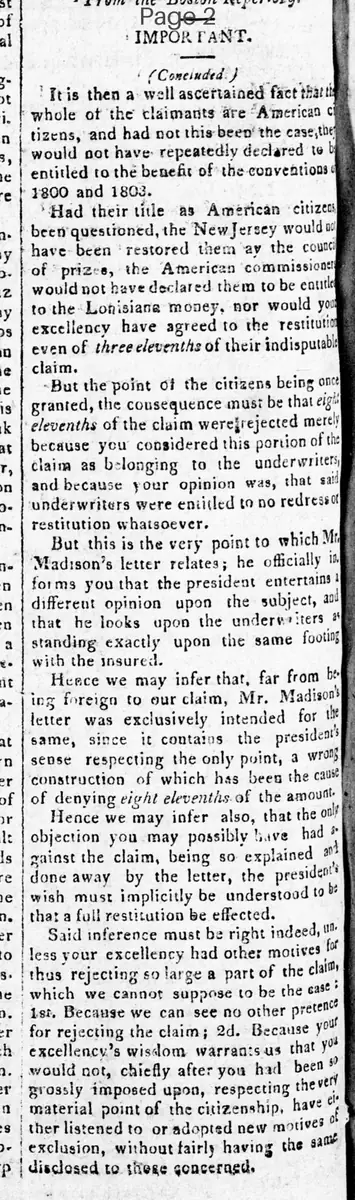
(Concluded.)
It is then a well ascertained fact that the whole of the claimants are American citizens, and had not this been the case, the [authorities] would not have repeatedly declared them to be entitled to the benefit of the conventions of 1800 and 1803.
Had their title as American citizens been questioned, the New Jersey would not have been restored to them by the council of prizes, the American commissioner would not have declared them to be entitled to the Louisiana money, nor would your excellency have agreed to the restitution even of three elevenths of their indisputable claim.
But the point of the citizens being once granted, the consequence must be that eight elevenths of the claim were rejected merely because you considered this portion of the claim as belonging to the underwriters, and because your opinion was, that said underwriters were entitled to no redress or restitution whatsoever.
But this is the very point to which Mr. Madison's letter relates: he officially informs you that the president entertains a different opinion upon the subject, and that he looks upon the underwriters as standing exactly upon the same footing with the insured.
Hence we may infer that, far from being foreign to our claim, Mr. Madison's letter was exclusively intended for the same, since it contains the president's sense respecting the only point, a wrong construction of which has been the cause of denying eight elevenths of the amount.
Hence we may infer also, that the only objection you may possibly have had against the claim, being so explained and done away by the letter, the president's wish must implicitly be understood to be that a full restitution be effected, unless your excellency had other motives for thus rejecting so large a part of the claim.
1st. Because we can see no other pretence for rejecting the claim; 2d. Because your excellency's wisdom warrants us that you would not, chiefly after you had been so grossly imposed upon, respecting the very material point of the citizenship, have come to such an exclusion, without fairly having the same either listened to or adopted new motives disclosed to those concerned.
No body better than your excellency, knows that the laws and manners of your country can admit of no arbitrary measures of no decision which is not supported by precedents, and by which said party might, in motives openly declared to the party con. the dark, be denied the eight elevenths of a just and considerable claim; no body better than you know that the American law has not vested a minister, nor any officer under the American constitution, with the right of denying any one of the benefit of a treaty, to which, as being "the law of the land," all Americans are equally entitled.
The claimants in the case of the New Jersey, have then as a kind of birth right to be informed, whether any motive, besides the one alluded to in Mr. Madison's letter, has become a bar to the full admitting of their claim. If any such exists, we solemnly engage to do it away also.
If there is none but the one alluded to, it is the president's will that the claim be admitted.
To the above we beg leave to add, as observed by us to his excellency the French minister, that the claim must be either good or bad, for the whole of it. Hence the unavoidable consequence that the claimants are unjustly wronged to the amount of 800,000 francs, in the first case. Or that the American treasury are wronged to the amount of 300,000 francs in the other case.
Such a precedent cannot stand upon the records of so pure and wise an administration as the American one; and we trust you will not hesitate in granting us the following our prayer, either to disclose to us the new motives by which you have been guided; or, if no new motive has occurred, and the opinion respecting the underwriters has been the only ground upon which the claim has been reduced, that you will, this ground being now happily removed, obtain from the French minister and government, an additional allowance equal to what remains due to the claimants upon the Louisiana fund:
The personal regard which said minister justly entertains for your excellency, added to the responsibility which a refusal on his part must attach to your government and to yourself, induces us to hope that your demand will be readily complied with.
Whether there are funds sufficient let is more than it is in our power to say But in case the same were wanting, we must, after doing every effort in our power to support our constituents' rights in this country, trust the same to the justice of their own country and the authority of the American law,
We must conclude with observing freely 'how sorry we have been to see it stated in your secretary's answer to us, the case is terminated. We can in a few words convince your excellency that it is not.
1st. When we have received the 500,000 francs and given our receipt accordingly, to which said expression must allude, we did it merely because upon our declining it at first, the French minister positively declared to us that, "should said sum be refused, we should have nothing at all."
2d. The powers we had from the claimants were intended only for a fair and full restitution of the amount of the claim. Hence the inference that we had no authority to compromise or agree to so heavy and so unjust a sacrifice, and that, when compelled to do it, if we have received a partial payment only, the claimant's rights cannot, in the least, be impaired by it.
3d. A settlement of this kind can never be compared with the one made between individuals in the usual course of judiciary proceedings. We admit that where two parties being of age, after being at law, come to a compromise, said compromise must be a bar to their respective claims, because every party had a right to support and defend his claim and to abide by the decision of the law. But the case is quite the reverse in an administrative settlement, that is, a settlement between an individual claimant and a government. Governments, as being the source of justice, sit as judges in their own cause; and their party is denied the privilege of debating or otherwise supporting his rights. Hence the necessary inference that an administrative settlement can never be said to terminate a case, unless the same be just and equal to the demand; because as long as there is something unjust, the claimant is of right supposed to have made a reservation of what he could not force an actual payment of, for which he must trust to the justice of his debtor; and for which he has a fair claim as soon as the indebted government perceive that they were mistaken and that they have but partially done that justice which it was their wish and duty to do full and complete.
These rules are constantly practised by the French administration, whose agents are sensible that from the very circumstance of their own cause, no act of theirs can be set up as a bar against the creditor; as long as justice was not completely done.
As to the American government; the same rule ought the more to prevail in this case, as their representative, thro’ errors of which no man is exempt; and which said government has officially disclaimed, has been the author of the enormous and unjust reduction which the claim has experienced.
We trust, therefore; that your excellency will not consider this as being a terminated case; that you will deem it right and proper to grant us our said request, either to have the balance of the claim discharged, or to state to us whether any and what motives, besides the one alluded to in Mr. Madison's letter, has and still does prevent the discharging the whole amount aforesaid.
Should your excellency refuse both these two points, we think it our duty to persist in the protestation we have already made, as well as those which the claimants themselves have made both in their memorial to the secretary of state of the 25th of July last, and in their letter to you of the 9th of August.
With the highest regard,
We have the honor to be,
Sir, your excellency's
Most ob't hum ble serv'ts,
J. M. DE LA GRANGE.
DU PONT.
What sub-type of article is it?
What themes does it cover?
What keywords are associated?
What entities or persons were involved?
Letter to Editor Details
Author
J. M. De La Grange. Du Pont.
Recipient
Your Excellency
Main Argument
the claimants demand full restitution of their eight-elevenths rejected claim from the louisiana fund, arguing that madison's letter removes the only objection regarding underwriters' rights, and insisting the case is not terminated by partial payment under duress.
Notable Details