Thank you for visiting SNEWPapers!
Sign up free
Editorial
February 29, 1792
Gazette Of The United States
New York, New York County, New York
What is this article about?
An editorial from correspondents defends Congress members serving as National Bank directors and the funding of the national debt, highlighting inconsistencies in critics who ignore similar state practices and portraying the measures as fulfilling long-delayed creditor obligations amid partisan attacks.
Clipping
OCR Quality
95%
Excellent
Full Text
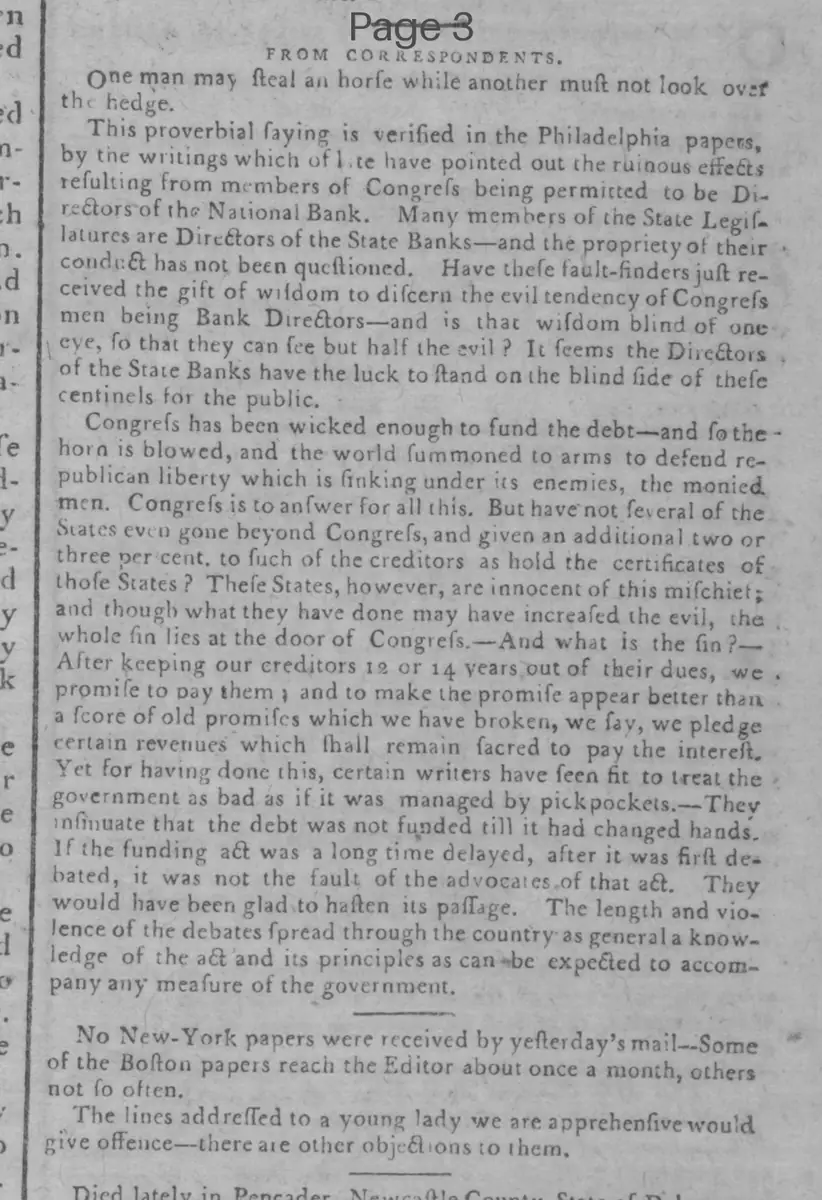
FROM CORRESPONDENTS.
One man may steal a horse while another must not look over the hedge.
This proverbial saying is verified in the Philadelphia papers, by the writings which of late have pointed out the ruinous effects resulting from members of Congress being permitted to be Directors of the National Bank. Many members of the State Legislatures are Directors of the State Banks—and the propriety of their conduct has not been questioned. Have these fault-finders just received the gift of wisdom to discern the evil tendency of Congress men being Bank Directors-and is that wisdom blind of one eye, so that they can see but half the evil? It seems the Directors of the State Banks have the luck to stand on the blind side of these sentinels for the public.
Congress has been wicked enough to fund the debt-and so the horn is blowed, and the world summoned to arms to defend republican liberty which is sinking under its enemies, the monied men. Congress is to answer for all this. But have not several of the States even gone beyond Congress, and given an additional two or three per cent, to such of the creditors as hold the certificates of those States? These States, however, are innocent of this mischief; and though what they have done may have increased the evil, the whole sin lies at the door of Congress.-And what is the sin?—After keeping our creditors 12 or 14 years out of their dues, we promise to pay them; and to make the promise appear better than a score of old promises which we have broken, we say, we pledge certain revenues which shall remain sacred to pay the interest. Yet for having done this, certain writers have seen fit to treat the government as bad as if it was managed by pick pockets.-They insinuate that the debt was not funded till it had changed hands. If the funding Act was a long time delayed, after it was first debated, it was not the fault of the advocates of that Act. They would have been glad to hasten its passage. The length and violence of the debates spread through the country as general a knowledge of the Act and its principles as can be expected to accompany any measure of the government.
No New-York papers were received by yesterday's mail--Some of the Boston papers reach the Editor about once a month, others not so often.
The lines addressed to a young lady we are apprehensive would give offence—there are other objections to them.
One man may steal a horse while another must not look over the hedge.
This proverbial saying is verified in the Philadelphia papers, by the writings which of late have pointed out the ruinous effects resulting from members of Congress being permitted to be Directors of the National Bank. Many members of the State Legislatures are Directors of the State Banks—and the propriety of their conduct has not been questioned. Have these fault-finders just received the gift of wisdom to discern the evil tendency of Congress men being Bank Directors-and is that wisdom blind of one eye, so that they can see but half the evil? It seems the Directors of the State Banks have the luck to stand on the blind side of these sentinels for the public.
Congress has been wicked enough to fund the debt-and so the horn is blowed, and the world summoned to arms to defend republican liberty which is sinking under its enemies, the monied men. Congress is to answer for all this. But have not several of the States even gone beyond Congress, and given an additional two or three per cent, to such of the creditors as hold the certificates of those States? These States, however, are innocent of this mischief; and though what they have done may have increased the evil, the whole sin lies at the door of Congress.-And what is the sin?—After keeping our creditors 12 or 14 years out of their dues, we promise to pay them; and to make the promise appear better than a score of old promises which we have broken, we say, we pledge certain revenues which shall remain sacred to pay the interest. Yet for having done this, certain writers have seen fit to treat the government as bad as if it was managed by pick pockets.-They insinuate that the debt was not funded till it had changed hands. If the funding Act was a long time delayed, after it was first debated, it was not the fault of the advocates of that Act. They would have been glad to hasten its passage. The length and violence of the debates spread through the country as general a knowledge of the Act and its principles as can be expected to accompany any measure of the government.
No New-York papers were received by yesterday's mail--Some of the Boston papers reach the Editor about once a month, others not so often.
The lines addressed to a young lady we are apprehensive would give offence—there are other objections to them.
What sub-type of article is it?
Economic Policy
Partisan Politics
What keywords are associated?
Bank Directors
Debt Funding
Congress Criticism
State Banks
Creditors
Republican Liberty
Funding Act
What entities or persons were involved?
Congress
Members Of Congress
National Bank
State Legislatures
State Banks
Creditors
Editorial Details
Primary Topic
Defense Of Congress Bank Directors And Debt Funding
Stance / Tone
Defensive Of Federal Actions Critical Of Inconsistent Critics
Key Figures
Congress
Members Of Congress
National Bank
State Legislatures
State Banks
Creditors
Key Arguments
Critics Inconsistently Attack Congress Members As Bank Directors While Ignoring State Legislators.
States Have Exceeded Congress By Adding Interest To Creditor Certificates.
Funding The Debt Fulfills Long Delayed Promises To Creditors With Pledged Revenues.
Delay In Funding Act Was Due To Debates, Not Advocates' Fault, And Informed The Public.
Attacks Portray Government As Managed By Pickpockets And Benefit Speculators Unjustly.