Thank you for visiting SNEWPapers!
Sign up free
Letter to Editor
October 14, 1805
Norfolk Gazette And Publick Ledger
Norfolk, Virginia
What is this article about?
Judge H. H. Brackenridge defends Governor M'Kean's refusal to remove him from office amid Pennsylvania political turmoil, arguing it upholds justice and due process. He explains his offer for impeachment as patriotic self-denial to counter favoritism claims, urging support for the governor's re-election in 1805.
Clipping
OCR Quality
98%
Excellent
Full Text
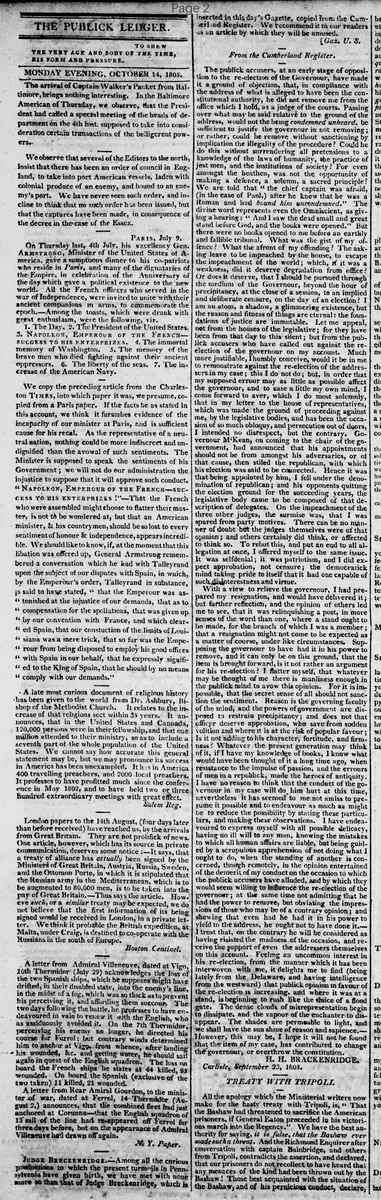
Judge Brackenridge. Among all the curious productions to which the present turmoils in Pennsylvania have given birth, we have met with none more so than that of Judge Brackenridge, which is inserted in this day's Gazette, copied from the Cumberland Register. We recommend it to our readers as an article by which they will be amused.
[Guz. U. S.]
From the Cumberland Register.
The publick accusers, at an early stage of opposition to the re-election of the Governour, have made it a ground of objection, that, in compliance with the address of what is alleged to have been the constitutional authority, he did not remove me from the office which I hold, as a judge of the courts. Passing over what may be said relative to the ground of the address, would not the being condemned unheard, be sufficient to justify the governour in not removing; or rather; could he remove without sanctioning by implication the illegality of the procedure? Could he do this without surrendering all pretensions to a knowledge of the laws of humanity, the practice of just men, and the institutions of society? For even amongst the heathen, was not the opportunity of making a defence, a solemn, a sacred principle?
We are told that "the chief captain was afraid, (in the case of Paul,) after he knew that he was a Roman and had bound him uncondemned." The divine word represents even the Omniscient, as giving a hearing: "And I saw the dead small and great stand before God, and the books were opened." But there were no books opened to me before an earthly and fallible tribunal. What was the gist of my offence? What the affront of my offending? The asking leave to be impeached by the house, to escape the impeachment of the world; which, if it was a weakness, did it deserve degradation from office? Or does it deserve, that I should be pursued through the medium of the Governour, beyond the hour of precipitancy, at the close of a session, to an implied and deliberate censure, on the day of an election? I am an atom, a shadow, a glimmering existence, but the reason and fitness of things are eternal: the foundations of justice are immutable. Let me appeal, not from the houses of the legislative; for they have been from that day to this silent; but from the publick accusers who have called out against the re-election of the governour on my account. Much more justifiable, I humbly conceive, would it be in me to remonstrate against the re-election of the addressers in my case; this I do not do; but, in order that my supposed errour may as little as possible affect the governour, and to ease a little my own mind, I come forward to aver, which I do most solemnly, that in my letter to the house of representatives, which was made the ground of proceeding against me, by the legislative bodies, and has been the occasion of so much obloquy, and persecution out of doors, I intended no disrespect, but the contrary. Governour M'Kean, on coming to the chair of the government, had announced that his appointments should not be from amongst his adversaries, or of that cause, then stiled the republican, with which his election was said to be connected. Hence it was that being appointed by him, I fell under the denomination of republican; and his opponents quitting the election ground for the succeeding years, the legislative body came to be composed of that description of delegates. On the impeachment of the three other judges, the surmise was, that I was spared from party motives. There can be no manner of doubt but the judges themselves were of that opinion; and others certainly did think, or affected to think so. To rebut this, and put an end to all allegation at once, I offered myself to the same issue. It was self-denial; it was patriotism, and I did expect approbation, not censure; the democratick mind taking pride to itself that it had one capable of such disinterestness and virtue.
With a view to relieve the governour, I had prepared my resignation, and would have delivered it; but farther reflection, and the opinion of others led me to see, that it was relinquishing a post, in more senses of the word than one, where a stand ought to be made, for the branch of which I was a member; that a resignation might not come to be expected as a matter of course, under like circumstances. Supposing the governour to have had it in his power to remove, and it can only be on this ground, that the item is brought forward, is it not rather an argument for his re-election? I flatter myself, that whatever may be thought of me there is manliness enough in the publick mind to avow this opinion. For it is impossible, that the secret sense of all should not sanction the sentiment. Reason is the governing faculty of the mind, and the powers of government are disposed to restrain precipitancy; and does not that officer deserve approbation, who save from sudden volition and where it is at the risk of popular favour; Is it not adding to his character, fortitude, and firmness? Whatever the present generation may think of it, if I have my knowledge of books, I know what would have been thought of it a long time ago, when resistance to the impulse of passion, and the errours of men in a republick, made the heroes of antiquity. I have no reason to think that the conduct of the governour in my case will do him hurt at this time, nevertheless it has seemed to me not amiss to presume it possible and to endeavour as much as might be to reduce the possibility by stating these particulars, and making these observations. I have endeavoured to express myself with all possible delicacy, having no ill will to any man, knowing the mistakes to which all human affairs are liable, but being guided by a scrupulous apprehension of not doing what I ought to do, when the standing of another is concerned, though remotely, in the opinion entertained of the demerit of my conduct on the occasion to which the publick accusers have alluded, and by which they would seem willing to influence the re-election of the governour; at the same time not admitting that he had the power to remove, but obviating the impressions of those who may be of a contrary opinion; and shewing that even had he had it in his power to yield to the address, he ought not to have done it.— I trust that, on the contrary he will be considered as having resisted the madness of the occasion, and receive the support of even the addressers themselves on this account. Feeling an uncommon interest in his re-election, from the manner which it has been interwoven with me, it delights me to find (being lately from the Delaware, and having intelligence from the westward) that publick opinion in favour of the re-election is increasing, and where it was at a stand, is beginning to rush like the sluice of a flood gate. The dense clouds of misrepresentation begin to dissipate, and the vapour of the enchanter to disappear. The shades are permeable to light, and we shall have the sun shine of reason and sapience.— However, this may be, I hope it will not be found that the item of my case, has contributed to change the governour, or overthrow the constitution.
H. H. BRACKENRIDGE.
Carlisle, September 23, 1805.
[Guz. U. S.]
From the Cumberland Register.
The publick accusers, at an early stage of opposition to the re-election of the Governour, have made it a ground of objection, that, in compliance with the address of what is alleged to have been the constitutional authority, he did not remove me from the office which I hold, as a judge of the courts. Passing over what may be said relative to the ground of the address, would not the being condemned unheard, be sufficient to justify the governour in not removing; or rather; could he remove without sanctioning by implication the illegality of the procedure? Could he do this without surrendering all pretensions to a knowledge of the laws of humanity, the practice of just men, and the institutions of society? For even amongst the heathen, was not the opportunity of making a defence, a solemn, a sacred principle?
We are told that "the chief captain was afraid, (in the case of Paul,) after he knew that he was a Roman and had bound him uncondemned." The divine word represents even the Omniscient, as giving a hearing: "And I saw the dead small and great stand before God, and the books were opened." But there were no books opened to me before an earthly and fallible tribunal. What was the gist of my offence? What the affront of my offending? The asking leave to be impeached by the house, to escape the impeachment of the world; which, if it was a weakness, did it deserve degradation from office? Or does it deserve, that I should be pursued through the medium of the Governour, beyond the hour of precipitancy, at the close of a session, to an implied and deliberate censure, on the day of an election? I am an atom, a shadow, a glimmering existence, but the reason and fitness of things are eternal: the foundations of justice are immutable. Let me appeal, not from the houses of the legislative; for they have been from that day to this silent; but from the publick accusers who have called out against the re-election of the governour on my account. Much more justifiable, I humbly conceive, would it be in me to remonstrate against the re-election of the addressers in my case; this I do not do; but, in order that my supposed errour may as little as possible affect the governour, and to ease a little my own mind, I come forward to aver, which I do most solemnly, that in my letter to the house of representatives, which was made the ground of proceeding against me, by the legislative bodies, and has been the occasion of so much obloquy, and persecution out of doors, I intended no disrespect, but the contrary. Governour M'Kean, on coming to the chair of the government, had announced that his appointments should not be from amongst his adversaries, or of that cause, then stiled the republican, with which his election was said to be connected. Hence it was that being appointed by him, I fell under the denomination of republican; and his opponents quitting the election ground for the succeeding years, the legislative body came to be composed of that description of delegates. On the impeachment of the three other judges, the surmise was, that I was spared from party motives. There can be no manner of doubt but the judges themselves were of that opinion; and others certainly did think, or affected to think so. To rebut this, and put an end to all allegation at once, I offered myself to the same issue. It was self-denial; it was patriotism, and I did expect approbation, not censure; the democratick mind taking pride to itself that it had one capable of such disinterestness and virtue.
With a view to relieve the governour, I had prepared my resignation, and would have delivered it; but farther reflection, and the opinion of others led me to see, that it was relinquishing a post, in more senses of the word than one, where a stand ought to be made, for the branch of which I was a member; that a resignation might not come to be expected as a matter of course, under like circumstances. Supposing the governour to have had it in his power to remove, and it can only be on this ground, that the item is brought forward, is it not rather an argument for his re-election? I flatter myself, that whatever may be thought of me there is manliness enough in the publick mind to avow this opinion. For it is impossible, that the secret sense of all should not sanction the sentiment. Reason is the governing faculty of the mind, and the powers of government are disposed to restrain precipitancy; and does not that officer deserve approbation, who save from sudden volition and where it is at the risk of popular favour; Is it not adding to his character, fortitude, and firmness? Whatever the present generation may think of it, if I have my knowledge of books, I know what would have been thought of it a long time ago, when resistance to the impulse of passion, and the errours of men in a republick, made the heroes of antiquity. I have no reason to think that the conduct of the governour in my case will do him hurt at this time, nevertheless it has seemed to me not amiss to presume it possible and to endeavour as much as might be to reduce the possibility by stating these particulars, and making these observations. I have endeavoured to express myself with all possible delicacy, having no ill will to any man, knowing the mistakes to which all human affairs are liable, but being guided by a scrupulous apprehension of not doing what I ought to do, when the standing of another is concerned, though remotely, in the opinion entertained of the demerit of my conduct on the occasion to which the publick accusers have alluded, and by which they would seem willing to influence the re-election of the governour; at the same time not admitting that he had the power to remove, but obviating the impressions of those who may be of a contrary opinion; and shewing that even had he had it in his power to yield to the address, he ought not to have done it.— I trust that, on the contrary he will be considered as having resisted the madness of the occasion, and receive the support of even the addressers themselves on this account. Feeling an uncommon interest in his re-election, from the manner which it has been interwoven with me, it delights me to find (being lately from the Delaware, and having intelligence from the westward) that publick opinion in favour of the re-election is increasing, and where it was at a stand, is beginning to rush like the sluice of a flood gate. The dense clouds of misrepresentation begin to dissipate, and the vapour of the enchanter to disappear. The shades are permeable to light, and we shall have the sun shine of reason and sapience.— However, this may be, I hope it will not be found that the item of my case, has contributed to change the governour, or overthrow the constitution.
H. H. BRACKENRIDGE.
Carlisle, September 23, 1805.
What sub-type of article is it?
Persuasive
Political
Reflective
What themes does it cover?
Politics
Constitutional Rights
Morality
What keywords are associated?
Governor Mkean Re Election
Judge Brackenridge Defense
Impeachment Offer
Constitutional Removal
Pennsylvania Politics
Due Process
Party Favoritism
What entities or persons were involved?
H. H. Brackenridge
Letter to Editor Details
Author
H. H. Brackenridge
Main Argument
judge brackenridge defends governor m'kean's refusal to remove him from office without due process, portraying his own offer for impeachment as patriotic self-denial to counter favoritism allegations, and argues this demonstrates the governor's firmness, warranting re-election support.
Notable Details
Biblical References To Paul's Trial And Divine Judgment
Impeachment Of Three Other Judges
Prepared Resignation To Relieve Governor But Reconsidered
Appeal To Ancient Heroes And Republican Virtues