Thank you for visiting SNEWPapers!
Sign up free
The Recorder
Richmond, Virginia
What is this article about?
Extract from Paris letter critiques how French Revolution disrupts diplomatic etiquette, with arrests of ambassadors and insults; profiles key envoys like Austrian Count Cobentzel, Russian Count Marcoff, Prussian Marquis de Lucchini, Swedish Baron D'Ehrenfward, and Danish Chevalier de Dreyer, noting their backgrounds and challenges in revolutionary France.
Merged-components note: These two components form a single continuous foreign news article about diplomats in Paris, with sequential reading orders and flowing text content.
Clipping
OCR Quality
Full Text
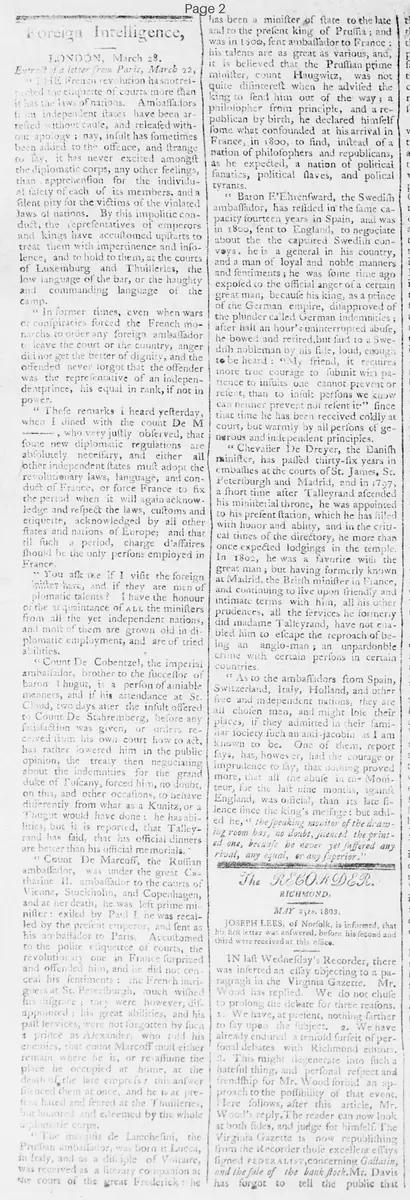
LONDON, March 28.
Extract of a letter from Paris, March 22,
The French revolution has not retarded the etiquette of courts more than it has the laws of nations. Ambassadors from independent states have been arrested without cause, and released without apology; nay, insult has sometimes been added to the offence, and strange to say, it has never excited amongst the diplomatic corps, any other feelings, than apprehension for the individual safety of each of its members, and a silent pity for the victims of the violated laws of nations. By this impolitic conduct, the representatives of emperors and kings have accustomed upstarts to treat them with impertinence and insolence, and to hold to them, at the courts of Luxembourg and Tuilleries, the low language of the bar, or the haughty and commanding language of the camp.
"In former times, even when wars or conspiracies forced the French monarchs to order any foreign ambassador to leave the court or the country, anger did not get the better of dignity, and the offended never forgot that the offender was the representative of an independent prince, his equal in rank, if not in power.
"These remarks I heard yesterday, when I dined with the count De M--, who very justly observed, that some new diplomatic regulations are absolutely necessary, and either all other independent states must adopt the revolutionary laws, language, and conduct of France, or force France to fix the period when it will again acknowledge and respect the laws, customs and etiquette, acknowledged by all other states and nations of Europe; and that till such a period, charge d'affaires should be the only persons employed in France.
"You ask me if I visit the foreign ministers here, and if they are men of diplomatic talents? I have the honour of the acquaintance of all the ministers from all the yet independent nations, and most of them are grown old in diplomatic employment, and are of tried abilities.
Count De Cobentzel, the imperial ambassador, brother to the successor of baron Thugut, is a person of amiable manners, and if his attendance at St. Cloud, two days after the insult offered to Count De Starhemberg, before any satisfaction was given, or orders received from his own court how to act, has rather lowered him in the public opinion, the treaty then negotiating about the indemnities for the grand duke of Tuscany, forced him, no doubt, on this, and other occasions, to behave differently from what as a Kunitz, or a Thugut would have done: he has abilities, but it is reported, that Talleyrand has said, that his official dinners are better than his official memorials.
Count De Marcoff, the Russian ambassador, was under the great Catherine I. ambassador to the courts of Vienna, Stockholm, and Copenhagen, and at her death, he was left prime minister: exiled by Paul I. he was recalled by the present emperor, and sent as his ambassador to Paris. Accustomed to the polite etiquette of courts, the revolutionary one in France surprised and offended him, and he did not conceal his sentiments: the French intriguers at St. Petersburg, much wished his disgrace; they were however, disappointed; his great abilities, and his past services, were not forgotten by such a prince as Alexander, who told his enemies, that count Marcoff must either remain where he is, or re-assume the place he occupied at home, at the death of the late empress: this answer silenced them at once, and he is respected and feared at the Tuilleries, but honored and esteemed by the whole diplomatic corps.
The marquis de Lucchini, the Prussian ambassador, was born at Lucca, in Italy, and as a disciple of Voltaire, was received as a literary companion at the court of the great Frederick: he has been a minister of state to the late and to the present king of Prussia; and was in 1800, sent ambassador to France: his talents are as great as various, and, it is believed that the Prussian prime minister, count Haugwitz, was not quite disinterested when he advised the king to send him out of the way; a philosopher from principle, and a republican by birth, he declared himself somewhat confounded at his arrival in France, in 1800, to find, instead of a nation of philosophers and republicans, as he expected, a nation of political fanatics, political slaves, and political tyrants.
"Baron D'Ehrenfward, the Swedish ambassador, has resided in the same capacity fourteen years in Spain, and was in 1800, sent to England, to negotiate about the captured Swedish convoys. he is a general in his country, and a man of loyal and noble manners and sentiments; he was some time ago exposed to the official anger of a certain great man, because his king, as a prince of the German empire, disapproved of the plunder called German indemnities; after half an hour's uninterrupted abuse, he bowed and retired, but said to a Swedish nobleman by his side, loud, enough to be heard: "My friend, it requires more true courage to submit with patience to insults one cannot prevent or resent, than to insult persons we know can neither prevent nor resent it" since that time he has been received coldly at court, but warmly by all persons of generous and independent principles.
"Chevalier De Dreyer, the Danish minister, has passed thirty-six years in embassies at the courts of St. James, St. Petersburgh and Madrid, and in 1797, a short time after Talleyrand ascended his ministerial throne, he was appointed to his present station, which he has filled with honor and ability, and in the critical times of the directory, he more than once expected lodgings in the temple.
In 1800, he was a favorite with the great man; but having formerly known at Madrid, the British minister in France, and continuing to live upon friendly and intimate terms with him, all his other prudences, all the services he formerly did madame Talleyrand, have not enabled him to escape the reproach of being an anglo-man; an unpardonable crime with certain persons in certain countries.
"As to the ambassadors from Spain, Switzerland, Italy, Holland, and other free and independent nations, they are all chosen men, and might lose their places, if they admitted in their familiar society such an anti-jacobin as I am known to be. One of them, report says, has, however, had the courage or imprudence to say, that nothing proved more, that all the abuse in the Moniteur, for the last nine months, against England, was official, than its late silence since the king's message: but added he, "the speaking monitor of the drawing room has, no doubt, silenced the printed one, because he never yet suffered any rival, any equal, or any superior."
What sub-type of article is it?
What keywords are associated?
What entities or persons were involved?
Where did it happen?
Foreign News Details
Primary Location
Paris
Event Date
March 22
Key Persons
Outcome
critique of violated diplomatic norms leading to calls for new regulations; ambassadors face insults but maintain positions through abilities and past services; varied receptions at french court.
Event Details
Letter from Paris discusses how the French Revolution has eroded diplomatic etiquette and international laws, with unapologetic arrests and insults to ambassadors. The writer, after dining with Count De M--, advocates for new diplomatic rules or limiting representation to charge d'affaires. Profiles several experienced ambassadors in Paris, detailing their backgrounds, talents, and challenges adapting to revolutionary France, including specific incidents of insult and political pressures.