Thank you for visiting SNEWPapers!
Sign up free
The Kentucke Gazette
Lexington, Fayette County, Kentucky
What is this article about?
Hezekiah Stubblefield writes satirically to Mr. Bradford, opposing the separation of Kentucky from Virginia and the Union. He criticizes pro-separation writers under pseudonyms like Farmer and Brutus, defends Cornplanter against attacks, and threatens to petition Congress to suppress the local press unless it publishes only anti-separation views.
Merged-components note: These two components form a single continuous letter to the editor, spanning page 1 and page 2, with sequential reading orders and matching content and signature.
Clippings
1 of 2
OCR Quality
Full Text
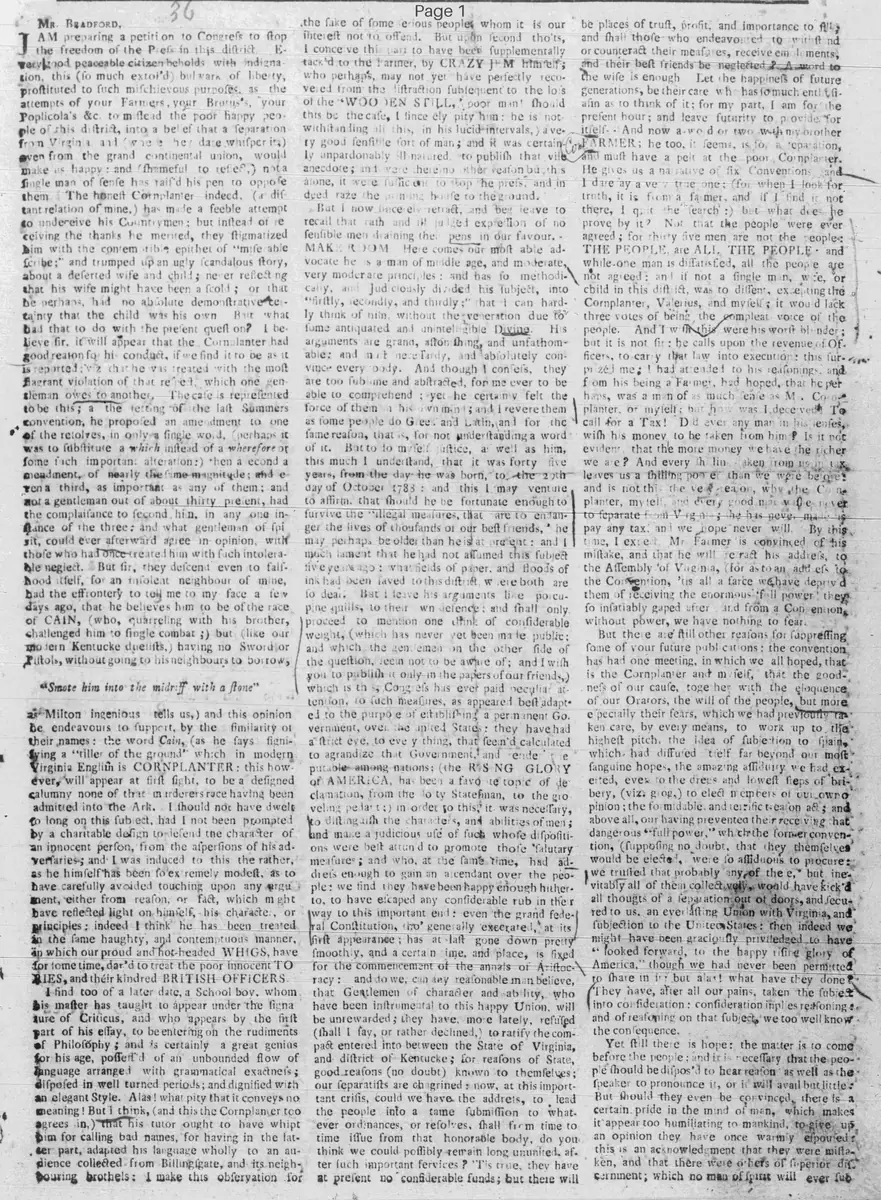
I am preparing a petition to Congress to stop the freedom of the press in this district. Every good peaceable citizen beholds with indignation, this (so much extolled) bill of rights of liberty, prostituted to such mischievous purposes, as the attempts of your Farmers, your Brutus's, your Poplicola's, &c. to mislead the poor happy people of this district, into a belief that a separation from Virginia (and even, as some here darkly whisper) even from the grand continental union, would make us happy: and shameful to reflect, not a single man of sense has raised his pen to oppose them. The honest Cornplanter indeed (a distant relation of mine) made a feeble attempt to undeceive his countrymen; but instead of receiving the thanks he merited, they stigmatized him with the contemptible epithet of "miserable scribe;" and trumped up an ugly scandalous story, about a deserted wife and child; never reflecting that his wife might have been a scold; or that he perhaps, had no absolute demonstrative testimony that the child was his own. But what had that to do with the present question? I believe it, it will appear that the Cornplanter had good reason for his conduct, if we find it to be as it is reported, viz. that he was treated with the most flagrant violation of that respect, which one gentleman owes to another. The case is represented to be this: at the sitting of the last summer's convention, he proposed an amendment to one of the resolves, in only a single word (perhaps it was to substitute a which instead of a wherefore, or some such important alteration:) then a second amendment, of nearly the same magnitude; and even a third, as important as any of them; and not a gentleman out of about thirty present, had the complaisance to second him, in any one instance of the three: and what gentleman of spirit, could ever afterward agree in opinion, with those who had once treated him with such intolerable neglect. But sir, they descend even to falsehood itself, for an insolent neighbor of mine, had the effrontery to tell me to my face a few days ago, that he believes him to be of the race of CAIN, (who, quarreling with his brother, challenged him to single combat;) but (like our modern Kentucky duelists,) having no sword or pistols, without going to his neighbors to borrow, "Smote him hip and thigh with a stone" (Milton ingeniously tells us,) and this opinion he endeavors to support, by the similarity of their names: the word Cain (as he says signifying a "tiller of the ground" which in modern Virginia English is CORNPLANTER: this however, will appear at first sight, to be a designed calumny, none of that murderer's race having been admitted into the Ark. I should not have dwelt so long on this subject, had I not been prompted by a charitable design to defend the character of an innocent person, from the aspersions of his adversaries; and I was induced to this the rather, as he himself has been so extremely modest, as to have carefully avoided touching upon any argument, either from reason, or fact, which might have reflected light on himself, his character, or principles: indeed I think he has been treated in the same haughty, and contemptuous manner, in which our proud and hot-headed WHIGS, have for some time, dared to treat the poor innocent TORIES, and their kindred BRITISH OFFICERS.
I find too, of a later date, a school boy, whom his master has taught to appear under the ignisure of Criticus, and who appears by the first part of his essay, to be entering on the rudiments of philosophy; and is certainly a great genius for his age, possessed of an unbounded flow of language arranged with grammatical exactness; disposed in well turned periods; and dignified with an elegant style. Alas! what pity that it conveys no meaning! But I think (and this the Cornplanter too agrees in,) that his tutor ought to have whipped him for calling bad names, for having in the latter part, adapted his language wholly to an audience collected from Billingsgate, and its neighboring devouring brothels: I make this observation for the sake of some serious people whom it is our interest not to offend. But upon second thoughts, I conceive this essay to have been supplementally tacked to the Farmer, by CRAZY J.M. himself; who perhaps, may not yet have perfectly recovered from the distraction subsequent to the loss of the WOOLEN SKILL, poor man! should this be the case, I sincerely pity him: he is notwithstanding (in his lucid intervals) a very good sensible sort of man; and it was certainly unpardonably ill-natured to publish that vile anecdote; in view hereof no other reason but his alone, it were sufficient to stop the press, and in deed raze the printing house to the ground.
But I now sincerely retract, and beg leave to recall that rash and ill-judged expression of no sensible men deigning to take the pens in our favor. MAKE ROOM! Here comes our most able advocate he is a man of middle age, and moderate, very moderate principles: and has so methodically, and judiciously divided his subject, into "firstly, secondly, and thirdly;" that I can hardly think of him without the veneration due to some antiquated and unintelligible divine. His arguments are grand, astonishing, and unfathomable: and not needlessly, and absolutely convince every body. And though I confess, they are too subtle and abstracted, for me ever to be able to comprehend; yet he certainly felt the force of them in his own mind; and I revere them as some people do Greek and Latin, and for the same reason, that for not understanding a word of it. But to do myself justice, as well as him, this much I understand, that it was forty-five years, from the day he was born, to the 29th day of October 1783: and this I may venture to affirm, that should he be fortunate enough to survive the "illegal measures, that are to endanger the lives of thousands of our best friends," he may perhaps be older than he is at present: and I much lament that he had not assumed this subject seventeen years ago: vast fields of paper, and floods of ink had been saved to this district, where both are so dear. But I leave his arguments like porcupine quills, to their own defense; and shall only proceed to mention one thing of considerable weight (which has never yet been made public: and which the gentlemen on the other side of the question, seem not to be aware of; and I wish you to publish it only in the papers of our friends,) which is this, Congress has ever paid particular attention, to such measures, as appeared best adapted to the purpose of establishing a permanent government over the United States: they have had a strict eye, to every thing, that seemed calculated to aggrandize that government, and render it reputable among nations: (the RISING GLORY OF AMERICA, has been a favorite topic of declamation, from the lofty statesman, to the groveling peasant;) in order to this, it was necessary, to distinguish the characters, and abilities of men; and make a judicious use of such whose dispositions were best attuned to promote those salutary measures; and who, at the same time, had address enough to gain an ascendant over the people: we find they have been happy enough hitherto, to have escaped any considerable rub in their way to this important end: even the grand federal Constitution, though generally execrated, at its birth appearance; has at last gone down pretty smoothly, and a certain time, and place, is fixed for the commencement of the annals of aristocracy: and do we, can any reasonable man believe, that gentlemen of character and ability, who have been instrumental to this happy union, will be unrewarded; they have, more lately, refused (shall I say, or rather declined) to ratify the compact entered into between the state of Virginia, and district of Kentucky; for reasons of state, good reasons (no doubt) known to themselves; our separatists are chagrined: now, at this important crisis, could we have the address, to lead the people into a tame submission to whatever ordinances, or resolves, shall from time to time issue from that honorable body, do you think we could possibly remain long ununited, after such important services? 'Tis true, they have at present no considerable funds: but there will be places of trust, profit, and importance to fill and shall those who endeavored to resist and or counteract their measures, receive emoluments, and their best friends be neglected? A word to the wise is enough. Let the happiness of future generations, be their care who has so much enthusiasm as to think of it: for my part, I am for the present hour; and leave futurity to provide for itself. And now a word or two with my brother on FARMER; he too, it seems, is so, a separation, and must have a pelt at the poor Cornplanter. He gives us a narrative of six conventions, and I dread a very true one; (for when I look for truth, it is from a farmer, and if I find it not there, I quit the search:) but what does he prove by it? Not that the people were ever agreed; for thirty-five men are not the people: THE PEOPLE are ALL THE PEOPLE: and while one man is dissatisfied, all the people are not agreed: and if not a single man, wife, or child in this district, was to dissent, excepting the Cornplanter, Valerius, and myself; it would lack three votes of being the complete voice of the people. And I wish this were his worst blunder: but it is not so: he calls upon the revenue officers to carry that law into execution: this surprises me: I had attended to his reasoning, and from his being a Farmer, had hoped, that he perhaps was a man of as much sense as Mr. Cornplanter, or myself: but how was I deceived! To call for a tax! Did ever any man in his senses, wish his money to be taken from him? Is it not evident, that the more money we have the richer we are? And every shilling taken from us in taxes leaves us a shilling poorer than we were before: and is not this the true reason, why the Cornplanter, myself, and every good natured liver to separate from Virginia; he has never made us pay any tax, and we hope never will. By this time, I expect Mr. Farmer is convinced of his mistake, and that he will retract his address, to the assembly of Virginia (for as to an address to the convention, 'tis all a farce; we have deprived them of receiving the enormous full power they so insatiably gaped after and from a convention, without power, we have nothing to fear.
But there are still other reasons for suppressing some of your future publications: the convention has had one meeting, in which we all hoped, that as the Cornplanter and myself, that the goodness of our cause, together with the eloquence of our orators, the will of the people, but more especially their fears, which we had previously taken care, by every means, to work up to the highest pitch, the idea of subjection to Spain: which had diffused itself far beyond our most sanguine hopes, the amazing industry we had exerted, even to the grossest and lowest steps of bribery, (viz. grog,) to elect members of our own opinion; the formidable and terrific treason act; and above all, our having prevented their receiving that dangerous "full power," which the former convention (supposing no doubt, that they themselves would be elected, were so assiduous to procure: we trusted that probably any of these, but inevitably all of them collectively would have kicked all thoughts of a separation out of doors, and secured to us an everlasting union with Virginia, and subjection to the United States: then indeed we might have been graciously privileged to have "looked forward, to the happy rising glory of America," though we had never been permitted to share in it; but alas! what have they done? They have, after all our pains, taken the subject into consideration: consideration implies reasoning: and of reasoning on that subject, we too well know the consequence.
Yet still there is hope: the matter is to come before the people: and it is necessary that the people should be disposed to hear reason as well as the speaker to pronounce it, or it will avail but little. But should they even be convinced, there is a certain pride in the mind of man, which makes it appear too humiliating to mankind, to give up an opinion they have once warmly espoused: this is an acknowledgment that they were mistaken, and that there were others of superior discernment; which no man of spirit will ever submit
commit to: This (together with our old friend grog,)
is our last and never-failing refuge. But I have
departed from my subject, I was going to say,
that (no doubt,) these things would come to your
press, pompously let off, in the most ostentatious
light; which, if you publish, there will then be
the most irrefragable reason for silencing your
press. But sir, if you, will without fail, publish
this, with whatsoever comes from our party; and
will not on any account whatsoever, publish
any Cards, Anecdotes, Essays, &c. from our ad-
versaries, the Philopatria's, the Candidus's, the
Brutus's, &c. We will forgive what is past; will
not petition to Congress demolish your press;
we will write as much and as fast as we can, to
keep you in business; and give you leave to pro-
cure as many subscriptions as you can, to pay you
for your trouble.
I am sir the Cornplanters and
Your humble Servant
HEZEKIAH STUBBLEFIELD.
P.S. I intend to suspend my petition 'till I see
how you behave.
What sub-type of article is it?
What themes does it cover?
What keywords are associated?
What entities or persons were involved?
Letter to Editor Details
Author
Hezekiah Stubblefield
Recipient
Mr. Bradford
Main Argument
the freedom of the press is being misused to promote the harmful idea of separating kentucky from virginia and the union; the printer should only publish anti-separation writings to avoid a petition to congress suppressing the press entirely.
Notable Details