Thank you for visiting SNEWPapers!
Sign up free
Wheeling Times And Advertiser
Wheeling, Ohio County, West Virginia
What is this article about?
Report on U.S. House of Representatives proceedings on January 7, 1846, including failed resolutions, bill introductions on roads, foundry, tariff, pensions, apportionment, Oregon territory, slavery abolition, and debate on Oregon notice to Britain amid potential war tensions.
Clipping
OCR Quality
Full Text
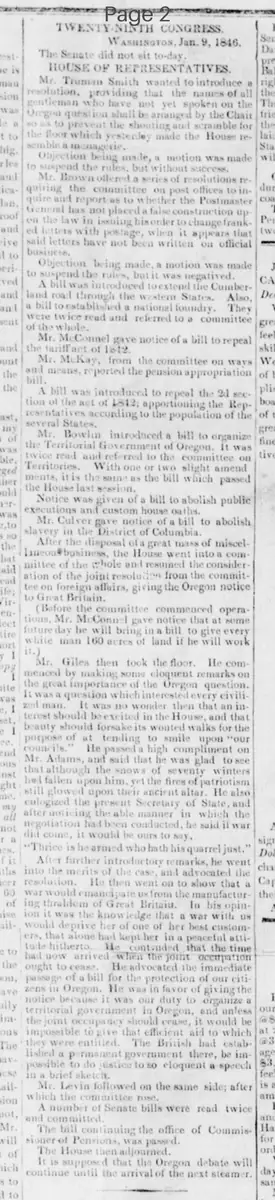
WASHINGTON, Jan. 7, 1846.
The Senate did not sit to-day.
HOUSE OF REPRESENTATIVES
Mr. Truman Smith wanted to introduce a resolution, providing that the names of all gentlemen who have not yet spoken on the Oregon question shall be arranged by the Chair so as to prevent the shouting and scramble for the floor which yesterday made the House resemble a menagerie.
Objection being made, a motion was made to suspend the rules, but without success.
Mr. Brown offered a series of resolutions requiring the committee on post offices to inquire and report as to whether the Postmaster General has not placed a false construction upon the law in issuing his order to charge franked letters with postage, when it appears that said letters have not been written on official business.
Objection being made, a motion was made to suspend the rules, but it was negatived.
A bill was introduced to extend the Cumberland road through the western States. Also, a bill to establish a national foundry. They were twice read and referred to a committee of the whole.
Mr. McConnel gave notice of a bill to repeal the tariff act of 1842.
Mr. McKay, from the committee on ways and means, reported the pension appropriation bill.
A bill was introduced to repeal the 2d section of the act of 1842, apportioning the Representatives according to the population of the several States.
Mr. Bowlin introduced a bill to organize the Territorial Government of Oregon. It was twice read and referred to the committee on Territories. With one or two slight amendments, it is the same as the bill which passed the House last session.
Notice was given of a bill to abolish public executions and custom house oaths.
Mr. Culver gave notice of a bill to abolish slavery in the District of Columbia.
After the disposal of a great mass of miscellaneous business, the House went into a committee of the whole and resumed the consideration of the joint resolution from the committee on foreign affairs, giving the Oregon notice to Great Britain.
(Before the committee commenced operations, Mr. McConnell gave notice that at some future day he will bring in a bill to give every white man 160 acres of land if he will work it.)
Mr. Giles then took the floor. He commenced by making some eloquent remarks on the great importance of the Oregon question. It was a question which interested every civilized man. It was no wonder then that an interest should be excited in the House, and that beauty should forsake its wonted walks for the purpose of attending to smile upon "our counsels." He passed a high compliment on Mr. Adams, and said that he was glad to see that although the snows of seventy winters had fallen upon him, yet the fires of patriotism still glowed upon their ancient altar. He also eulogized the present Secretary of State, and after noticing the able manner in which the negotiation has been conducted, he said if war did come, it would be ours to say,
"Thrice is he armed who hath his quarrel just."
After further introductory remarks, he went into the merits of the case, and advocated the resolution. He then went on to show that a war would emancipate us from the manufacturing thraldom of Great Britain. In his opinion it was the knowledge that a war with us would deprive her of one of her best customers, that alone had kept her in a peaceful attitude hitherto. He contended that the time had now arrived when the joint occupation ought to cease. He advocated the immediate passage of a bill for the protection of our citizens in Oregon. He was in favor of giving the notice because it was our duty to organize a territorial government in Oregon, and unless the joint occupancy should cease, it would be impossible to give that efficient aid to which they were entitled. The British had established a permanent government there. It would be impossible to do justice to so eloquent a speech in a brief sketch.
Mr. Levin followed on the same side: after which the committee rose.
A number of Senate bills were read twice and committed.
The bill continuing the office of Commissioner of Pensions, was passed.
The House then adjourned.
It is supposed that the Oregon debate will continue until the arrival of the next steamer.
What sub-type of article is it?
What themes does it cover?
What keywords are associated?
What entities or persons were involved?
Where did it happen?
Story Details
Key Persons
Location
Washington
Event Date
Jan. 7, 1846
Story Details
The House addressed various bills and resolutions, including those on postal franking, roads, foundry, tariff repeal, pensions, apportionment, Oregon territorial government, abolition of slavery in D.C., and debated the joint resolution to give notice to Great Britain on ending joint occupation of Oregon, with speeches by Mr. Giles and Mr. Levin advocating for it amid war considerations.