Thank you for visiting SNEWPapers!
Sign up free
Editorial
February 13, 1840
Watchman Of The South
Richmond, Virginia
What is this article about?
Editorial by Boardman condemns the theatre as society's greatest evil, citing immoral plays, disreputable performers, Sabbath operations, broils, victim allure, and merchant avoidance of theatre-goers, urging its suppression for the common good.
Clipping
OCR Quality
98%
Excellent
Full Text
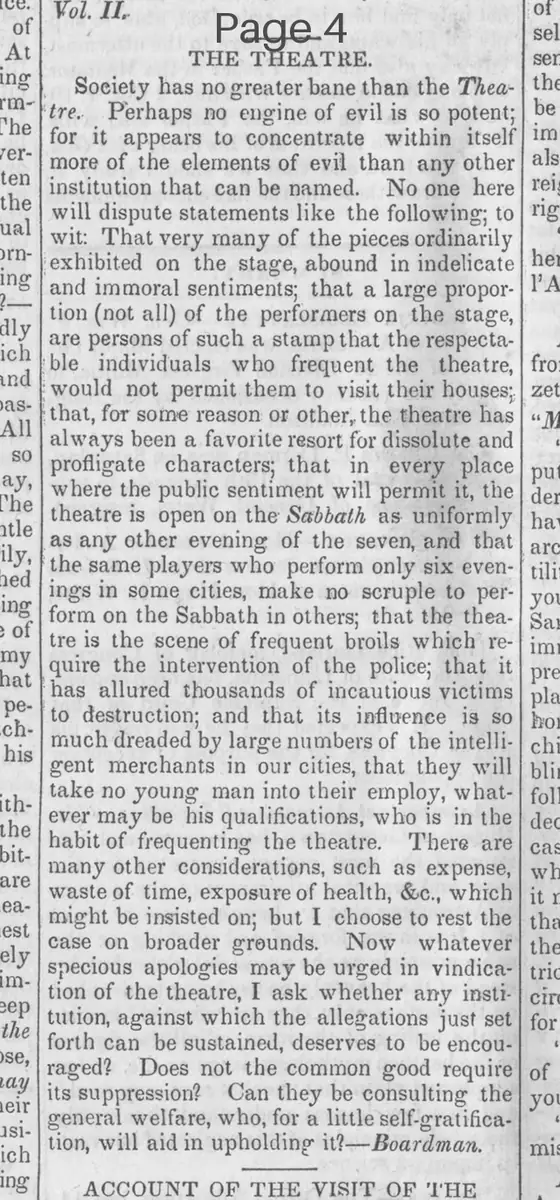
THE THEATRE.
Society has no greater bane than the Theatre. Perhaps no engine of evil is so potent; for it appears to concentrate within itself more of the elements of evil than any other institution that can be named. No one here will dispute statements like the following; to wit: That very many of the pieces ordinarily exhibited on the stage, abound in indelicate and immoral sentiments; that a large proportion (not all) of the performers on the stage, are persons of such a stamp that the respectable individuals who frequent the theatre, would not permit them to visit their houses; that, for some reason or other, the theatre has always been a favorite resort for dissolute and profligate characters; that in every place where the public sentiment will permit it, the theatre is open on the Sabbath as uniformly as any other evening of the seven, and that the same players who perform only six evenings in some cities, make no scruple to perform on the Sabbath in others; that the theatre is the scene of frequent broils which require the intervention of the police; that it has allured thousands of incautious victims to destruction; and that its influence is so much dreaded by large numbers of the intelligent merchants in our cities, that they will take no young man into their employ, whatever may be his qualifications, who is in the habit of frequenting the theatre. There are many other considerations, such as expense, waste of time, exposure of health, &c., which might be insisted on; but I choose to rest the case on broader grounds. Now whatever specious apologies may be urged in vindication of the theatre, I ask whether any institution, against which the allegations just set forth can be sustained, deserves to be encouraged? Does not the common good require its suppression? Can they be consulting the general welfare, who, for a little self-gratification, will aid in upholding it?—Boardman.
Society has no greater bane than the Theatre. Perhaps no engine of evil is so potent; for it appears to concentrate within itself more of the elements of evil than any other institution that can be named. No one here will dispute statements like the following; to wit: That very many of the pieces ordinarily exhibited on the stage, abound in indelicate and immoral sentiments; that a large proportion (not all) of the performers on the stage, are persons of such a stamp that the respectable individuals who frequent the theatre, would not permit them to visit their houses; that, for some reason or other, the theatre has always been a favorite resort for dissolute and profligate characters; that in every place where the public sentiment will permit it, the theatre is open on the Sabbath as uniformly as any other evening of the seven, and that the same players who perform only six evenings in some cities, make no scruple to perform on the Sabbath in others; that the theatre is the scene of frequent broils which require the intervention of the police; that it has allured thousands of incautious victims to destruction; and that its influence is so much dreaded by large numbers of the intelligent merchants in our cities, that they will take no young man into their employ, whatever may be his qualifications, who is in the habit of frequenting the theatre. There are many other considerations, such as expense, waste of time, exposure of health, &c., which might be insisted on; but I choose to rest the case on broader grounds. Now whatever specious apologies may be urged in vindication of the theatre, I ask whether any institution, against which the allegations just set forth can be sustained, deserves to be encouraged? Does not the common good require its suppression? Can they be consulting the general welfare, who, for a little self-gratification, will aid in upholding it?—Boardman.
What sub-type of article is it?
Moral Or Religious
What keywords are associated?
Theatre
Immorality
Sabbath
Vice
Profligacy
Suppression
What entities or persons were involved?
Boardman
Editorial Details
Primary Topic
Condemnation Of The Theatre As A Moral Evil
Stance / Tone
Strongly Anti Theatre Moral Exhortation
Key Figures
Boardman
Key Arguments
Theatre Promotes Indelicate And Immoral Sentiments In Plays.
Many Performers Are Disreputable And Unwelcome In Respectable Homes.
Theatre Attracts Dissolute And Profligate Characters.
Theatres Operate On The Sabbath Where Permitted.
Theatre Scenes Involve Frequent Broils Requiring Police.
Theatre Allures Victims To Destruction.
Merchants Avoid Employing Theatre Frequenting Young Men.
The Common Good Requires Suppression Of The Theatre.