Thank you for visiting SNEWPapers!
Sign up free
Alexandria Gazette & Daily Advertiser
Alexandria, Virginia
What is this article about?
Report on U.S. Congressional proceedings on March 8, 1820, covering Senate discussions on public lands sales and forfeitures, House reports on land claims, military bills, patents, census, navy appropriations, and debates on military establishment reductions and funding.
Clipping
OCR Quality
Full Text
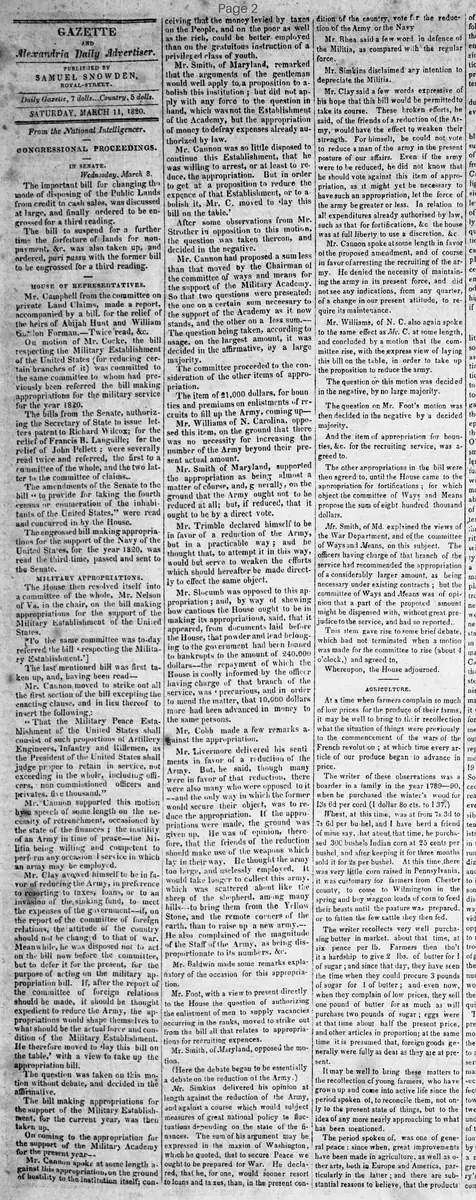
CONGRESSIONAL PROCEEDINGS.
IN SENATE.
Wednesday, March 8.
The important bill for changing the mode of disposing of the Public Lands from credit to cash sales, was discussed at large, and finally ordered to be engrossed for a third reading.
The bill to suspend for a further time the forfeiture of lands for non-payment, &c. was also taken up, and ordered, pari passu with the former bill to be engrossed for a third reading.
HOUSE OF REPRESENTATIVES.
Mr. Campbell from the committee on private Land Claims, made a report, accompanied by a bill, for the relief of the heirs of Abijah Hunt and William &c. John Forman.—Twice read, &c.
On motion of Mr. Cocke, the bill respecting the Military Establishment of the United States (for reducing certain branches of it) was committed to the same committee to whom had previously been referred the bill making appropriations for the military service for the year 1820.
The bills from the Senate, authorizing the Secretary of State to issue letters patent to Richard Wilcox; for the relief of Francis B. Languille; for the relief of John Pellett: were severally read twice and referred, the first to a committee of the whole, and the two latter to the committee of claims.
The amendments of the Senate to the bill "to provide for taking the fourth census or enumeration of the inhabitants of the United States," were read and concurred in by the House.
The engrossed bill making appropriations for the support of the Navy of the United States, for the year 1820, was read the third time, passed and sent to the Senate.
MILITARY APPROPRIATIONS.
The House then resolved itself into a committee of the whole, Mr. Nelson of Va. in the chair, on the bill making appropriations for the support of the Military Establishment of the United States.
To the same committee was to-day referred the bill respecting the Military Establishment.
The last mentioned bill was first taken up, and, having been read—
Mr. Cannon moved to strike out all the first section of the bill excepting the enacting clause, and in lieu thereof to insert the following:
That the Military Peace Establishment of the United States shall consist of such proportions of Artillery Engineers, Infantry and Riflemen, as the President of the United States shall judge proper to retain in service, not exceeding in the whole, including officers, non commissioned officers and privates, five thousand."
Mr. Cannon supported this motion by a speech of some length on the necessity of retrenchment, occasioned by the state of the finances; the utility of an Army in time of peace—the Militia being willing and competent to perform any occasional service in which an army may be employed.
Mr. Clay avowed himself to be in favor of reducing the Army, in preference to resorting to taxes, loans, or to an invasion of the sinking fund, to meet the expenses of the government—if, on the report of the committee of foreign relations, the attitude of the country should not be changed to that of war.
Meanwhile, he was disposed not to act on the bill now before the committee, but to defer it for the present, for the purpose of acting on the military appropriation bill. If, after the report of the committee of foreign relations should be made, it should be thought expedient to reduce the Army, the appropriations would shape themselves to what should be the actual force and condition of the Military Establishment.
He therefore moved to lay this bill on the table, with a view to take up the appropriation bill.
The question was taken on this motion without debate, and decided in the affirmative.
The bill making appropriations for the support of the Military Establishment, for the current year, was then taken up.
On coming to the appropriation for the support of the Military Academy for the present year—
Mr. Cannon spoke at some length against this appropriation, on the ground of hostility to the institution itself; conceiving that the money levied by taxes on the People, and on the poor as well as the rich, could be better employed than on the gratuitous instruction of a privileged class of youth.
Mr. Smith, of Maryland, remarked that the arguments of the gentleman would well apply to a proposition to abolish this institution; but did not apply with any force to the question in hand, which was not the Establishment of the Academy, but the appropriation of money to defray expenses already authorized by law.
Mr. Cannon was so little disposed to continue this Establishment, that he was willing to arrest, or at least to reduce, the appropriation. But in order to get at a proposition to reduce the expense of that Establishment, or to abolish it, Mr. C. moved to lay this bill on the table.
After some observations from Mr. Strother in opposition to this motion, the question was taken thereon, and decided in the negative.
Mr. Cannon had proposed a sum less than that moved by the Chairman of the committee of ways and means for the support of the Military Academy.
So that two questions were presented: the one on a certain sum necessary to the support of the Academy as it now stands, and the other on a less sum.—
The question being taken, according to usage, on the largest amount, it was decided in the affirmative, by a large majority.
The committee proceeded to the consideration of the other items of appropriation.
The item of 21,000 dollars, for bounties and premiums on enlistments of recruits to fill up the Army, coming up—
Mr. Williams of N. Carolina, opposed this item, on the ground that there was no necessity for increasing the number of the Army beyond their present actual amount.
Mr. Smith of Maryland, supported the appropriation as being almost a matter of course, and, generally, on the ground that the Army ought not to be reduced at all: but, if reduced, that it ought to be by a direct vote.
Mr. Trimble declared himself to be in favor of a reduction of the Army, but in a practicable way; and he thought that, to attempt it in this way, would but serve to weaken the efforts which should hereafter be made directly to effect the same object.
Mr. Slocumb was opposed to this appropriation; and, by way of shewing how cautious the House ought to be in making its appropriations, said, that it appeared, from documents laid before the House, that powder and lead belonging to the government had been loaned to bankrupts to the amount of 240,000 dollars—the repayment of which the House is coolly informed by the officer having charge of that branch of the service, was 'precarious,' and in order to mend the matter, that 10,000 dollars more had been advanced in money to the same persons.
Mr. Cobb made a few remarks against the appropriation.
Mr. Livermore delivered his sentiments in favor of a reduction of the Army. But, he said, though many were in favor of that reduction, there were also many who were opposed to it—and the only way in which the former would secure their object, was to reduce the appropriation. If the appropriations were made, the ground was given up. He was of opinion, therefore, that the friends of the reduction should make use of the weapons which lay in their way. He thought the army too large, and uselessly employed. It would take longer to collect this army, which was scattered about like the sheep of the shepherd, among many hills—to bring them from the Yellow Stone, and the remote corners of the earth, than to raise up a new army.—
He also complained of the magnitude of the Staff of the Army, as being disproportionate to its numbers, &c.
Mr. Baldwin made some remarks explanatory of the occasion for this appropriation.
Mr. Foot, with a view to present directly to the House the question of authorizing the enlistment of men to supply vacancies occurring in the ranks, moved to strike out from the bill all that relates to appropriations for recruiting expenses.
Mr. Smith, of Maryland, opposed the motion.
(Here the debate began to be essentially a debate on the reduction of the Army.)
Mr. Simkins delivered his opinion at length against the reduction of the Army, and against a course which would subject measures of great national policy to fluctuations depending on the state of the finances. The sum of his argument may be expressed in the maxim of Washington, which he quoted, that to secure Peace we ought to be prepared for War. He declared, that he, for one, would sooner resort to loans and taxes, than, in the present condition of the country, vote for the reduction of the Army or the Navy.
Mr. Rhea said a few words in defence of the Militia, as compared with the regular force.
Mr. Simkins disclaimed any intention to depreciate the Militia.
Mr. Clay said a few words expressive of his hope that this bill would be permitted to take its course. These broken efforts, he said, of the friends of a reduction of the Army, would have the effect to weaken their strength. For himself, he could not vote to reduce a man of the army in the present posture of our affairs. Even if the army were to be reduced, he did not know that he should vote against this item of appropriation, as it might yet be necessary to have such an appropriation, let the force of the army be greater or less. In relation to all expenditures already authorised by law, such as that for fortifications, &c. the house was at full liberty to use a discretion. &c.
Mr. Cannon spoke at some length in favor of the proposed amendment, and of course in favor of arresting the recruiting of the army. He denied the necessity of maintaining the army in its present force, and did not see any indications, from any quarter, of a change in our present attitude, to require its maintenance.
Mr. Williams, of N. C. also again spoke to the same effect as Mr. C. at some length, and concluded by a motion that the committee rise, with the express view of laying this bill on the table, in order to take up the proposition to reduce the army.
The question of this motion was decided in the negative, by no large majority.
The question on Mr. Foot's motion was then decided in the negative by a decided majority.
And the item of appropriation for bounties, &c. for the recruiting service, was agreed to.
The other appropriations in the bill were then agreed to, until the House came to the appropriation for fortifications; for which object the committee of Ways and Means propose the sum of eight hundred thousand dollars.
Mr. Smith, of Md. explained the views of the War Department, and of the committee of Ways and Means, on this subject. The officers having charge of that branch of the service had recommended the appropriation of a considerably larger amount, as being necessary under existing contracts; but the committee of Ways and Means was of opinion that a part of the proposed amount might be dispensed with, without great prejudice to the service, and had so reported.
This item gave rise to some brief debate, which had not terminated when a motion was made for the committee to rise (about 4 o'clock.) and agreed to,
Whereupon, the House adjourned.
What sub-type of article is it?
What keywords are associated?
What entities or persons were involved?
Where did it happen?
Story Details
Key Persons
Location
United States Congress
Event Date
March 8, 1820
Story Details
Senate advances bills on public lands sales and forfeitures. House handles land claims relief, military bills referrals, patent and relief bills, concurs on census amendments, passes navy appropriations. Committee debates military establishment reduction to 5,000 men and appropriations, including opposition to Military Academy funding and recruiting bounties; motions to reduce fail, appropriations proceed with debate on fortifications.