Thank you for visiting SNEWPapers!
Sign up free
The Independent Press
Abbeville, Abbeville County, South Carolina
What is this article about?
A visitor's account of meeting Dr. Strauss in Heidelberg during September university vacation. Strauss, author of the infidel 'Life of Jesus Christ,' expresses regret for his theological pursuits, prefers literary independence but laments lack of official influence, and updates his views to see Gospel authors as intentional deceivers.
Clipping
OCR Quality
Full Text
WHOLE NUMBER 263
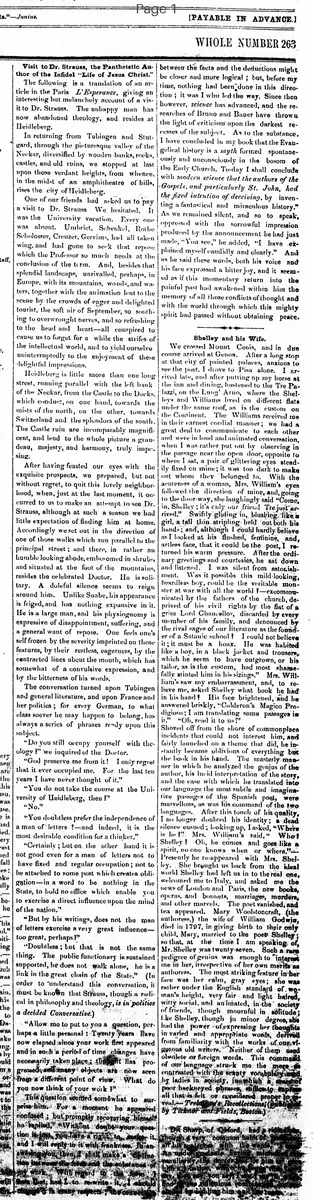
Visit to Dr. Strauss, the Pantheistic Author of the Infidel "Life of Jesus Christ."
The following is a translation of an article in the Paris L'Esperance, giving an interesting but melancholy account of a visit to Dr. Strauss. The unhappy man has now abandoned theology, and resides at Heidelberg.
In returning from Tubingen and Stuttgart, through the picturesque valley of the Neckar, diversified by wooded banks, rocks, castles, and old ruins, we stopped at last upon those verdant heights, from whence, in the midst of an amphitheatre of hills, rises the city of Heidelberg.
One of our friends had asked us to pay a visit to Dr. Strauss. We hesitated. It was the University vacation. Every one was absent. Umbreit, Schenkel, Rothe, Schlosser, Creuzer, Gervinus, had all taken wing, and had gone to seek that repose which the Professor so much needs at the conclusion of the term. And, besides that splendid landscape, unrivalled, perhaps, in Europe, with its mountains, woods, and waters, together with the animation lent to the scene by the crowds of eager and delighted tourists, the soft air of September, so soothing to overwrought nerves, and so refreshing to the head and heart--all conspired to cause us to forget for a while the strifes of the intellectual world, and to yield ourselves uninterruptedly to the enjoyment of these delightful impressions.
Heidelberg is little more than one long street, running parallel with the left bank of the Neckar, from the Castle to the Docks which conduct, on one hand, towards the mists of the north, on the other, towards Switzerland and the splendors of the south. The Castle ruins are incomparably magnificent, and lend to the whole picture a grandeur, majesty, and harmony, truly imposing.
After having feasted our eyes with the exquisite prospects, we prepared, but not without regret, to quit this lovely neighborhood, when, just at the last moment, it occurred to us to make an attempt to see Dr. Strauss, although at such a season we had little expectation of finding him at home. Accordingly we set out in the direction of one of those walks which run parallel to the principal street; and there, in rather an humble looking abode, embosomed in shrubs and situated at the foot of the mountains, resides the celebrated Doctor. He is solitary. A doleful silence seems to reign around him. Unlike Swabia, his appearance is frigid, and has nothing expansive in it. He is a large man, and his physiognomy is expressive of disappointment, suffering, and a general want of repose. One feels one's self frozen by the severity imprinted on those features, by their restless eagerness, by the contracted lines about the mouth, which has somewhat of a convulsive expression, and by the bitterness of his words.
The conversation turned upon Tubingen and general literature, and upon France and her politics; for every German, to what class soever he may happen to belong, has always a series of phrases ready upon this subject.
"Do you still occupy yourself with theology?" we inquired of the Doctor.
"God preserve me from it! I only regret that it ever occupied me. For the last ten years I have never thought of it."
"You do not take the course at the University of Heidelberg, then?"
"No."
"You doubtless prefer the independence of a man of letters?--and indeed, it is the most desirable condition for a thinker."
"Certainly: but on the other hand it is not good even for a man of letters not to have fixed and regular occupation; not to be attached to some post which creates obligation--in a word to be nothing in the State, to hold no office which enable you to exercise a direct influence upon the mind of the nation."
"But by his writings, does not the man of letters exercise a very great influence-- too great, perhaps?"
"Doubtless: but that is not the same thing. The public functionary is sustained supported, he does not walk alone, he is a link in the great chain of the State." (In order to understand this conversation, it must be known that Strauss, though a radical in philosophy and theology, is in politics a decided Conservative.)
"Allow me to put to you a question, perhaps a little personal: Twenty four years have now elapsed since your work first appeared and in such a period of time changes have necessarily taken place: thought has progressed and many objects now seen from a different point of view. What do you now think of your work?"
This question seemed somewhat to surprise and confuse him; but promptly recovering himself he replied, "Without doubt your question is just; you have a right to ask it, and I will reply to it with frankness. I thank you that you have made it, criticism upon the form and the deductions of my work would be regarded with indifference by me now; had I to write it, I would not change a word of it. Between the facts and the deductions might be closer and more logical; but, before my time, nothing had been done in this direction; it was I who led the way. Since then however, science has advanced; and the researches of Bruno and Bauer have thrown the light of criticism upon the darkest recesses of the subject. As to the substance, I have concluded in my book that the Evangelical history is a myth formed spontaneously and unconsciously in the bosom of the Early Church. To-day I shall conclude with modern science that the authors of the Gospels, and particularly St. John, had the fixed intention of deceiving, by inventing a fantastical and miraculous history."
As we remained silent, and so to speak, oppressed with the sorrowful impression produced by the announcement he had just made, "You see," he added, "I have explained myself candidly and clearly." And as he said these words, both his voice and his face expressed a bitter joy, and it seemed as if this momentary return into the painful past had awakened within him the memory of all those conflicts of thought and with the world through which this mighty spirit had passed without obtaining peace.
What sub-type of article is it?
What themes does it cover?
What keywords are associated?
What entities or persons were involved?
Where did it happen?
Story Details
Key Persons
Location
Heidelberg
Event Date
September
Story Details
A visitor hesitantly visits the reclusive Dr. Strauss in Heidelberg during university vacation. Strauss, appearing disappointed and frigid, regrets his theological past, prefers independence but misses official influence, and affirms his work on the 'Life of Jesus Christ' while updating his view that Gospel authors intentionally deceived by inventing miracles.