Thank you for visiting SNEWPapers!
Sign up free
Literary
April 15, 1818
Alexandria Gazette & Daily Advertiser
Alexandria, Virginia
What is this article about?
An essay advocating the cultivation of apple orchards for profit, pleasure, and social benefit, emphasizing proper planting, pruning, and management to produce good cider as an alternative to ardent spirits. Signed by Agricole from the Raleigh Register.
Clipping
OCR Quality
95%
Excellent
Full Text
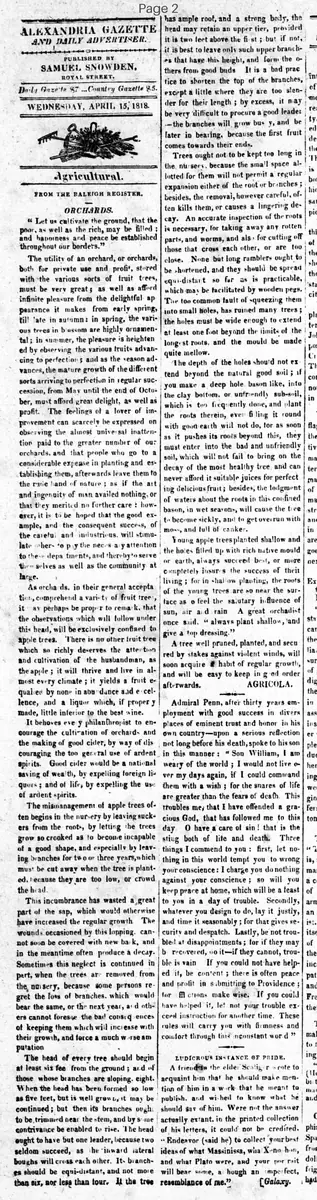
FROM THE RALEIGH REGISTER.
ORCHARDS.
"Let us cultivate the ground, that the poor, as well as the rich, may be filled; and happiness and peace be established throughout our borders."
The utility of an orchard, or orchards, both for private use and profit, stored with the various sorts of fruit trees, must be very great; as well as afford infinite pleasure from the delightful appearance it makes from early spring till late in autumn: in spring, the various trees in blossom are highly ornamental; in summer, the pleasure is heightened by observing the various fruits advancing to perfection; and as the season advances, the mature growth of the different sorts arriving to perfection in regular succession, from May until the end of October, must afford great delight, as well as profit. The feelings of a lover of improvement can scarcely be expressed on observing the almost universal inattention paid to the greater number of our orchards, and that people who go to a considerable expense in planting and establishing them, afterwards leave them to the rude hand of nature; as if the art and ingenuity of man availed nothing, or that they merited no further care: however, it is to be hoped that the good example, and the consequent success, of the careful and industrious, will stimulate others to pay the necessary attention to their departments, and thereby serve themselves as well as the community at large.
As orchards, in their general acceptation, comprehend a variety of fruit tree, it may perhaps be proper to remark, that the observations which will follow under this head, will be exclusively confined to apple trees. There is no other fruit tree which so richly deserves the attention and cultivation of the husbandman, as the apple; it will thrive and live in almost every climate; it yields a fruit unequalled by none in abundance and excellence, and a liquor which, if properly made, little inferior to the best wine. It behoves every philanthropist to encourage the cultivation of orchards and the making of good cider, by way of discouraging the too general use of ardent spirits. Good cider would be a national saving of wealth, by expelling foreign liquors; and of life, by expelling the use of ardent spirits.
The mismanagement of apple trees often begins in the nursery by leaving suckers from the roots, by letting the trees grow so crooked as to become incapable of a good shape, and especially by leaving branches for two or three years, which must be cut away when the tree is planted, because they are too low, or crowd the head. This incumbrance has wasted a great part of the sap, which would otherwise have increased the regular growth. The wounds occasioned by this lopping, cannot soon be covered with new bark, and in the meantime often produce a decay. Sometimes this neglect is continued in part, when the trees are removed from the nursery, because some persons regret the loss of branches, which would bear the same, or the next year, and others cannot foresee the bad consequences of keeping them which will increase with their growth, and force a much worse amputation. The head of every tree should begin at least six feet from the ground; and of those whose branches are sloping, eight. When the head has been formed so low as five feet, but is well grown, it may be continued; but then its branches ought to be trimmed near the stem, and by some contrivance be enabled to rise. The head ought to have but one leader, because two seldom succeed, as the inward lateral boughs will cross each other. Its branches should be equi-distant, and not more than six, nor less than four. If the tree has ample root, and a strong body, the head may retain an upper tier, provided it is two feet above the first; but if not, it is best to leave only such upper branches that have this height, and form the others from good buds. It is a bad practice to shorten the top of the branches, except a little where they are too slender for their length; by excess, it may be very difficult to procure a good leader—the branches will grow bushy, and be later in bearing, because the first fruit comes towards their ends.
Trees ought not to be kept too long in the nursery, because the small space allotted for them will not permit a regular expansion either of the root or branches; besides, the removal, however careful, often kills them, or causes a lingering decay. An accurate inspection of the roots is necessary, for taking away any rotten parts, and worms, and also, for cutting off those that cross each other, or are too close. None but long ramblers ought to be shortened, and they should be spread equi-distant so far as is practicable, which may be facilitated by wooden pegs. The too common fault of squeezing them into small holes, has ruined many trees; the holes must be wide enough to extend at least one foot beyond the limits of the longest roots, and the mould be made quite mellow. The depth of the holes should not extend beyond the natural good soil; if you make a deep hole basin like, into the clay bottom, or unfriendly sub-soil, which is too frequently done, and plant the roots therein, ever filling it round with good earth will not do, for as soon as it pushes its roots beyond this, they must enter into the bad and unfriendly soil, which will not fail to bring on the decay of the most healthy tree and can never afford it suitable juices for perfecting delicious fruit; besides, the lodgment of waters about the roots in this confined basin, in wet seasons, will cause the tree to become sickly, and to get overrun with moss, and full of canker.
Young apple trees planted shallow and the holes filled up with rich native mould or earth, always succeed best, or more completely insures the success of their living; for in shallow planting, the roots of the young trees are so near the surface as to feel the salutary influence of sun, air and rain. A great orchardist once said, "always plant shallow, and give a top dressing."
A tree well pruned, planted, and secured by stakes against violent winds, will soon acquire habit of regular growth, and will be easy to keep in good order afterwards.
AGRICOLE.
ORCHARDS.
"Let us cultivate the ground, that the poor, as well as the rich, may be filled; and happiness and peace be established throughout our borders."
The utility of an orchard, or orchards, both for private use and profit, stored with the various sorts of fruit trees, must be very great; as well as afford infinite pleasure from the delightful appearance it makes from early spring till late in autumn: in spring, the various trees in blossom are highly ornamental; in summer, the pleasure is heightened by observing the various fruits advancing to perfection; and as the season advances, the mature growth of the different sorts arriving to perfection in regular succession, from May until the end of October, must afford great delight, as well as profit. The feelings of a lover of improvement can scarcely be expressed on observing the almost universal inattention paid to the greater number of our orchards, and that people who go to a considerable expense in planting and establishing them, afterwards leave them to the rude hand of nature; as if the art and ingenuity of man availed nothing, or that they merited no further care: however, it is to be hoped that the good example, and the consequent success, of the careful and industrious, will stimulate others to pay the necessary attention to their departments, and thereby serve themselves as well as the community at large.
As orchards, in their general acceptation, comprehend a variety of fruit tree, it may perhaps be proper to remark, that the observations which will follow under this head, will be exclusively confined to apple trees. There is no other fruit tree which so richly deserves the attention and cultivation of the husbandman, as the apple; it will thrive and live in almost every climate; it yields a fruit unequalled by none in abundance and excellence, and a liquor which, if properly made, little inferior to the best wine. It behoves every philanthropist to encourage the cultivation of orchards and the making of good cider, by way of discouraging the too general use of ardent spirits. Good cider would be a national saving of wealth, by expelling foreign liquors; and of life, by expelling the use of ardent spirits.
The mismanagement of apple trees often begins in the nursery by leaving suckers from the roots, by letting the trees grow so crooked as to become incapable of a good shape, and especially by leaving branches for two or three years, which must be cut away when the tree is planted, because they are too low, or crowd the head. This incumbrance has wasted a great part of the sap, which would otherwise have increased the regular growth. The wounds occasioned by this lopping, cannot soon be covered with new bark, and in the meantime often produce a decay. Sometimes this neglect is continued in part, when the trees are removed from the nursery, because some persons regret the loss of branches, which would bear the same, or the next year, and others cannot foresee the bad consequences of keeping them which will increase with their growth, and force a much worse amputation. The head of every tree should begin at least six feet from the ground; and of those whose branches are sloping, eight. When the head has been formed so low as five feet, but is well grown, it may be continued; but then its branches ought to be trimmed near the stem, and by some contrivance be enabled to rise. The head ought to have but one leader, because two seldom succeed, as the inward lateral boughs will cross each other. Its branches should be equi-distant, and not more than six, nor less than four. If the tree has ample root, and a strong body, the head may retain an upper tier, provided it is two feet above the first; but if not, it is best to leave only such upper branches that have this height, and form the others from good buds. It is a bad practice to shorten the top of the branches, except a little where they are too slender for their length; by excess, it may be very difficult to procure a good leader—the branches will grow bushy, and be later in bearing, because the first fruit comes towards their ends.
Trees ought not to be kept too long in the nursery, because the small space allotted for them will not permit a regular expansion either of the root or branches; besides, the removal, however careful, often kills them, or causes a lingering decay. An accurate inspection of the roots is necessary, for taking away any rotten parts, and worms, and also, for cutting off those that cross each other, or are too close. None but long ramblers ought to be shortened, and they should be spread equi-distant so far as is practicable, which may be facilitated by wooden pegs. The too common fault of squeezing them into small holes, has ruined many trees; the holes must be wide enough to extend at least one foot beyond the limits of the longest roots, and the mould be made quite mellow. The depth of the holes should not extend beyond the natural good soil; if you make a deep hole basin like, into the clay bottom, or unfriendly sub-soil, which is too frequently done, and plant the roots therein, ever filling it round with good earth will not do, for as soon as it pushes its roots beyond this, they must enter into the bad and unfriendly soil, which will not fail to bring on the decay of the most healthy tree and can never afford it suitable juices for perfecting delicious fruit; besides, the lodgment of waters about the roots in this confined basin, in wet seasons, will cause the tree to become sickly, and to get overrun with moss, and full of canker.
Young apple trees planted shallow and the holes filled up with rich native mould or earth, always succeed best, or more completely insures the success of their living; for in shallow planting, the roots of the young trees are so near the surface as to feel the salutary influence of sun, air and rain. A great orchardist once said, "always plant shallow, and give a top dressing."
A tree well pruned, planted, and secured by stakes against violent winds, will soon acquire habit of regular growth, and will be easy to keep in good order afterwards.
AGRICOLE.
What sub-type of article is it?
Essay
What themes does it cover?
Agriculture Rural
Temperance
Commerce Trade
What keywords are associated?
Orchards
Apple Trees
Cultivation
Cider
Pruning
Planting
Agriculture
Temperance
What entities or persons were involved?
Agricole.
Literary Details
Title
Orchards.
Author
Agricole.
Subject
On The Cultivation Of Apple Orchards And Making Cider
Key Lines
"Let Us Cultivate The Ground, That The Poor, As Well As The Rich, May Be Filled; And Happiness And Peace Be Established Throughout Our Borders."
It Behoves Every Philanthropist To Encourage The Cultivation Of Orchards And The Making Of Good Cider, By Way Of Discouraging The Too General Use Of Ardent Spirits.
Good Cider Would Be A National Saving Of Wealth, By Expelling Foreign Liquors; And Of Life, By Expelling The Use Of Ardent Spirits.
A Great Orchardist Once Said, "Always Plant Shallow, And Give A Top Dressing."