Thank you for visiting SNEWPapers!
Sign up free
The Minneapolis Journal
Minneapolis, Hennepin County, Minnesota
What is this article about?
In Washington on Jan. 3, a compromise proposal was submitted to Congress's postal committees to merge third and fourth-class mail rates for parcels under one pound, aiming to simplify classification issues, amid opposition from express companies and discussions on rural mail delivery.
Clipping
OCR Quality
Full Text
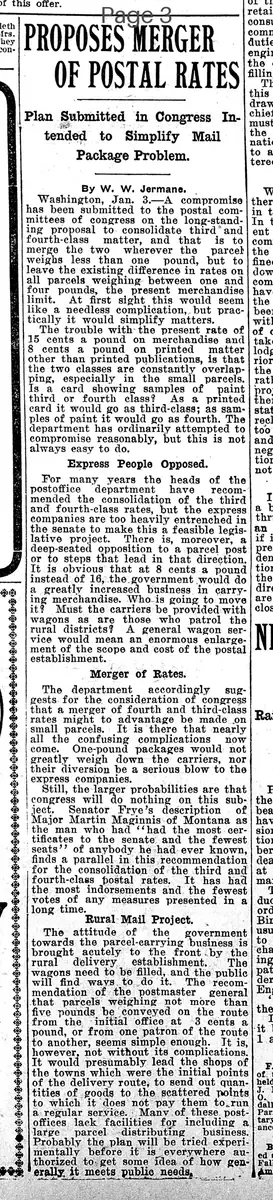
OF POSTAL RATES
Plan Submitted in Congress Intended to Simplify Mail Package Problem.
By W. W. Jermane.
Washington, Jan. 3.—A compromise has been submitted to the postal committees of congress on the long-standing proposal to consolidate third and fourth-class matter, and that is to merge the two wherever the parcel weighs less than one pound, but to leave the existing difference in rates on all parcels weighing between one and four pounds, the present merchandise limit. At first sight this would seem like a needless complication, but practically it would simplify matters.
The trouble with the present rate of 15 cents a pound on merchandise and 8 cents a pound on printed matter other than printed publications, is that the two classes are constantly overlapping, especially in the small parcels. Is a card showing samples of paint third or fourth class? As a printed card it would go as third-class; as samples of paint it would go as fourth. The department has ordinarily attempted to compromise reasonably, but this is not always easy to do.
Express People Opposed.
For many years the heads of the postoffice department have recommended the consolidation of the third and fourth-class rates, but the express companies are too heavily entrenched in the senate to make this a feasible legislative project. There is, moreover, a deep-seated opposition to a parcel post or to steps that lead in that direction.
It is obvious that at 8 cents a pound instead of 15, the government would do a greatly increased business in carrying merchandise. Who is going to move it? Must the carriers be provided with wagons as are those who patrol the rural districts? A general wagon service would mean an enormous enlargement of the scope and cost of the postal establishment.
Merger of Rates.
The department accordingly suggests for the consideration of congress that a merger of fourth and third-class rates might to advantage be made on small parcels. It is there that nearly all the confusing complications now come. One-pound packages would not greatly weigh down the carriers, nor their diversion be a serious blow to the express companies.
Still, the larger probabilities are that congress will do nothing on this subject. Senator Frye's description of Major Martin Maginnis of Montana as the man who had 'had the most certificates to the senate and the fewest seats' of anybody he had ever known, finds a parallel in this recommendation for the consolidation of the third and fourth-class postal rates. It has had the most indorsements and the fewest votes of any measures presented in a long time.
Rural-Mail Project.
The attitude of the government towards the parcel-carrying business is brought acutely to the front by the rural delivery establishment. The wagons need to be filled, and the public will find ways to do it. The recommendation of the postmaster general that parcels weighing not more than five pounds be conveyed on the route from the initial office at 3 cents a pound, or from one patron of the route to another, seems simple enough. It is, however, not without its complications.
It would presumably lead the shops of the towns which were the initial points of the delivery route, to send out quantities of goods to the scattered points to which it does not pay them to run a regular service. Many of these post-offices lack facilities for including a large parcel distributing business.
Probably the plan will be tried experimentally before it is everywhere authorized to get some idea of how generally it meets public needs.
What sub-type of article is it?
What keywords are associated?
What entities or persons were involved?
Where did it happen?
Domestic News Details
Primary Location
Washington
Event Date
Jan. 3
Key Persons
Outcome
proposal submitted but likely to receive no action from congress; potential experimental trial of rural mail plan.
Event Details
A compromise proposal to merge third and fourth-class postal rates for parcels under one pound was submitted to congressional postal committees to address overlapping classifications. Opposition from express companies and concerns over increased postal costs discussed. Related rural mail delivery recommendation for parcels up to five pounds at 3 cents per pound proposed by postmaster general.