Thank you for visiting SNEWPapers!
Sign up free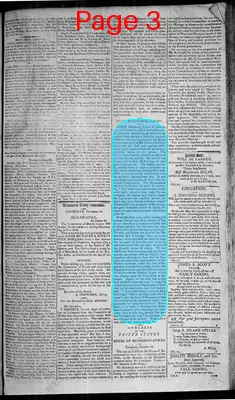
Letter to Editor
October 27, 1803
Alexandria Daily Advertiser
Alexandria, Virginia
What is this article about?
A letter to the Alexandria Daily Advertiser uses an Eastern anecdote about Sultan Mahmud to illustrate how even despots can be influenced, contrasting it with Napoleon Bonaparte's impenetrable heart, erratic temper, and uncertain destiny amid military threats.
Clipping
OCR Quality
95%
Excellent
Full Text
For the Alexandria Daily Advertiser.
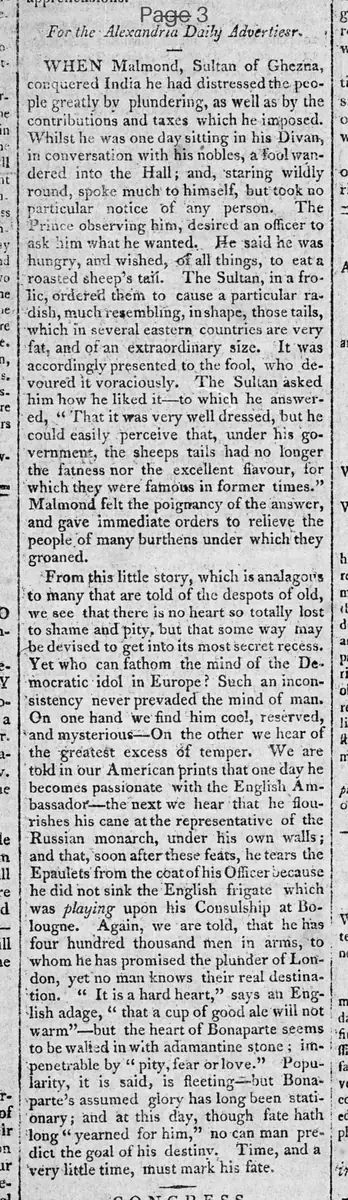
WHEN Mahmud, Sultan of Ghazna, conquered India he had distressed the people greatly by plundering, as well as by the contributions and taxes which he imposed. Whilst he was one day sitting in his Divan in conversation with his nobles, a fool wandered into the Hall; and, staring wildly round, spoke much to himself, but took no particular notice of any person. The Prince observing him, desired an officer to ask him what he wanted. He said he was hungry, and wished, of all things, to eat a roasted sheep's tail. The Sultan, in a frolic, ordered them to cause a particular radish, much resembling, in shape, those tails, which in several eastern countries are very fat, and of an extraordinary size. It was accordingly presented to the fool, who devoured it voraciously. The Sultan asked him how he liked it--to which he answered, "That it was very well dressed, but he could easily perceive that, under his government, the sheep's tails had no longer the fatness nor the excellent flavour, for which they were famous in former times." Mahmud felt the poignancy of the answer. and gave immediate orders to relieve the people of many burthens under which they groaned.
From this little story, which is analogous to many that are told of the despots of old, we see that there is no heart so totally lost to shame and pity, but that some way may be devised to get into its most secret recess. Yet who can fathom the mind of the Democratic idol in Europe? Such an inconsistency never pervaded the mind of man. On one hand we find him cool, reserved, and mysterious -On the other we hear of the greatest excess of temper. We are told in our American prints that one day he becomes passionate with the English Ambassador--the next we hear that he flourishes his cane at the representative of the Russian monarch, under his own walls; and that, soon after these feats, he tears the Epaulets from the coat of his Officer because he did not sink the English frigate which was playing upon his Consulship at Boulogne. Again, we are told, that he has four hundred thousand men in arms, to whom he has promised the plunder of London, yet no man knows their real destination. "It is a hard heart," says an English adage, "that a cup of good ale will not warm" -but the heart of Bonaparte seems to be walled in with adamantine stone; impenetrable by "pity, fear or love." Popularity, it is said, is fleeting =-but Bonaparte's assumed glory has long been stationary; and at this day, though fate hath long "yearned for him," no man can predict the goal of his destiny. Time, and a very little time, must mark his fate.
WHEN Mahmud, Sultan of Ghazna, conquered India he had distressed the people greatly by plundering, as well as by the contributions and taxes which he imposed. Whilst he was one day sitting in his Divan in conversation with his nobles, a fool wandered into the Hall; and, staring wildly round, spoke much to himself, but took no particular notice of any person. The Prince observing him, desired an officer to ask him what he wanted. He said he was hungry, and wished, of all things, to eat a roasted sheep's tail. The Sultan, in a frolic, ordered them to cause a particular radish, much resembling, in shape, those tails, which in several eastern countries are very fat, and of an extraordinary size. It was accordingly presented to the fool, who devoured it voraciously. The Sultan asked him how he liked it--to which he answered, "That it was very well dressed, but he could easily perceive that, under his government, the sheep's tails had no longer the fatness nor the excellent flavour, for which they were famous in former times." Mahmud felt the poignancy of the answer. and gave immediate orders to relieve the people of many burthens under which they groaned.
From this little story, which is analogous to many that are told of the despots of old, we see that there is no heart so totally lost to shame and pity, but that some way may be devised to get into its most secret recess. Yet who can fathom the mind of the Democratic idol in Europe? Such an inconsistency never pervaded the mind of man. On one hand we find him cool, reserved, and mysterious -On the other we hear of the greatest excess of temper. We are told in our American prints that one day he becomes passionate with the English Ambassador--the next we hear that he flourishes his cane at the representative of the Russian monarch, under his own walls; and that, soon after these feats, he tears the Epaulets from the coat of his Officer because he did not sink the English frigate which was playing upon his Consulship at Boulogne. Again, we are told, that he has four hundred thousand men in arms, to whom he has promised the plunder of London, yet no man knows their real destination. "It is a hard heart," says an English adage, "that a cup of good ale will not warm" -but the heart of Bonaparte seems to be walled in with adamantine stone; impenetrable by "pity, fear or love." Popularity, it is said, is fleeting =-but Bonaparte's assumed glory has long been stationary; and at this day, though fate hath long "yearned for him," no man can predict the goal of his destiny. Time, and a very little time, must mark his fate.
What sub-type of article is it?
Satirical
Provocative
Historical
What themes does it cover?
Politics
Military War
What keywords are associated?
Sultan Mahmud
Bonaparte
Despotism
Sheep Tail Anecdote
Military Threats
Napoleon Temper
Political Inconsistency
What entities or persons were involved?
Alexandria Daily Advertiser
Letter to Editor Details
Recipient
Alexandria Daily Advertiser
Main Argument
an anecdote about sultan mahmud shows that even despotic hearts can be reached by wit, but napoleon bonaparte's mind is unfathomable and impenetrable, with his erratic behavior and vast army's purpose unknown, foretelling his imminent downfall.
Notable Details
Anecdote Of Sultan Mahmud And The Fool With The Radish
Bonaparte's Temper With English Ambassador
Flourishes Cane At Russian Representative
Tears Epaulets From Officer Over English Frigate At Boulogne
400,000 Men Promised Plunder Of London
English Adage On Hard Hearts
Quotes On Pity, Fear, Or Love