Thank you for visiting SNEWPapers!
Sign up free
Story
November 8, 1899
The Anderson Intelligencer
Anderson, Anderson County, South Carolina
What is this article about?
Professor W.M. Hayes compares farming in Europe and America, praising Germany's forestry education while highlighting U.S. advantages in funding, organization, and innovations like sugar beet breeding, urging farmers to advance knowledge.
Clipping
OCR Quality
98%
Excellent
Full Text
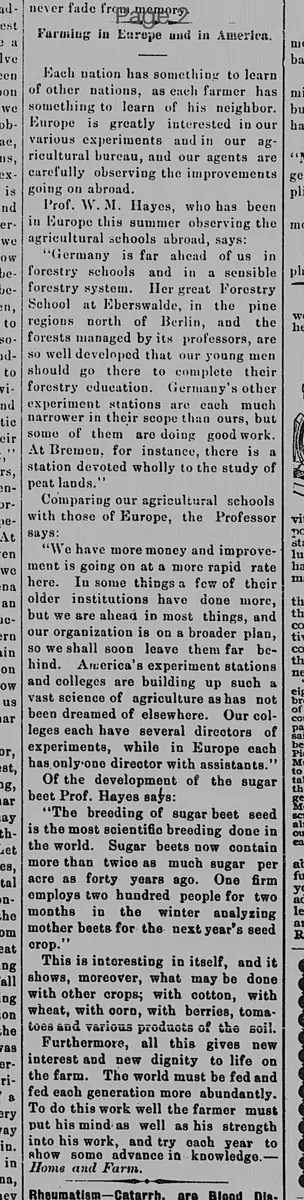
Farming in Europe and in America.
Each nation has something to learn
of other nations, as each farmer has
something to learn of his neighbor.
Europe is greatly interested in our
various experiments and in our agricultural bureau, and our agents are
carefully observing the improvements
going on abroad.
Prof. W. M. Hayes, who has been
in Europe this summer observing the
agricultural schools abroad, says:
"Germany is far ahead of us in
forestry schools and in a sensible
forestry system. Her great Forestry
School at Eberswalde, in the pine
regions north of Berlin, and the
forests managed by its professors, are
so well developed that our young men
should go there to complete their
forestry education. Germany's other
experiment stations are each much
narrower in their scope than ours, but
some of them are doing good work.
At Bremen, for instance, there is a
station devoted wholly to the study of
peat lands."
Comparing our agricultural schools
with those of Europe, the Professor
says:
"We have more money and improvement is going on at a more rapid rate
here. In some things a few of their
older institutions have done more,
but we are ahead in most things, and
our organization is on a broader plan,
so we shall soon leave them far behind. America's experiment stations
and colleges are building up such a
vast science of agriculture as has not
been dreamed of elsewhere. Our colleges each have several directors of
experiments, while in Europe each
has only one director with assistants."
Of the development of the sugar
beet Prof. Hayes says:
"The breeding of sugar beet seed
is the most scientific breeding done in
the world. Sugar beets now contain
more than twice as much sugar per
acre as forty years ago. One firm
employs two hundred people for two
months in the winter analyzing
mother beets for the next year's seed
crop.
This is interesting in itself, and it
shows, moreover, what may be done
with other crops; with cotton, with
wheat, with corn, with berries, tomatoes and various products of the soil.
Furthermore, all this gives new
interest and new dignity to life on
the farm. The world must be fed and
fed each generation more abundantly.
To do this work well the farmer must
put his mind as well as his strength
into his work, and try each year to
show some advance in knowledge."
-- Home and Farm.
Each nation has something to learn
of other nations, as each farmer has
something to learn of his neighbor.
Europe is greatly interested in our
various experiments and in our agricultural bureau, and our agents are
carefully observing the improvements
going on abroad.
Prof. W. M. Hayes, who has been
in Europe this summer observing the
agricultural schools abroad, says:
"Germany is far ahead of us in
forestry schools and in a sensible
forestry system. Her great Forestry
School at Eberswalde, in the pine
regions north of Berlin, and the
forests managed by its professors, are
so well developed that our young men
should go there to complete their
forestry education. Germany's other
experiment stations are each much
narrower in their scope than ours, but
some of them are doing good work.
At Bremen, for instance, there is a
station devoted wholly to the study of
peat lands."
Comparing our agricultural schools
with those of Europe, the Professor
says:
"We have more money and improvement is going on at a more rapid rate
here. In some things a few of their
older institutions have done more,
but we are ahead in most things, and
our organization is on a broader plan,
so we shall soon leave them far behind. America's experiment stations
and colleges are building up such a
vast science of agriculture as has not
been dreamed of elsewhere. Our colleges each have several directors of
experiments, while in Europe each
has only one director with assistants."
Of the development of the sugar
beet Prof. Hayes says:
"The breeding of sugar beet seed
is the most scientific breeding done in
the world. Sugar beets now contain
more than twice as much sugar per
acre as forty years ago. One firm
employs two hundred people for two
months in the winter analyzing
mother beets for the next year's seed
crop.
This is interesting in itself, and it
shows, moreover, what may be done
with other crops; with cotton, with
wheat, with corn, with berries, tomatoes and various products of the soil.
Furthermore, all this gives new
interest and new dignity to life on
the farm. The world must be fed and
fed each generation more abundantly.
To do this work well the farmer must
put his mind as well as his strength
into his work, and try each year to
show some advance in knowledge."
-- Home and Farm.
What sub-type of article is it?
Historical Event
Curiosity
What themes does it cover?
Exploration
Triumph
Moral Virtue
What keywords are associated?
Agriculture Comparison
Forestry Schools
Sugar Beet Breeding
Experiment Stations
Farm Progress
What entities or persons were involved?
Prof. W. M. Hayes
Where did it happen?
Europe (Germany, Bremen, Eberswalde) And America
Story Details
Key Persons
Prof. W. M. Hayes
Location
Europe (Germany, Bremen, Eberswalde) And America
Event Date
This Summer
Story Details
Professor Hayes observes European agricultural schools, noting Germany's lead in forestry but America's broader organization and rapid progress in experiment stations. He highlights scientific breeding of sugar beets doubling sugar yield and potential for other crops, emphasizing intellectual advancement in farming.