Thank you for visiting SNEWPapers!
Sign up free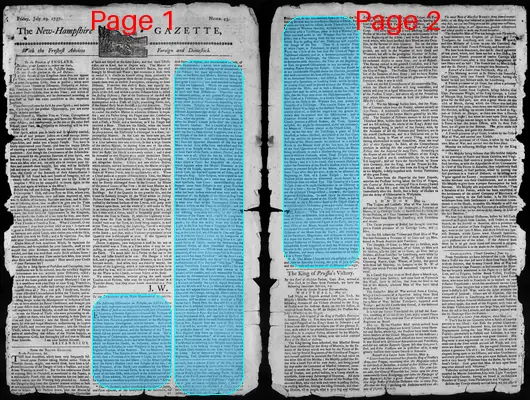
The New Hampshire Gazette
Portsmouth, Rockingham County, New Hampshire
What is this article about?
An anonymous letter to the New Hampshire Gazette educates readers on the scientific causes and types of eclipses, dispelling ancient superstitions, detailing safe observation methods, and predicting a notable solar eclipse in August and a lunar one in late July for New England.
Merged-components note: This is a continuation of the letter to the publisher about eclipses and observations; the second part was mislabeled as literary but is scientific content fitting letter_to_editor.
Clippings
1 of 2
OCR Quality
Full Text
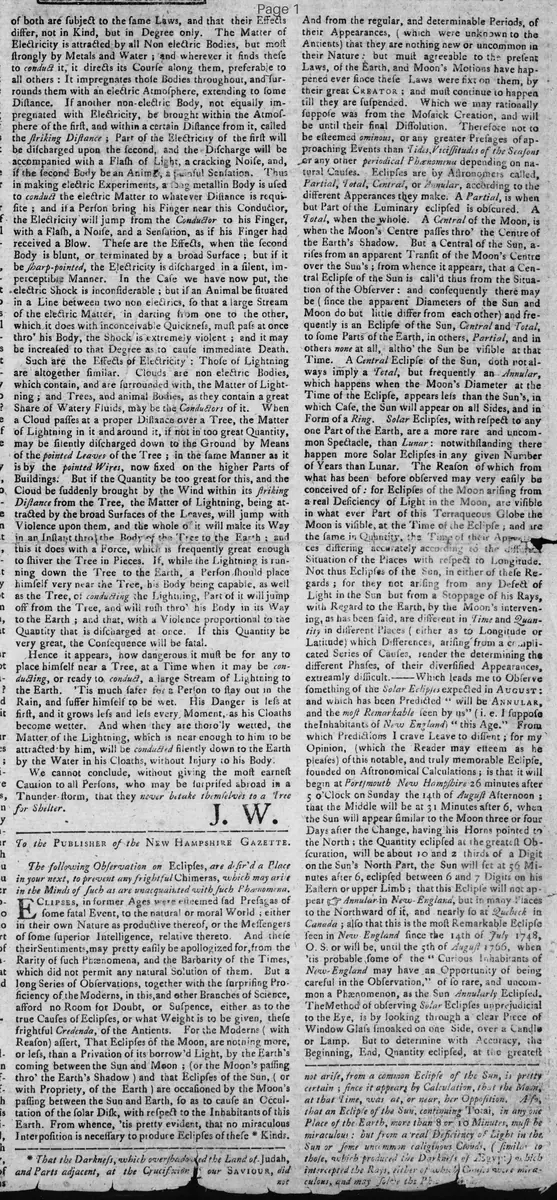
The following Observation on Eclipses, are desir'd a Place in your next, to prevent any frightful Chimeras, which may arise in the Minds of such as are unacquainted with such Phenomena.
Eclipses, in former Ages were esteemed sad Presages of some fatal Event, to the natural or moral World; either in their own Nature as productive thereof, or the Messengers of some superior Intelligence, relative thereto. And these their Sentiments, may pretty easily be apologized for, from the Rarity of such Phænomena, and the Barbarity of the Times, which did not permit any natural Solution of them. But a long Series of Observations, together with the surprising Proficiency of the Moderns, in this, and other Branches of Science, afford no Room for Doubt, or Suspense, either as to the true Causes of Eclipses, or what Weight is to be given, these frightful Credenda, of the Antients. For the Moderns (with Reason) assert, That Eclipses of the Moon, are nothing more, or less, than a Privation of its borrow'd Light, by the Earth's coming between the Sun and Moon; (or the Moon's passing thro' the Earth's Shadow) and that Eclipses of the Sun, (or with Propriety, of the Earth) are occasioned by the Moon's passing between the Sun and Earth, so as to cause an Occultation of the Solar Disk, with respect to the Inhabitants of this Earth. From whence, 'tis pretty evident, that no miraculous Interposition is necessary to produce Eclipses of these Kinds.*
That the Darkness, which overshadowed the Land of Judah And from the regular, and determinable Periods, of their Appearances, (which were unknown to the Antients) that they are nothing new or uncommon in their Nature: but must agreeable to the present Laws, of the Earth, and Moon's Motions have happen'd ever since these Laws were fixt on them, by their great Creator; and must continue to happen till they are suspended. Which we may rationally suppose was from the Mosaick Creation, and will be until their final Dissolution. Therefore not to be esteemed ominous, or any greater Presages of approaching Events than Tides, Vicissitudes of the Seasons or any other periodical Phenomena depending on natural Causes. - Eclipses are by Astronomers called, Partial, Total, Central, or Annular, according to the different Appearances they make. A Partial, is when but Part of the Luminary eclipsed is obscured. A Total, when the whole. A Central of the Moon, is when the Moon's Centre passes thro' the Centre of the Earth's Shadow. But a Central of the Sun, arises from an apparent Transit of the Moon's Centre over the Sun's; from whence it appears, that a Central Eclipse of the Sun is call'd thus from the Situation of the Observer: and consequently there may be (since the apparent Diameters of the Sun and Moon do but little differ from each other) and frequently is an Eclipse of the Sun, Central and Total. to some Parts of the Earth, in others, Partial, and in others none at all, altho' the Sun be visible at that Time. A Central Eclipse of the Sun, doth not always imply a Total, but frequently an Annular, which happens when the Moon's Diameter at the Time of the Eclipse, appears less than the Sun's, in which Case, the Sun will appear on all Sides, and in Form of a Ring. Solar Eclipses, with respect to any one Part of the Earth, are a more rare and uncommon Spectacle, than Lunar: notwithstanding there happen more Solar Eclipses in any given Number of Years than Lunar. The Reason of which from what has been before observed may very easily be conceived of: for Eclipses of the Moon arising from a real Deficiency of Light in the Moon, are visible in what ever Part of this Terraqueous Globe the Moon is visible, at the Time of the Eclipse; and are the same in Quantity, the Time of their Appearances differing accurately according to the different Situation of the Places with respect to Longitude. Not thus Eclipses of the Sun, in either of these Regards; for they not arising from any Defect of Light in the Sun but from a Stoppage of his Rays, with Regard to the Earth, by the Moon's intervening, as has been said, are different in Time and Quantity in different Places (either as to Longitude or Latitude) which Differences, arising from a complicated Series of Causes, render the determining the different Phæs, of their diversified Appearances, extremely difficult.-- Which leads me to Observe something of the Solar Eclipses expected in August: and which has been Predicted "will be Annular, and the most Remarkable seen by us" (i. e. I suppose the Inhabitants of New England) "this Age." From which Predictions I crave Leave to dissent; for my Opinion, (which the Reader may esteem as he pleases) of this notable, and truly memorable Eclipse, founded on Astronomical Calculations; is that it will begin at Portsmouth New Hampshire 26 minutes after 5 o'Clock on Sunday the 14th of August Afternoon; that the Middle will be at 3 1 Minutes after 6, when the Sun will appear similar to the Moon three or four Days after the Change, having his Horns pointed to the North; the Quantity eclipsed at the greatest Obscuration, will be about 10 and 2 thirds of a Digit on the Sun's North Part, the Sun will set at 56 Minutes after 6, eclipsed between 6 and 7 Digits on his Eastern or upper Limb; that this Eclipse will not appear Annular in New-England, but in many Places to the Northward of it, and nearly so at Quebeck in Canada: also that this is the most Remarkable Eclipse Seen in New-England since the 14th of July 1748, O. S. or will be, until the 5th of August 1766, when 'tis probable some of the Curious Inhabitants of New-England may have an Opportunity of being careful in the Observation." of so rare, and uncommon a Phænomenon, as the Sun Annularly Eclipsed.
The Method of observing Solar Eclipses unprejudicial to the Eye, is by Looking through a clear Piece of Window Glass Smoked on one Side, over a Candle or Lamp. But to determine with Accuracy, the Beginning, End, Quantity eclipsed, at the greatest not arise, from a common Eclipse of the Sun, is pretty certain; since it appears by Calculation, that the Moon, at that Time, was at, or near, her Opposition. Also, that an Eclipse of the Sun, continuing Total, in any one Place of the Earth, more than 8 or, 10 Minutes, must be miraculous: but from a real Deficiency of Light in the Sun or some uncommon caliginous Clouds, (similar to those, which produced the Darkness of Egypt:) which intercepted the Rays, either of both Conjunctions above mira- culous, and may solve this Puzzle. Obscuration, or any intermediate Space of Time, the following Method may be necessary--Darken a Room, from whence the Sun will be visible, at the Time of the Eclipse, by means of Window-Shutters, or otherways, and being provided with a Telescope, place it in such a Manner, to a Hole you must make in the Window shut for that Purpose; that a Ray coming from the Sun may pass thro' it; which Ray on passing thro' the Telescope will represent the Image of the Sun. Then if a circular Piece of white Paper, or Pasteboard, be placed exactly at the Place, the Circle of the Sun suits the Circle of Paper or Pasteboard assumed, and in a situation perpendicular to the Axis of the Telescope, the Observer will be able to determine with Accuracy, the Time of the Beginning, or End, the greatest Obscuration, or any increasing or decreasing Phases during the Eclipse. If the Sun should be at any considerable Height above the Horizon, the easiest and most convenient Method will be to place the Telescope in an horizontal Situation; and reflect a Ray thro' it by means of a Speculum, or Looking-Glass: which Speculum, or Looking Glass, must be placed without the Window shut, just under the Hole, and in such a Manner, as, that its upper Part may be raised, or lowered, as the Sun rises, or falls, that the Rays may enter the Hole horizontally. The Eye Glass of a Telescope, or a double Convex Lens, applied to the Hole in the Window shut, may answer the Purposes of a Telescope. The circular Paper or Pasteboard should be as large as the darkened Room will conveniently allow of, at least the larger it be the greater Accuracy may be attained thro' the Observation; and its diameter divided into 12 or more equal Parts. If the Clouds prevent a distinct Shadow, the Time, Quantity eclipsed, &c. might be determined, altho' not accurately, by Means of Threads placed at the Object Glass. To look on the Sun thro' the Telescope, a piece of Glass smoked, as before directed, and placed at the Eye Glass, will be needful to prevent the Rays hurting the Eye.
Eclipses of the Moon cannot be observed in a darkened Room in the Manner those of the Sun may, by Reason of the small Quantities of Light, reflected from the Moon, being insufficient to cause a Shadow during her Continuance in absolute Darkness, when Total Eclipses happen. But they may be observed by looking thro' a Telescope on the Moon; and it is to be noted, that a certain Duskiness called the Penumbra of the Earth's Shadow, which is found always to precede Eclipses of the Moon, and to continue some Time after they are over, is not to be esteemed the Beginning, or End, of a Lunar Eclipse: but the real Shadow which cannot be discovered much sooner by a Telescope than the naked Eye. The Quantity of a Lunar Eclipse is not of so much Consequence to an Observer as that of a Solar; for the Time of the Beginning and End are the principal Things desired; however, the Quantity in partial Eclipses may, 'tis most likely be ascertained by Means of Threads placed at the Object Glass, as before observed, or by a Micrometer fixed at the Object Glass, of which Chamber's Dictionary gives a particular Account of.
Thus much for the Nature, Origin and Manner of observing Eclipses-- Their Use and Advantage to Mankind, is very considerable, such as determining the Longitude of Places; (than which nothing affords greater Ease and Certainty) the Spherical Figure of the Earth, the elliptical Orbit of the Moon, beyond reasonable Doubt, Increase and Decrease of Gravity, according to the different Distances of the Moon from the Earth; also something of the Parallaxes, Magnitudes and Distances of these Bodies from the Earth--Likewise, their Use in ascertaining beyond Possibility of Deception, the Time in which any remarkable Event happened, to these the Wisdom of their Creator in the precise Regularity of their seeming irregular Motions, and many others, too numerous to be inserted in a News Paper.
N. B. The Moon I suppose will rise eclipsed 10 Digits and more on Saturday Evening, the 30th of July Instant, and the Eclipse will not be over till 26 Minutes after eight.
What sub-type of article is it?
What themes does it cover?
What keywords are associated?
What entities or persons were involved?
Letter to Editor Details
Recipient
To The Publisher Of The New Hampshire Gazette
Main Argument
eclipses are natural astronomical phenomena caused by the positions of the sun, earth, and moon, not omens or presages of events, and can be explained and predicted through science rather than superstition.
Notable Details