Thank you for visiting SNEWPapers!
Sign up free
The Wilmington Morning Star
Wilmington, New Hanover County, North Carolina
What is this article about?
Six U.S. economists at a New York symposium agreed that post-war prosperity requires tax reforms, wage policies, and government intervention, but differed on implementation details including surtaxes, productivity distribution, and fiscal deficits.
Clipping
OCR Quality
Full Text
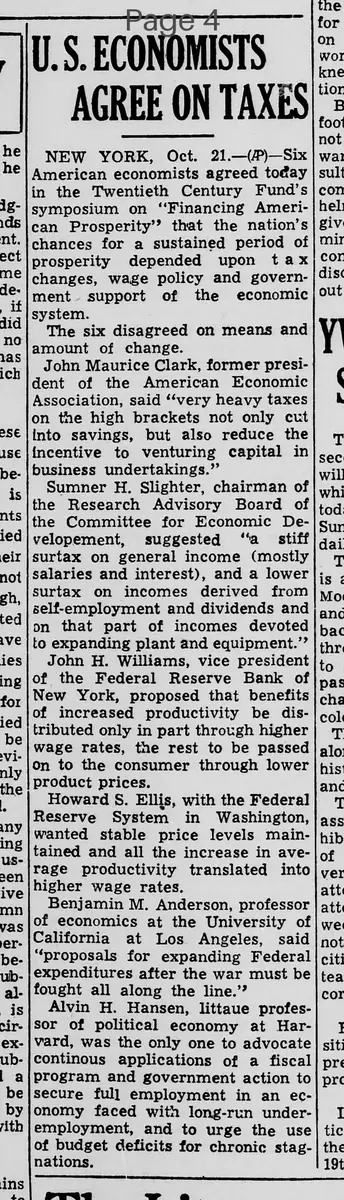
NEW YORK, Oct. 21.-(P)-Six American economists agreed today in the Twentieth Century Fund's symposium on "Financing American Prosperity' that the nation's chances for a sustained period of prosperity depended upon tax changes, wage policy and government support of the economic system.
The six disagreed on means and amount of change.
John Maurice Clark, former president of the American Economic Association, said "very heavy taxes on the high brackets not only cut into savings. but also reduce the incentive to venturing capital in business undertakings
Sumner H. Slichter. chairman of the Research Advisory Board of the Committee for Economic Development, suggested 'a stiff surtax on general income (mostly salaries and interest), and a lower surtax on incomes derived from self-employment and dividends and on that part of incomes devoted to expanding plant and equipment."
John H. Williams. vice president of the Federal Reserve Bank of New York. proposed that benefits of increased productivity be distributed only in part through higher wage rates, the rest to be passed on to the consumer through lower product prices.
Howard S. Ellis. with the Federal Reserve System in Washington, wanted stable price levels maintained and all the increase in average productivity translated into higher wage rates.
Benjamin M. Anderson, professor of economics at the University of California at Los Angeles, said "proposals for expanding Federal expenditures after the war must be fought all along the line."
Alvin H. Hansen, littaue professor of political economy at Harvard, was the only one to advocate continous applications of a fiscal program and government action to secure full employment in an economy faced with long-run underemployment, and to urge the use of budget deficits for chronic stagations.
What sub-type of article is it?
What keywords are associated?
What entities or persons were involved?
Where did it happen?
Domestic News Details
Primary Location
New York
Event Date
Oct. 21.
Key Persons
Event Details
Six American economists agreed in the Twentieth Century Fund's symposium on 'Financing American Prosperity' that sustained prosperity depends on tax changes, wage policy, and government support. They disagreed on specifics: Clark on heavy taxes reducing incentives; Slichter on surtaxes; Williams on distributing productivity benefits via wages and prices; Ellis on stable prices and higher wages; Anderson opposing expanded federal expenditures; Hansen advocating fiscal programs and deficits for full employment.