Thank you for visiting SNEWPapers!
Sign up free
Story
April 12, 1935
The Midland Journal
Rising Sun, Cecil County, Maryland
What is this article about?
US Department of Agriculture reports sufficient seed supplies, especially legumes, to plant over 30 million acres of grass and hay crops in 1935, exceeding normal 29 million acres, for soil-building and reserve accumulation in drought areas.
Clipping
OCR Quality
98%
Excellent
Full Text
Seed for Pasture Hay Is Available
Supply Believed Sufficient for Planting More Than 30,000,000 Acres.
Supplied by the United States Department of Agriculture.-WNU Service.
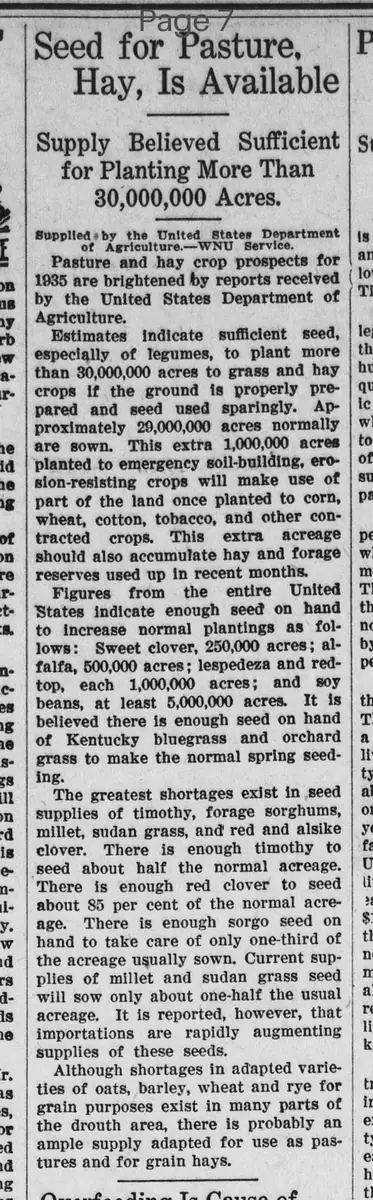
Pasture and hay crop prospects for 1935 are brightened by reports received by the United States Department of Agriculture. Estimates indicate sufficient seed, especially of legumes, to plant more than 30,000,000 acres to grass and hay crops if the ground is properly prepared and seed used sparingly. Approximately 29,000,000 acres normally are sown. This extra 1,000,000 acres planted to emergency soil-building, erosion-resisting crops will make use of part of the land once planted to corn, wheat, cotton, tobacco, and other contracted crops. This extra acreage should also accumulate hay and forage reserves used up in recent months. Figures from the entire United States indicate enough seed on hand to increase normal plantings as follows: Sweet clover, 250,000 acres; alfalfa, 500,000 acres; lespedeza and red top, each 1,000,000 acres; and soy beans, at least 5,000,000 acres. It is believed there is enough seed on hand of Kentucky bluegrass and orchard grass to make the normal spring seeding. The greatest shortages exist in seed supplies of timothy, forage sorghums, millet, sudan grass, and red and alsike clover. There is enough timothy to seed about half the normal acreage. There is enough red clover to seed about 85 per cent of the normal acreage. There is enough sorgo seed on hand to take care of only one-third of the acreage usually sown. Current supplies of millet and sudan grass seed will sow only about one-half the usual acreage. It is reported, however, that importations are rapidly augmenting supplies of these seeds. Although shortages in adapted varieties of oats, barley, wheat and rye for grain purposes exist in many parts of the drouth area, there is probably an ample supply adapted for use as pastures and for grain hays.
Supply Believed Sufficient for Planting More Than 30,000,000 Acres.
Supplied by the United States Department of Agriculture.-WNU Service.
Pasture and hay crop prospects for 1935 are brightened by reports received by the United States Department of Agriculture. Estimates indicate sufficient seed, especially of legumes, to plant more than 30,000,000 acres to grass and hay crops if the ground is properly prepared and seed used sparingly. Approximately 29,000,000 acres normally are sown. This extra 1,000,000 acres planted to emergency soil-building, erosion-resisting crops will make use of part of the land once planted to corn, wheat, cotton, tobacco, and other contracted crops. This extra acreage should also accumulate hay and forage reserves used up in recent months. Figures from the entire United States indicate enough seed on hand to increase normal plantings as follows: Sweet clover, 250,000 acres; alfalfa, 500,000 acres; lespedeza and red top, each 1,000,000 acres; and soy beans, at least 5,000,000 acres. It is believed there is enough seed on hand of Kentucky bluegrass and orchard grass to make the normal spring seeding. The greatest shortages exist in seed supplies of timothy, forage sorghums, millet, sudan grass, and red and alsike clover. There is enough timothy to seed about half the normal acreage. There is enough red clover to seed about 85 per cent of the normal acreage. There is enough sorgo seed on hand to take care of only one-third of the acreage usually sown. Current supplies of millet and sudan grass seed will sow only about one-half the usual acreage. It is reported, however, that importations are rapidly augmenting supplies of these seeds. Although shortages in adapted varieties of oats, barley, wheat and rye for grain purposes exist in many parts of the drouth area, there is probably an ample supply adapted for use as pastures and for grain hays.
What sub-type of article is it?
Agricultural Report
News Update
What themes does it cover?
Recovery
Nature
What keywords are associated?
Seed Supply
Pasture Hay
1935 Crops
Legumes
Drought Area
Soil Building
What entities or persons were involved?
United States Department Of Agriculture
Where did it happen?
United States, Drouth Area
Story Details
Key Persons
United States Department Of Agriculture
Location
United States, Drouth Area
Event Date
1935
Story Details
Reports indicate sufficient seed for over 30 million acres of grass and hay crops, exceeding normal plantings, with specifics on increases for various seeds and shortages in others, aiding soil-building and reserves post-drought depletion.