Thank you for visiting SNEWPapers!
Sign up free
Editorial
December 8, 1926
The Bismarck Tribune
Bismarck, Mandan, Burleigh County, Morton County, North Dakota
What is this article about?
Editorial defends German ambassador Baron von Maltzan's display of the German flag at the Washington embassy on Armistice Day, against German criticism. Foreign Minister Stresemann argues the U.S. commemorates peace, not victory. Compares to England's flag on July 4.
Clipping
OCR Quality
100%
Excellent
Full Text
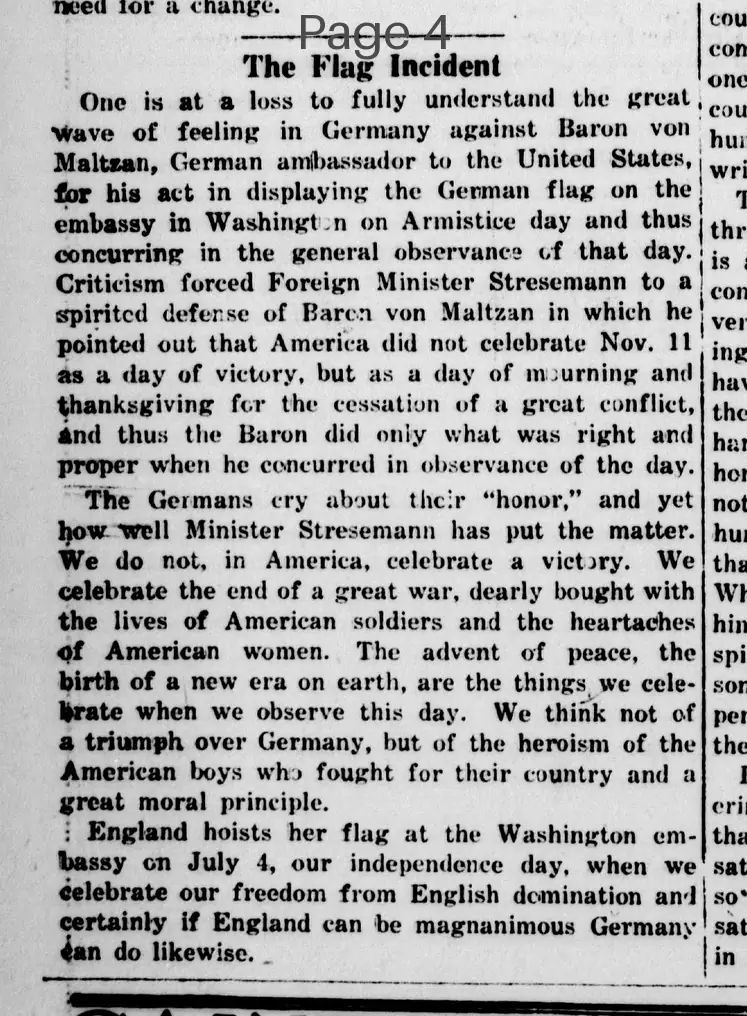
The Flag Incident
One is at a loss to fully understand the great
wave of feeling in Germany against Baron von
Maltzan, German ambassador to the United States,
for his act in displaying the German flag on the
embassy in Washington on Armistice day and thus
concurring in the general observance of that day.
Criticism forced Foreign Minister Stresemann to a
spirited defense of Baron von Maltzan in which he
pointed out that America did not celebrate Nov. 11
as a day of victory, but as a day of mourning and
thanksgiving for the cessation of a great conflict,
and thus the Baron did only what was right and
proper when he concurred in observance of the day.
The Germans cry about their "honor," and yet
how well Minister Stresemann has put the matter.
We do not, in America, celebrate a victory. We
celebrate the end of a great war, dearly bought with
the lives of American soldiers and the heartaches
of American women. The advent of peace, the
birth of a new era on earth, are the things we celebrate when we observe this day. We think not of
a triumph over Germany, but of the heroism of the
American boys who fought for their country and a
great moral principle.
England hoists her flag at the Washington em-
bassy on July 4, our independence day, when we
celebrate our freedom from English domination and
certainly if England can be magnanimous Germany
can do likewise.
One is at a loss to fully understand the great
wave of feeling in Germany against Baron von
Maltzan, German ambassador to the United States,
for his act in displaying the German flag on the
embassy in Washington on Armistice day and thus
concurring in the general observance of that day.
Criticism forced Foreign Minister Stresemann to a
spirited defense of Baron von Maltzan in which he
pointed out that America did not celebrate Nov. 11
as a day of victory, but as a day of mourning and
thanksgiving for the cessation of a great conflict,
and thus the Baron did only what was right and
proper when he concurred in observance of the day.
The Germans cry about their "honor," and yet
how well Minister Stresemann has put the matter.
We do not, in America, celebrate a victory. We
celebrate the end of a great war, dearly bought with
the lives of American soldiers and the heartaches
of American women. The advent of peace, the
birth of a new era on earth, are the things we celebrate when we observe this day. We think not of
a triumph over Germany, but of the heroism of the
American boys who fought for their country and a
great moral principle.
England hoists her flag at the Washington em-
bassy on July 4, our independence day, when we
celebrate our freedom from English domination and
certainly if England can be magnanimous Germany
can do likewise.
What sub-type of article is it?
Foreign Affairs
War Or Peace
What keywords are associated?
Armistice Day
German Ambassador
Flag Incident
Post War Diplomacy
Peace Celebration
What entities or persons were involved?
Baron Von Maltzan
Foreign Minister Stresemann
Germany
United States
England
Editorial Details
Primary Topic
Defense Of German Ambassador's Flag Display On Armistice Day
Stance / Tone
Supportive Of Diplomatic Gesture And Critical Of German Overreaction
Key Figures
Baron Von Maltzan
Foreign Minister Stresemann
Germany
United States
England
Key Arguments
America Observes Armistice Day As Mourning And Thanksgiving For Peace, Not Victory
Baron Von Maltzan Appropriately Concurred In The Observance
Germans Overly Concerned With Honor Despite The Non Victorious Nature Of The Day
England Magnanimously Hoists Flag On July 4, So Germany Should Do Likewise