Thank you for visiting SNEWPapers!
Sign up free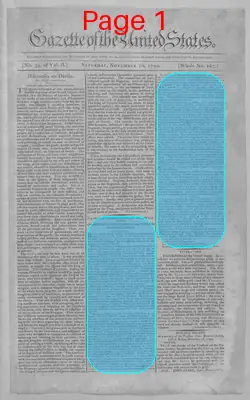
Literary
November 20, 1790
Gazette Of The United States
New York, New York County, New York
What is this article about?
In this excerpt from Noah Webster's 'Dissertations on the English Language,' he critiques modern corruptions in English pronunciation, arguing that true custom must be national and uniform, not local dialects or elite innovations. He challenges Horace's rule on custom, cites philologer Michaelis on democratic language rights, and quotes Pope on learned errors, emphasizing propriety over caprice.
Clipping
OCR Quality
95%
Excellent
Full Text
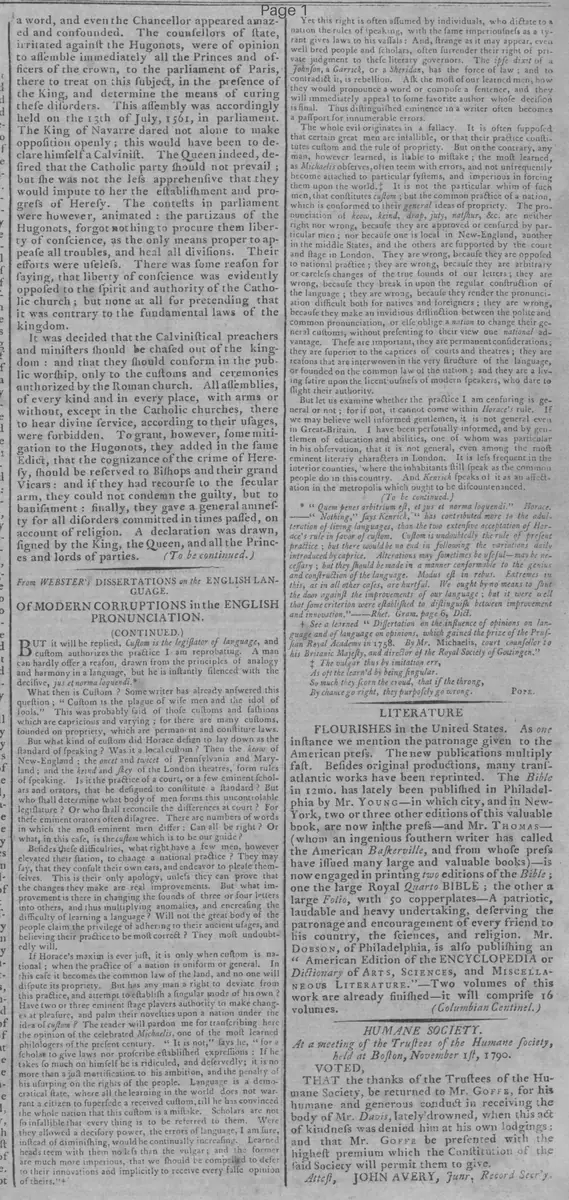
From WEBSTER's DISSERTATIONS on the ENGLISH LANGUAGE.
Of MODERN CORRUPTIONS in the ENGLISH PRONUNCIATION.
(CONTINUED.)
BUT it will be replied, Custom is the legislator of language, and custom authorizes the practice I am reprobating. A man can hardly offer a reason, drawn from the principles of analogy and harmony in a language, but he is instantly silenced with the decisive, jus et norma loquendi.*
What then is Custom? Some writer has already answered this question; "Custom is the plague of wise men and the idol of fools." This was probably said of those customs and fashions which are capricious and varying; for there are many customs, founded on propriety, which are permanent and constitute laws. But what kind of custom did Horace deign to lay down as the standard of speaking? Was it a local custom? Then the keow of New-England; the oncet and twicet of Pennsylvania and Maryland; and the keind and key of the London theatres, form rules of speaking. Is it the practice of a court, or a few eminent scholars and orators, that he deigned to constitute a standard? But who shall determine what body of men forms this uncontrollable legislature? Or who shall reconcile the differences at court? For these eminent orators often disagree. There are numbers of words in which the most eminent men differ: Can all be right? Or what, in this case, is the custom which is to be our guide?
Besides these difficulties, what right have a few men, however elevated their station, to change a national practice? They may say, that they consult their own ears, and endeavor to please themselves. This is their only apology, unless they can prove that the changes they make are real improvements. But what improvement is there in changing the sounds of three or four letters into others, and thus multiplying anomalies, and increasing the difficulty of learning a language? Will not the great body of the people claim the privilege of adhering to their ancient usages, and believing their practice to be most correct? They most undoubtedly will.
If Horace's maxim is ever just, it is only when custom is national; when the practice of a nation is uniform or general. In this case it becomes the common law of the land, and no one will dispute its propriety. But has any man a right to deviate from this practice, and attempt to establish a singular mode of his own? Have two or three eminent stage players authority to make changes at pleasure, and palm their novelties upon a nation under the idea of custom? The reader will pardon me for transcribing here the opinion of the celebrated Michaelis, one of the most learned philologers of the present century. "It is not," says he, "for a scholar to give laws nor prescribe established expressions: If he takes so much on himself he is ridiculed, and deservedly; it is no more than a just mortification to his ambition, and the penalty of his usurping on the rights of the people. Language is a democratical state, where all the learning in the world does not warrant a citizen to supersede a received custom, till he has convinced the whole nation that this custom is a mistake. Scholars are not so infallible that every thing is to be referred to them. Were they allowed a decisive power, the errors of language, I am sure, instead of diminishing, would be continually increasing. Learned heads teem with them no less than the vulgar; and the former are much more imperious, that we should be compelled to defer to their innovations and implicitly to receive every false opinion of theirs."†
Yet this right is often assumed by individuals, who dictate to a nation the rules of speaking, with the same imperiousness as a tyrant gives laws to his vassals: And, strange as it may appear, even well bred people and scholars, often surrender their right of private judgment to these literary governors. The ipse dixit of Johnson, a Garrick, or a Sheridan, has the force of law; and to contradict it, is rebellion. Ask the most of our learned men, how they would pronounce a word or compose a sentence, and they will immediately appeal to some favorite author whose decision is final. Thus distinguished eminence in a writer often becomes a passport for innumerable errors.
The whole evil originates in a fallacy. It is often supposed that certain great men are infallible, or that their practice constitutes custom and the rule of propriety. But on the contrary, any man, however learned, is liable to mistake; the most learned, as Michaelis observes, often teem with errors, and not unfrequently become attached to particular systems, and imperious in forcing them upon the world. It is not the particular whim of such men, that constitutes custom; but the common practice of a nation, which is conformed to their general ideas of propriety. The pronunciation of keow, keind, drap, juty, natshur, &c. are neither right nor wrong, because they are approved or censured by particular men; nor because one is local in New-England, another in the middle States, and the others are supported by the court and stage in London. They are wrong, because they are opposed to national practice; they are wrong, because they are arbitrary or careless changes of the true sounds of our letters; they are wrong, because they break in upon the regular construction of the language; they are wrong, because they render the pronunciation difficult both for natives and foreigners; they are wrong, because they make an invidious distinction between the polite and common pronunciation, or else oblige a nation to change their general customs, without presenting to their view one national advantage. These are important, they are permanent considerations; they are superior to the caprices of courts and theatres; they are reasons that are interwoven in the very structure of the language, or founded on the common law of the nation; and they are a living satire upon the licentiousness of modern speakers, who dare to slight their authority.
But let us examine whether the practice I am censuring is general or not; for if not, it cannot come within Horace's rule. If we may believe well informed gentlemen, it is not general even in Great-Britain. I have been personally informed, and by gentlemen of education and abilities, one of whom was particular in his observation, that it is not general, even among the most eminent literary characters in London. It is less frequent in the interior counties, where the inhabitants still speak as the common people do in this country. And Kenrick speaks of it as an affectation in the metropolis which ought to be discountenanced.*
"Nothing," says Kenrick, "has contributed more to the adulteration of living languages, than the two extensive acceptation of Horace's rule in favor of custom. Custom is undoubtedly the rule of present practice; but there would be no end in following the variations daily introduced by caprice. Alterations may sometimes be useful-may be necessary; but they should be made in a manner conformable to the genius and construction of the language. Modus et in rebus. Extremes in this, as in all other cases, are hurtful. We ought by no means to shut the door against the improvements of our language; but it were well that some criterion were established to distinguish between improvement and innovation."—Rhet. Gram. page 6, Dict.
+ See a learned "Dissertation on the influence of opinions on language and of language on opinions, which gained the prize of the Prussian Royal Academy in 1758. By Mr. Michaelis, court counsellor to his Britannic Majesty, and director of the Royal Society of Gottingen."
The vulgar thus by imitation err,
As oft the learn'd by being singular.
So much they scorn the crowd, that if the throng,
By chance go right, they purposely go wrong
POPE.
(To be continued.)
Of MODERN CORRUPTIONS in the ENGLISH PRONUNCIATION.
(CONTINUED.)
BUT it will be replied, Custom is the legislator of language, and custom authorizes the practice I am reprobating. A man can hardly offer a reason, drawn from the principles of analogy and harmony in a language, but he is instantly silenced with the decisive, jus et norma loquendi.*
What then is Custom? Some writer has already answered this question; "Custom is the plague of wise men and the idol of fools." This was probably said of those customs and fashions which are capricious and varying; for there are many customs, founded on propriety, which are permanent and constitute laws. But what kind of custom did Horace deign to lay down as the standard of speaking? Was it a local custom? Then the keow of New-England; the oncet and twicet of Pennsylvania and Maryland; and the keind and key of the London theatres, form rules of speaking. Is it the practice of a court, or a few eminent scholars and orators, that he deigned to constitute a standard? But who shall determine what body of men forms this uncontrollable legislature? Or who shall reconcile the differences at court? For these eminent orators often disagree. There are numbers of words in which the most eminent men differ: Can all be right? Or what, in this case, is the custom which is to be our guide?
Besides these difficulties, what right have a few men, however elevated their station, to change a national practice? They may say, that they consult their own ears, and endeavor to please themselves. This is their only apology, unless they can prove that the changes they make are real improvements. But what improvement is there in changing the sounds of three or four letters into others, and thus multiplying anomalies, and increasing the difficulty of learning a language? Will not the great body of the people claim the privilege of adhering to their ancient usages, and believing their practice to be most correct? They most undoubtedly will.
If Horace's maxim is ever just, it is only when custom is national; when the practice of a nation is uniform or general. In this case it becomes the common law of the land, and no one will dispute its propriety. But has any man a right to deviate from this practice, and attempt to establish a singular mode of his own? Have two or three eminent stage players authority to make changes at pleasure, and palm their novelties upon a nation under the idea of custom? The reader will pardon me for transcribing here the opinion of the celebrated Michaelis, one of the most learned philologers of the present century. "It is not," says he, "for a scholar to give laws nor prescribe established expressions: If he takes so much on himself he is ridiculed, and deservedly; it is no more than a just mortification to his ambition, and the penalty of his usurping on the rights of the people. Language is a democratical state, where all the learning in the world does not warrant a citizen to supersede a received custom, till he has convinced the whole nation that this custom is a mistake. Scholars are not so infallible that every thing is to be referred to them. Were they allowed a decisive power, the errors of language, I am sure, instead of diminishing, would be continually increasing. Learned heads teem with them no less than the vulgar; and the former are much more imperious, that we should be compelled to defer to their innovations and implicitly to receive every false opinion of theirs."†
Yet this right is often assumed by individuals, who dictate to a nation the rules of speaking, with the same imperiousness as a tyrant gives laws to his vassals: And, strange as it may appear, even well bred people and scholars, often surrender their right of private judgment to these literary governors. The ipse dixit of Johnson, a Garrick, or a Sheridan, has the force of law; and to contradict it, is rebellion. Ask the most of our learned men, how they would pronounce a word or compose a sentence, and they will immediately appeal to some favorite author whose decision is final. Thus distinguished eminence in a writer often becomes a passport for innumerable errors.
The whole evil originates in a fallacy. It is often supposed that certain great men are infallible, or that their practice constitutes custom and the rule of propriety. But on the contrary, any man, however learned, is liable to mistake; the most learned, as Michaelis observes, often teem with errors, and not unfrequently become attached to particular systems, and imperious in forcing them upon the world. It is not the particular whim of such men, that constitutes custom; but the common practice of a nation, which is conformed to their general ideas of propriety. The pronunciation of keow, keind, drap, juty, natshur, &c. are neither right nor wrong, because they are approved or censured by particular men; nor because one is local in New-England, another in the middle States, and the others are supported by the court and stage in London. They are wrong, because they are opposed to national practice; they are wrong, because they are arbitrary or careless changes of the true sounds of our letters; they are wrong, because they break in upon the regular construction of the language; they are wrong, because they render the pronunciation difficult both for natives and foreigners; they are wrong, because they make an invidious distinction between the polite and common pronunciation, or else oblige a nation to change their general customs, without presenting to their view one national advantage. These are important, they are permanent considerations; they are superior to the caprices of courts and theatres; they are reasons that are interwoven in the very structure of the language, or founded on the common law of the nation; and they are a living satire upon the licentiousness of modern speakers, who dare to slight their authority.
But let us examine whether the practice I am censuring is general or not; for if not, it cannot come within Horace's rule. If we may believe well informed gentlemen, it is not general even in Great-Britain. I have been personally informed, and by gentlemen of education and abilities, one of whom was particular in his observation, that it is not general, even among the most eminent literary characters in London. It is less frequent in the interior counties, where the inhabitants still speak as the common people do in this country. And Kenrick speaks of it as an affectation in the metropolis which ought to be discountenanced.*
"Nothing," says Kenrick, "has contributed more to the adulteration of living languages, than the two extensive acceptation of Horace's rule in favor of custom. Custom is undoubtedly the rule of present practice; but there would be no end in following the variations daily introduced by caprice. Alterations may sometimes be useful-may be necessary; but they should be made in a manner conformable to the genius and construction of the language. Modus et in rebus. Extremes in this, as in all other cases, are hurtful. We ought by no means to shut the door against the improvements of our language; but it were well that some criterion were established to distinguish between improvement and innovation."—Rhet. Gram. page 6, Dict.
+ See a learned "Dissertation on the influence of opinions on language and of language on opinions, which gained the prize of the Prussian Royal Academy in 1758. By Mr. Michaelis, court counsellor to his Britannic Majesty, and director of the Royal Society of Gottingen."
The vulgar thus by imitation err,
As oft the learn'd by being singular.
So much they scorn the crowd, that if the throng,
By chance go right, they purposely go wrong
POPE.
(To be continued.)
What sub-type of article is it?
Essay
What themes does it cover?
Social Manners
Political
Moral Virtue
What keywords are associated?
English Pronunciation
Language Custom
National Practice
Horace Rule
Michaelis Opinion
Pope Quote
What entities or persons were involved?
Webster
Literary Details
Title
Of Modern Corruptions In The English Pronunciation.
Author
Webster
Subject
Custom As The Legislator Of Language And Critique Of Pronunciation Corruptions
Form / Style
Argumentative Prose Dissertation
Key Lines
Custom Is The Plague Of Wise Men And The Idol Of Fools.
Language Is A Democratical State, Where All The Learning In The World Does Not Warrant A Citizen To Supersede A Received Custom, Till He Has Convinced The Whole Nation That This Custom Is A Mistake.
The Vulgar Thus By Imitation Err,
As Oft The Learn'd By Being Singular.
So Much They Scorn The Crowd, That If The Throng,
By Chance Go Right, They Purposely Go Wrong