Thank you for visiting SNEWPapers!
Sign up free
Editorial
June 20, 1804
The National Intelligencer And Washington Advertiser
Washington, District Of Columbia
What is this article about?
Editorial excerpts Miss Williams' book on Louis XVI's correspondence, noting her steadfast liberty advocacy post-French Revolution. Quotes Turgot's unpublished work viewing the American Revolution as advancing human perfectibility, with hopes fulfilled under the current U.S. president.
Clipping
OCR Quality
98%
Excellent
Full Text
WASHINGTON CITY.
WEDNESDAY, JUNE 20.
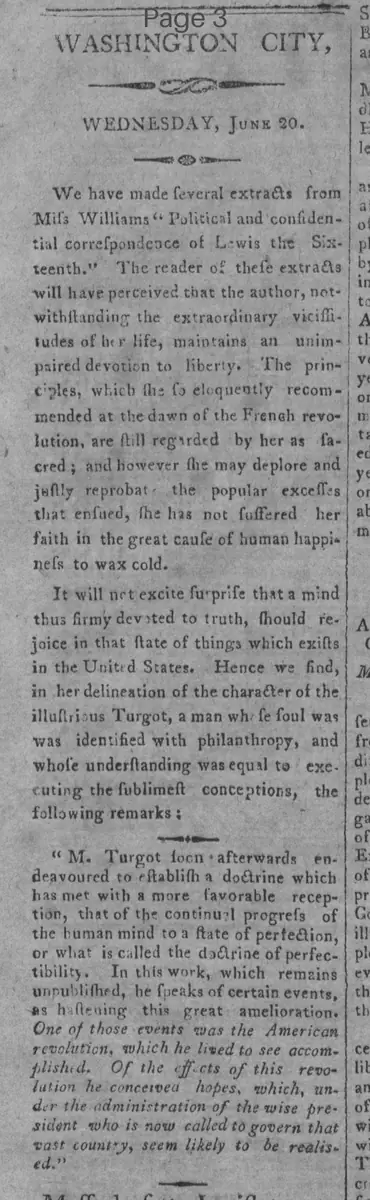
We have made several extracts from Miss Williams' "Political and confidential correspondence of Lewis the Sixteenth." The reader of these extracts will have perceived that the author, notwithstanding the extraordinary vicissitudes of her life, maintains an unimpaired devotion to liberty. The principles, which she so eloquently recommended at the dawn of the French revolution, are still regarded by her as sacred; and however she may deplore and justly reprobate the popular excesses that ensued, she has not suffered her faith in the great cause of human happiness to wax cold.
It will not excite surprise that a mind thus firmly devoted to truth, should rejoice in that state of things which exists in the United States. Hence we find, in her delineation of the character of the illustrious Turgot, a man whose soul was identified with philanthropy, and whose understanding was equal to executing the sublimest conceptions, the following remarks:
"M. Turgot soon afterwards endeavoured to establish a doctrine which has met with a more favorable reception, that of the continual progress of the human mind to a state of perfection, or what is called the doctrine of perfectibility. In this work, which remains unpublished, he speaks of certain events, as hastening this great amelioration. One of those events was the American revolution, which he lived to see accomplished. Of the effects of this revolution he conceived hopes, which, under the administration of the wise president who is now called to govern that vast country, seem likely to be realized."
WEDNESDAY, JUNE 20.
We have made several extracts from Miss Williams' "Political and confidential correspondence of Lewis the Sixteenth." The reader of these extracts will have perceived that the author, notwithstanding the extraordinary vicissitudes of her life, maintains an unimpaired devotion to liberty. The principles, which she so eloquently recommended at the dawn of the French revolution, are still regarded by her as sacred; and however she may deplore and justly reprobate the popular excesses that ensued, she has not suffered her faith in the great cause of human happiness to wax cold.
It will not excite surprise that a mind thus firmly devoted to truth, should rejoice in that state of things which exists in the United States. Hence we find, in her delineation of the character of the illustrious Turgot, a man whose soul was identified with philanthropy, and whose understanding was equal to executing the sublimest conceptions, the following remarks:
"M. Turgot soon afterwards endeavoured to establish a doctrine which has met with a more favorable reception, that of the continual progress of the human mind to a state of perfection, or what is called the doctrine of perfectibility. In this work, which remains unpublished, he speaks of certain events, as hastening this great amelioration. One of those events was the American revolution, which he lived to see accomplished. Of the effects of this revolution he conceived hopes, which, under the administration of the wise president who is now called to govern that vast country, seem likely to be realized."
What sub-type of article is it?
Foreign Affairs
Constitutional
What keywords are associated?
Liberty
French Revolution
American Revolution
Turgot
Perfectibility
Human Progress
What entities or persons were involved?
Miss Williams
Lewis The Sixteenth
Turgot
American President
Editorial Details
Primary Topic
Miss Williams' Devotion To Liberty And Turgot's Views On The American Revolution
Stance / Tone
Rejoicing In American Liberty And Human Progress
Key Figures
Miss Williams
Lewis The Sixteenth
Turgot
American President
Key Arguments
Author Maintains Devotion To Liberty Despite French Revolution Excesses
Turgot Advocated Doctrine Of Human Perfectibility
American Revolution Seen As Hastening Human Amelioration
Hopes For American Revolution's Effects Likely Realized Under Current U.S. President