Thank you for visiting SNEWPapers!
Sign up free
Lewiston Evening Teller
Lewiston, Nez Perce County, Idaho
What is this article about?
In Chicago, millionaire Charles E. Brown sues his socially prominent wife for divorce, accusing her of being a habitual drunkard for six years despite treatment efforts. She denies the charges as ridiculous, vows not to speak ill of him, and seeks $500 monthly alimony plus fees, amid surprise in society circles.
Clipping
OCR Quality
Full Text
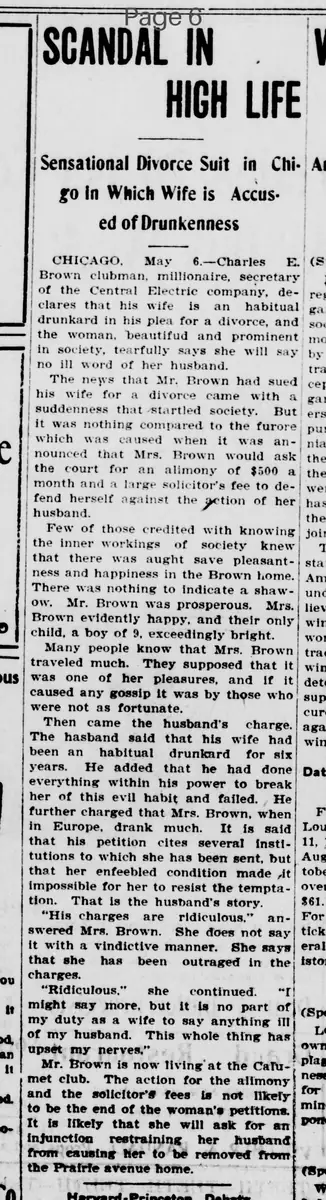
Chicago In Which Wife is Accused
of Drunkenness
CHICAGO.
May 6-Charles
E.
Brown clubman. millionaire, secretary
of the Central Electric company, declares that his wife
is
an habitual
drunkard in his plea for a divorce, and
the woman, beautiful and prominent
in society, tearfully says she will say
no ill word of her husband.
The news that Mr. Brown had sued
his wife for a divorce came with a
suddenness that startled society. But
it was nothing compared to the furore
which was caused when it was announced that Mrs. Brown would ask
the court for an alimony of $500 a
month and a large solicitor's fee to defend herself against the action of her
husband.
Few of those credited with knowing
the inner workings of society knew
that there was aught save pleasantness and happiness in the Brown home.
There was nothing to indicate a shadow. Mr. Brown was prosperous. Mrs.
Brown evidently happy, and their only
child, a boy of 9, exceedingly bright.
Many people know that Mrs. Brown
traveled much. They supposed that it
was one of her pleasures. and if it
caused any gossip it was by those who
were not as fortunate.
Then came the husband's charge.
The husband said that his wife had
been an habitual
drunkard for six
years. He added that he had done
everything within his power to break
her of this evil habit and failed. He
further charged that Mrs. Brown, when
in Europe, drank much. It is said
that his petition cites several institutions to which she has been sent, but
that her enfeebled condition made it
impossible for her to resist the temptation. That is the husband's story.
"His charges
are
ridiculous."
answered Mrs. Brown.
She does not say
it with a vindictive manner. She says
that she has been
outraged in the
charges.
"Ridiculous."
she
continued.
I might say more, but it is no part of
my duty as a wife to say anything ill
of my husband. This whole thing has
upset my nerves."
Mr. Brown is now living at the Calumet club. The action for the alimony
and the solicitor's fees is not likely
to be the end of the woman's petitions.
It is likely
that she will ask for an
injunction
restraining.
her husband
from causing her to be removed from
the Prairie avenue home.
What sub-type of article is it?
What themes does it cover?
What keywords are associated?
What entities or persons were involved?
Where did it happen?
Story Details
Key Persons
Location
Chicago
Event Date
May 6
Story Details
Charles E. Brown, a wealthy Chicago clubman, sues his wife for divorce, charging her with six years of habitual drunkenness despite his efforts to cure her, including stays in institutions. The socially prominent Mrs. Brown denies the accusations as ridiculous, refuses to speak ill of him, and seeks $500 monthly alimony, solicitor fees, and an injunction to remain in their Prairie Avenue home.