Thank you for visiting SNEWPapers!
Sign up free
Providence Patriot, Columbian Phenix
Providence, Providence County, Rhode Island
What is this article about?
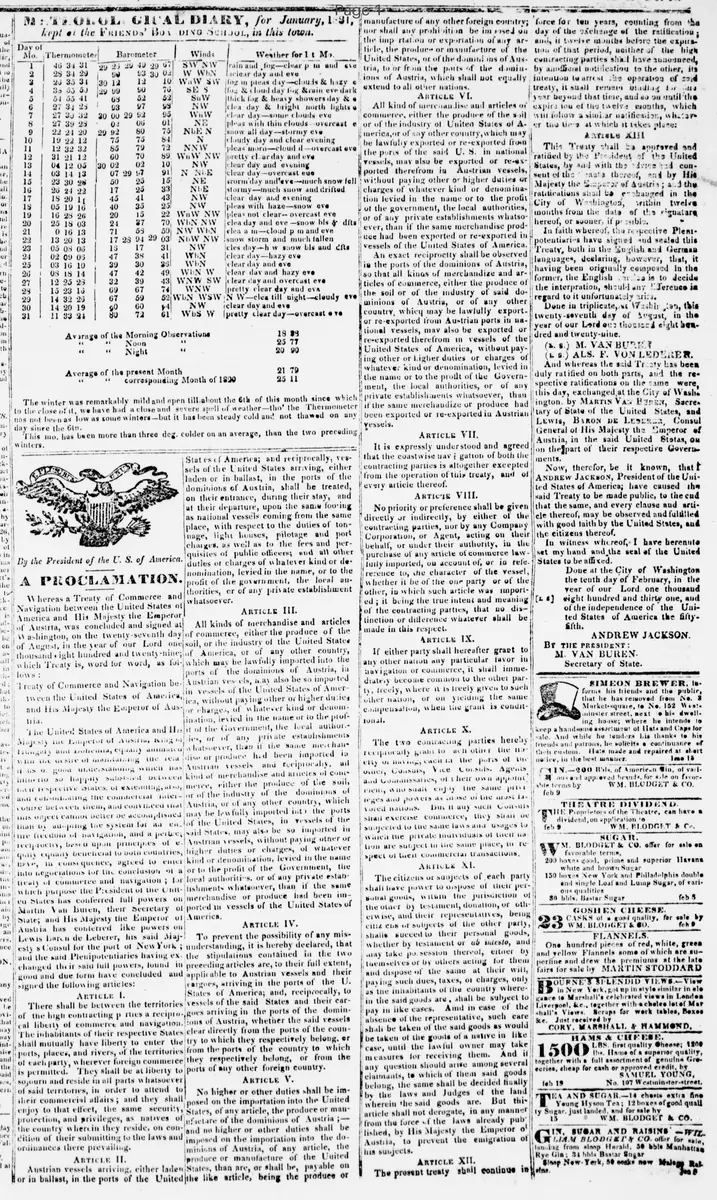
Proclamation by President Andrew Jackson announcing the ratification of the Treaty of Commerce and Navigation between the United States and Austria, signed August 27, 1829, in Washington, and ratifications exchanged February 10, 1831. The treaty establishes reciprocal trade, navigation rights, and most-favored-nation status.
Merged-components note: Image spatially adjacent and directly above the treaty proclamation text, likely an illustrative element for the foreign news article.
Clipping
OCR Quality
Full Text
A PROCLAMATION.
Whereas a Treaty of Commerce and Navigation between the United States of America and His Majesty the Emperor of Austria, was concluded and signed at Washington, on the twenty-seventh day of August, in the year of our Lord one thousand eight hundred and twenty-nine; which Treaty is, word for word, as follows:
Treaty of Commerce and Navigation between the United States of America and His Majesty the Emperor of Austria.
The United States of America and His Majesty the Emperor of Austria, King of Hungary and Bohemia, equally animated with the desire of maintaining the good understanding which has so happily subsisted between their respective states, of extending also, and consolidating the commercial intercourse between them, and considering that this object cannot better be accomplished than by adopting the system of free navigation, and a perfect reciprocity, based upon principles of equity equally beneficial to both countries, are, in consequence, agreed to enter into negotiations for the conclusion of a treaty of commerce and navigation; for which purpose the President of the United States has conferred full powers on Martin Van Buren, their Secretary of State; and His Majesty the Emperor of Austria has conferred like powers on Lewis Baron de Lederer, his said Majesty's Consul for the port of New York; and the said Plenipotentiaries having exchanged their said full powers, found in good and due form have concluded and signed the following articles:
ARTICLE I.
There shall be between the territories of the high contracting parties a reciprocal liberty of commerce and navigation. The inhabitants of their respective States shall mutually have liberty to enter the ports, places, and rivers, of the territories of each party, wherever foreign commerce is permitted. They shall be at liberty to sojourn and reside in all parts whatsoever of said territories, in order to attend to their commercial affairs; and they shall enjoy to that effect, the same security, protection, and privileges, as natives of the country wherein they reside, on condition of their submitting to the laws and ordinances there prevailing.
ARTICLE II.
Austrian vessels arriving, either laden or in ballast, in the ports of the United States of America; and reciprocally, vessels of the United States arriving, either laden or in ballast, in the ports of the dominions of Austria, shall be treated, on their entrance, during their stay, and at their departure, upon the same footing as national vessels coming from the same place, with respect to the duties of tonnage, light houses, pilotage and port charges, as well as to the fees and perquisites of public officers; and all other duties or charges of whatever kind or denomination, levied in the name, or to the profit of the government, the local authorities, or of any private establishment whatsoever.
ARTICLE III.
All kinds of merchandise and articles of commerce, either the produce of the soil, or the industry of the United States of America, or of any other country, which may be lawfully imported into the ports of the dominions of Austria, in Austrian vessels, may also be so imported in vessels of the United States of America, without paying other or higher duties or charges, of whatever kind or denomination, levied in the name or to the profit of the Government, the local authorities, or of any private establishments whatsoever, than if the same merchandise or produce had been imported in Austrian vessels and reciprocally, all kinds of merchandise and articles of commerce, either the produce of the soil, or of the industry of the dominions of Austria, or of any other country, which may be lawfully imported into the ports of the United States, in vessels of the said states, may also be so imported in Austrian vessels, without paying other or higher duties or charges, of whatever kind or denomination, levied in the name or to the profit of the Government, the local authorities, or of any private establishments whatsoever, than if the same merchandise or produce had been imported in vessels of the United States of America.
ARTICLE IV.
To prevent the possibility of any misunderstanding, it is hereby declared, that the stipulations contained in the two preceding articles are, to their full extent, applicable to Austrian vessels and their cargoes, arriving in the ports of the U. S. of America, and reciprocally to vessels of the United States and their cargoes, arriving in the ports of the dominions of Austria, whether the said vessels come directly from the ports of the country to which they respectively belong, or from the ports of any other foreign country.
ARTICLE V.
No higher or other duties shall be imposed on the importation into the United States, of any article, the produce or manufacture of the dominions of Austria; and no higher or other duties shall be imposed on the importation into the dominions of Austria, of any article, the produce or manufacture of the United States, than are, or shall be, payable on the like article, being the produce or manufacture of any other foreign country: nor shall any prohibition be imposed on the importation or exportation of any article, the produce or manufacture of the United States, or of the dominions of Austria, to or from the ports of the dominions of Austria, which shall not equally extend to all other nations.
ARTICLE VI.
All kind of merchandise and articles of commerce, either the produce of the soil or of the industry of United States of America, or of any other country, which may be lawfully exported or re-exported from the ports of the said U. S. in national vessels, may also be exported or re-exported therefrom in Austrian vessels, without paying other or higher duties or charges of whatever kind or denomination levied in the name or to the profit of the government, the local authorities, or of any private establishments whatsoever, than if the same merchandise produce had been exported or re-exported in vessels of the United States of America. An exact reciprocity shall be observed in the ports of the dominions of Austria, so that all kinds of merchandise and articles of commerce, either the produce of the soil or of the industry of said dominions of Austria, or of any other country, which may be lawfully export. or re-exported from Austrian ports in national vessels, may also be exported or re-exported therefrom in vessels of the United States of America, without paying other or higher duties or charges of whatever kind or denomination, levied in the name or to the profit of the Government, the local authorities, or of any private establishments whatsoever, than if the same merchandise or produce had been exported or re-exported in Austrian vessels.
ARTICLE VII.
It is expressly understood and agreed that the coastwise navigation of both the contracting parties is altogether excepted from the operation of this treaty, and of every article thereof.
ARTICLE VIII.
No priority or preference shall be given directly or indirectly, by either of the contracting parties, nor by any Company Corporation, or Agent, acting on their behalf, or under their authority, in the purchase of any article of commerce law- fully imported, or in reference to the character of the vessel, whether it be of the one party or of the other, in which such article was import- ed; it being the true intent and meaning of the contracting parties, that no dis- tinction or difference whatever shall be made in this respect.
ARTICLE IX.
If either party shall hereafter grant to any other nation any particular favor in navigation or commerce, it shall immediately become common to the other party, freely, where it is freely given to such other nation, or on yielding the same compensation, when the grant is conditional.
ARTICLE X.
The two contracting parties hereby reciprocally grant to each other the liberty of having, each in the ports of the other, Consuls, Vice Consuls, Agents and Commissaries, of their own appointment, who shall enjoy the same privileges and powers as those of the most favored nations. But if any such Consuls shall exercise commerce, they shall be subject to the same laws and usages to which the private individuals of their nation are subject in the same place, in respect of their commercial transactions.
ARTICLE XI.
The citizens or subjects of each party shall have power to dispose of their personal goods, within the jurisdiction of the other by testament, donation, or otherwise, and their representatives, being citizens or subjects of the other party, shall succeed to their personal goods, whether by testament or ab intestato, and may take possession thereof, either by themselves or by others acting for them and dispose of the same at their will paying such dues, taxes, or charges, only as the inhabitants of the country wherein the said goods are, shall be subject to pay in like cases. And in case of the absence of the representative, such care shall be taken of the said goods as would be taken of the goods of a native in like case, until the lawful owner may take measures for receiving them. And if any question should arise among several claimants, to which of them said goods belong, the same shall be decided finally by the laws and Judges of the land wherein the said goods are. But this article shall not derogate, in any manner from the force of the laws already pub- lished, by His Majesty the Emperor of Austria, to prevent the emigration of his subjects.
ARTICLE XII.
The present treaty shall continue in force for ten years, counting from the day of the exchange of the ratification: and, if twelve months before the expiration of that period, neither of the high contracting parties shall have announced, by an official notification to the other, its intention to arrest its operation, it shall remain binding in force one year beyond that time, and so on until the expiration of the twelve months, which shall follow a similar notification, wheresoever the time at which it takes place.
ARTICLE XIII.
This Treaty shall be approved and ratified by the President of the United States, by and with the advice and consent of the Senate thereof, and by His Majesty the Emperor of Austria; and the ratifications shall be exchanged in the City of Washington, within twelve months from the date of this signature hereof, or sooner, if possible.
In faith whereof, the respective Plenipotentiaries have signed and sealed this Treaty, both in the English and German languages, declaring, however, that, it having been originally composed in the former, the English, text is to decide the interpretation, should any difference in regard to it unfortunately arise.
Done in triplicate, at Washington, this twenty-seventh day of August, in the year of our Lord one thousand eight hundred and twenty-nine.
[L. S.] M. VAN BUREN.
[L. S.] ALS. F. VON LEDERER.
And whereas the said Treaty has been duly ratified on both parts, and the respective ratifications of the same were, this day, exchanged at the City of Washington, by Martin Van Buren, Secretary of State of the United States, and Lewis, Baron de Lederer, Consul General of His Majesty the Emperor of Austria, in the said United States, on the part of their respective Governments.
Now, therefore, be it known, that I, Andrew Jackson, President of the United States of America; have caused the said Treaty to be made public, to the end that the same, and every clause and article thereof, may be observed and fulfilled with good faith by the United States, and the citizens thereof.
In witness whereof, I have hereunto set my hand and the seal of the United States to be affixed.
Done at the City of Washington the tenth day of February, in the year of our Lord one thousand eight hundred and thirty one, and of the Independence of the United States of America the fifty-fifth.
ANDREW JACKSON.
By the President:
M. VAN BUREN,
Secretary of State.
What sub-type of article is it?
What keywords are associated?
What entities or persons were involved?
Where did it happen?
Foreign News Details
Primary Location
Washington
Event Date
Signed August 27, 1829; Ratifications Exchanged February 10, 1831
Key Persons
Outcome
treaty ratified and proclaimed in force, establishing reciprocal commerce and navigation rights between the us and austria.
Event Details
The treaty grants reciprocal liberty of commerce and navigation between the US and Austrian territories, equal treatment for vessels and merchandise, most-favored-nation provisions, consular rights, and inheritance protections, excluding coastwise navigation. Signed by plenipotentiaries Martin Van Buren and Lewis Baron de Lederer; ratified by President Jackson and the Austrian Emperor.