Thank you for visiting SNEWPapers!
Sign up free
Story
November 15, 1816
Daily National Intelligencer
Washington, District Of Columbia
What is this article about?
Topographical account of Switzerland County, Indiana, by D. T. Madox: geography, soils, crops, Swiss settlers' history in Vevay, vineyard success, and advocacy for wine over distilled spirits. County formed 1814, area 850,000 acres.
Clipping
OCR Quality
95%
Excellent
Full Text
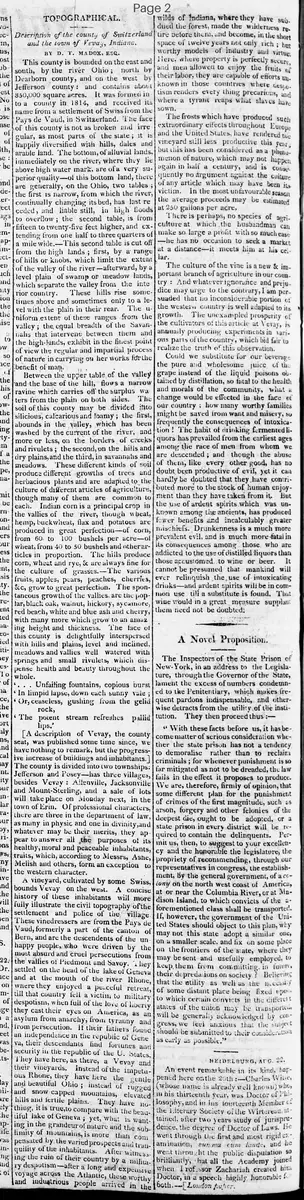
TOPOGRAPHICAL
Description of the county of Switzerland and the town of Vevay, Indiana.
BY D. T. MADOX, ESQ.
This county is bounded on the east and south, by the river Ohio; north by Dearborn county, and on the west by Jefferson county: and contains about 850,000 square acres. It was formed into a county in 1814, and received its name from a settlement of Swiss from the Pays de Vaud, in Switzerland. The face of this county is not as broken and irregular, as most parts of the state; it is happily diversified with hills, dales and arable land. The bottom, of alluvial lands, immediately on the river, where they lie above high water mark, are of a very superior quality-of this bottom land, there are generally, on the Ohio, two tables; the first is narrow, from which the river, continually changing its bed, has last receded, and liable still, in high floods to overflow; the second table, is from fifteen to twenty-five feet higher, and extending from one half to three quarters of a mile wide.--This second table is cut off from the high lands; first, by a range of hills or knobs, which limit the extent of the valley of the river -afterward, by a level plain of swamp or meadow lands, which separate the valley from the interior country. These hills rise sometimes above and sometimes only to a level with the plain in their rear. The uniform extent of these ranges from the valley; the equal breadth of the Savannahs that intervene between them and the high-lands, exhibit in the finest point of view the regular and impartial process of nature in carrying on her works for the benefit of man.
Between the upper table of the valley and the base of the hill, flows a narrow ravine which carries off the surplus waters from the plain on both sides. The soil of this county may be divided into silicious, calcarious and loamy; the first, abounds in the valley, which has been washed by the current of the river, and more or less, on the borders of creeks and rivulets; the second, on the hills and dry plains, and the third, in savannahs and meadows. These different kinds of soil produce different growths of trees and herbaceous plants and are adapted to the culture of different articles of agriculture, though many of them are common to each. Indian corn is a principal crop in the vallies of the river, though wheat hemp, buckwheat, flax and potatoes are produced in great perfection--of corn, from 60. to 100 bushels per acre-of wheat, from 40 to 50 bushels and other articles in proportion. The hills produce corn, wheat and rye, & are always fine for the culture of grasses.-The various fruits, apples, pears, peaches, cherries. &c, grow to great perfection. The spontaneous growth of the vallies, are the poplar, black oak, walnut, hickory, sycamore red beech, white and blue ash and cherry, with many more which grow to an amazing height and thickness. The face of this county is delightfully interspersed with hills and plains, level and inclined. meadows and vallies well watered with springs and small rivulets, which dispense health and beauty throughout the whole.
Unfailing fountains, copious burst
In limpid lapse, down each sunny vale;
Or, ceaseless, gushing from the gelid rock,
The potent stream refreshes pallid lips.
A description of Vevay, the county seat, was published some time since, we have nothing to remark, but the progressive increase of buildings and inhabitants. The county is divided into two townships: Jefferson and Posey-has three villages, besides Vevay: Allenville, Jacksonville and Mount-Sterling, and a sale of lots will take place on Monday next, in the town of Erin. Of professional characters, there are three in the department of law, as many in physic and one in divinity, and whatever may be their merits, they appear to answer all the purposes of its healthy, moral and peaceable inhabitants, traits, which, according to Messrs, Ashe, Melish and others, form an exception to the western character.
A vineyard, cultivated by some Swiss, bounds Vevay on the west. A concise history of these inhabitants will more fully illustrate the civil topography of the settlement and police of the village. These vinedressers are from the Pays de Vaud, formerly a part of the canton of Bern, and are the descendents of the unhappy people, who were driven by the most absurd and cruel persecutions from the vallies of Piedmont and Savoy. They settled on the head of the lake of Geneva and at the mouth of the river Rhone, where they enjoyed a peaceful retreat till that country fell a victim to military despotism, when full of the love of liberty they cast their eyes on America, as an asylum from anarchy, from tyranny and from persecution. If their fathers found an independence in the republic of Geneva, their descendants find fortunes and security in the republic of the U. States. They have here, as there, a Vevay and their vineyards. Instead of the impetuous Rhone, they have here the gentle and beautiful Ohio; instead of rugged and snow capped mountains, elevated hills and fertile plains. They have nothing, it is true, to compare with the beautiful lake of Geneva; yet, what is wanting in the grandeur of nature and the sublimity of mountains, is more than compensated by the varied prospects and tranquility of the inhabitants. After witnessing the ruin of their country by a military despotism-after a long and expensive voyage across the Atlantic, these worthy and industrious people arrived in the wilds of Indiana, where they have subdued the forest, made the wilderness retire before them, and become, in the short space of twelve years not only rich; but worthy models of industry and virtue: Here, where property is perfectly secure, and men allowed to enjoy the fruits of their labor, they are capable of efforts unknown in those countries where despotism renders every thing precarious, and where a tyrant reaps what slaves have sown.
The frosts which have produced such extraordinary effects throughout Europe and the United States, have rendered the vineyard still less productive this year: but this has been considered as a phenomenon of nature, which may not happen again in half a century, and is consequently no argument against the culture of any article which may have been its victim. In the most unfavourable season the average proceeds may be estimated at 250 gallons per acre.
There is perhaps, no species of agriculture at which the husbandman can make so large a profit with so much ease -he has no occasion to seek a market at a distance-it meets him at his cellar.
The culture of the vine is a new & important branch of agriculture in our country: And whatever ignorance and prejudice may urge to the contrary, I am persuaded that no inconsiderable portion of the western country is well adapted to its growth. The unexampled prosperity of the cultivators of this article at Vevay, is annually producing experiments in various parts of the country, which bid fair to realize the truth of this observation.
Could we substitute for our beverage the pure and wholesome juice of the grape instead of the liquid poisons obtained by distillation, so fatal to the health and morals of the community, what change would be effected in the face of our country; how many worthy families might be saved from want and misery, so frequently the consequences of intoxication! The habit of drinking fermented liquors has prevailed from the earliest ages among the race of men from whom we are descended; and though the abuse of them, like every other good, has no doubt been productive of evil, yet it can hardly be doubted that they have contributed more to the stock of human enjoyment than they have taken from it. But the use of ardent spirits which was unknown among the ancients, has produced fewer benefits and incalculably greater mischiefs. Drunkenness is a much more prevalent evil, and is much more fatal in its consequences among those who are addicted to the use of distilled liquors than those accustomed to wine or beer. It cannot be presumed that mankind will ever relinquish the use of intoxicating drinks--and ardent spirits will be in common use till a substitute is found. That wine would in a great measure supplant them need not be doubted!
Description of the county of Switzerland and the town of Vevay, Indiana.
BY D. T. MADOX, ESQ.
This county is bounded on the east and south, by the river Ohio; north by Dearborn county, and on the west by Jefferson county: and contains about 850,000 square acres. It was formed into a county in 1814, and received its name from a settlement of Swiss from the Pays de Vaud, in Switzerland. The face of this county is not as broken and irregular, as most parts of the state; it is happily diversified with hills, dales and arable land. The bottom, of alluvial lands, immediately on the river, where they lie above high water mark, are of a very superior quality-of this bottom land, there are generally, on the Ohio, two tables; the first is narrow, from which the river, continually changing its bed, has last receded, and liable still, in high floods to overflow; the second table, is from fifteen to twenty-five feet higher, and extending from one half to three quarters of a mile wide.--This second table is cut off from the high lands; first, by a range of hills or knobs, which limit the extent of the valley of the river -afterward, by a level plain of swamp or meadow lands, which separate the valley from the interior country. These hills rise sometimes above and sometimes only to a level with the plain in their rear. The uniform extent of these ranges from the valley; the equal breadth of the Savannahs that intervene between them and the high-lands, exhibit in the finest point of view the regular and impartial process of nature in carrying on her works for the benefit of man.
Between the upper table of the valley and the base of the hill, flows a narrow ravine which carries off the surplus waters from the plain on both sides. The soil of this county may be divided into silicious, calcarious and loamy; the first, abounds in the valley, which has been washed by the current of the river, and more or less, on the borders of creeks and rivulets; the second, on the hills and dry plains, and the third, in savannahs and meadows. These different kinds of soil produce different growths of trees and herbaceous plants and are adapted to the culture of different articles of agriculture, though many of them are common to each. Indian corn is a principal crop in the vallies of the river, though wheat hemp, buckwheat, flax and potatoes are produced in great perfection--of corn, from 60. to 100 bushels per acre-of wheat, from 40 to 50 bushels and other articles in proportion. The hills produce corn, wheat and rye, & are always fine for the culture of grasses.-The various fruits, apples, pears, peaches, cherries. &c, grow to great perfection. The spontaneous growth of the vallies, are the poplar, black oak, walnut, hickory, sycamore red beech, white and blue ash and cherry, with many more which grow to an amazing height and thickness. The face of this county is delightfully interspersed with hills and plains, level and inclined. meadows and vallies well watered with springs and small rivulets, which dispense health and beauty throughout the whole.
Unfailing fountains, copious burst
In limpid lapse, down each sunny vale;
Or, ceaseless, gushing from the gelid rock,
The potent stream refreshes pallid lips.
A description of Vevay, the county seat, was published some time since, we have nothing to remark, but the progressive increase of buildings and inhabitants. The county is divided into two townships: Jefferson and Posey-has three villages, besides Vevay: Allenville, Jacksonville and Mount-Sterling, and a sale of lots will take place on Monday next, in the town of Erin. Of professional characters, there are three in the department of law, as many in physic and one in divinity, and whatever may be their merits, they appear to answer all the purposes of its healthy, moral and peaceable inhabitants, traits, which, according to Messrs, Ashe, Melish and others, form an exception to the western character.
A vineyard, cultivated by some Swiss, bounds Vevay on the west. A concise history of these inhabitants will more fully illustrate the civil topography of the settlement and police of the village. These vinedressers are from the Pays de Vaud, formerly a part of the canton of Bern, and are the descendents of the unhappy people, who were driven by the most absurd and cruel persecutions from the vallies of Piedmont and Savoy. They settled on the head of the lake of Geneva and at the mouth of the river Rhone, where they enjoyed a peaceful retreat till that country fell a victim to military despotism, when full of the love of liberty they cast their eyes on America, as an asylum from anarchy, from tyranny and from persecution. If their fathers found an independence in the republic of Geneva, their descendants find fortunes and security in the republic of the U. States. They have here, as there, a Vevay and their vineyards. Instead of the impetuous Rhone, they have here the gentle and beautiful Ohio; instead of rugged and snow capped mountains, elevated hills and fertile plains. They have nothing, it is true, to compare with the beautiful lake of Geneva; yet, what is wanting in the grandeur of nature and the sublimity of mountains, is more than compensated by the varied prospects and tranquility of the inhabitants. After witnessing the ruin of their country by a military despotism-after a long and expensive voyage across the Atlantic, these worthy and industrious people arrived in the wilds of Indiana, where they have subdued the forest, made the wilderness retire before them, and become, in the short space of twelve years not only rich; but worthy models of industry and virtue: Here, where property is perfectly secure, and men allowed to enjoy the fruits of their labor, they are capable of efforts unknown in those countries where despotism renders every thing precarious, and where a tyrant reaps what slaves have sown.
The frosts which have produced such extraordinary effects throughout Europe and the United States, have rendered the vineyard still less productive this year: but this has been considered as a phenomenon of nature, which may not happen again in half a century, and is consequently no argument against the culture of any article which may have been its victim. In the most unfavourable season the average proceeds may be estimated at 250 gallons per acre.
There is perhaps, no species of agriculture at which the husbandman can make so large a profit with so much ease -he has no occasion to seek a market at a distance-it meets him at his cellar.
The culture of the vine is a new & important branch of agriculture in our country: And whatever ignorance and prejudice may urge to the contrary, I am persuaded that no inconsiderable portion of the western country is well adapted to its growth. The unexampled prosperity of the cultivators of this article at Vevay, is annually producing experiments in various parts of the country, which bid fair to realize the truth of this observation.
Could we substitute for our beverage the pure and wholesome juice of the grape instead of the liquid poisons obtained by distillation, so fatal to the health and morals of the community, what change would be effected in the face of our country; how many worthy families might be saved from want and misery, so frequently the consequences of intoxication! The habit of drinking fermented liquors has prevailed from the earliest ages among the race of men from whom we are descended; and though the abuse of them, like every other good, has no doubt been productive of evil, yet it can hardly be doubted that they have contributed more to the stock of human enjoyment than they have taken from it. But the use of ardent spirits which was unknown among the ancients, has produced fewer benefits and incalculably greater mischiefs. Drunkenness is a much more prevalent evil, and is much more fatal in its consequences among those who are addicted to the use of distilled liquors than those accustomed to wine or beer. It cannot be presumed that mankind will ever relinquish the use of intoxicating drinks--and ardent spirits will be in common use till a substitute is found. That wine would in a great measure supplant them need not be doubted!
What sub-type of article is it?
Historical Event
Curiosity
What themes does it cover?
Triumph
Exploration
Moral Virtue
What keywords are associated?
Swiss Settlement
Vevay Indiana
Ohio River Valley
Viticulture
Agriculture
Swiss Immigrants
What entities or persons were involved?
D. T. Madox
Swiss Vinedressers
Where did it happen?
Switzerland County, Vevay, Indiana
Story Details
Key Persons
D. T. Madox
Swiss Vinedressers
Location
Switzerland County, Vevay, Indiana
Event Date
1814
Story Details
Description of Switzerland County's geography, bounded by Ohio River, formed in 1814 from Swiss settlers; fertile lands, agriculture including corn, wheat, fruits; history of Swiss from Pays de Vaud fleeing persecution, establishing vineyards in Vevay; promotion of viticulture as profitable and moral alternative to ardent spirits.