Thank you for visiting SNEWPapers!
Sign up free
Letter to Editor
April 7, 1829
Constitutional Whig
Richmond, Virginia
What is this article about?
A letter to the Whig newspaper satirically critiques the logic used by Messrs. M'Candlish and Waller to urge voters in the Senatorial District to support the Williamsburg Convention Ticket over their personal preferences, arguing via syllogism that this contradicts expressing the majority will.
Clipping
OCR Quality
98%
Excellent
Full Text
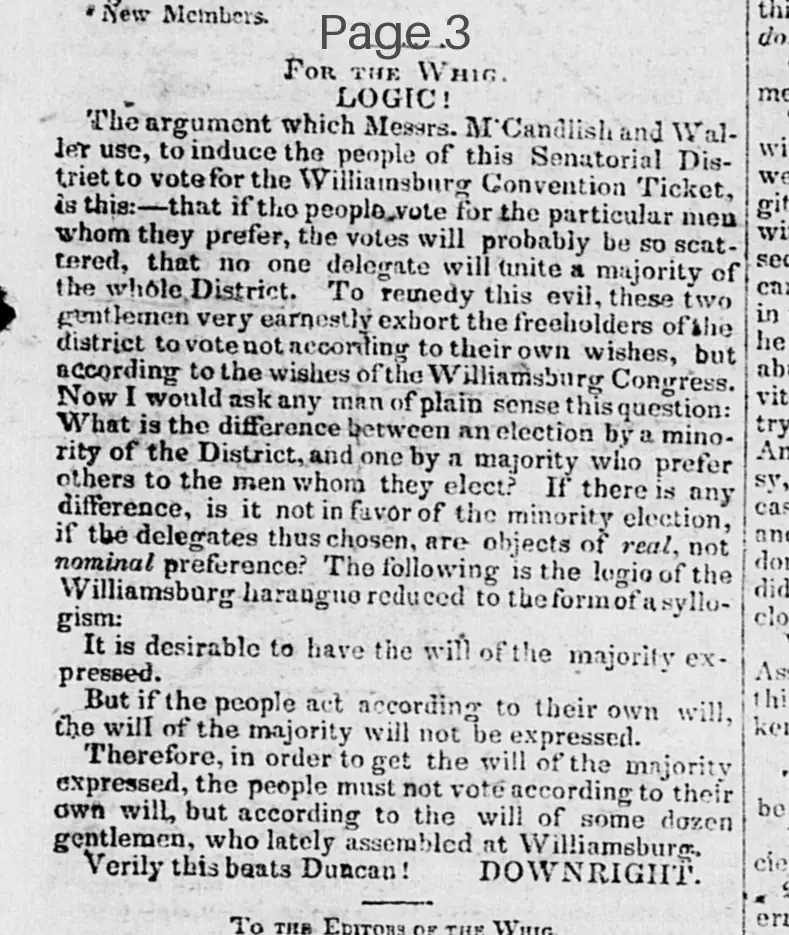
FOR THE WHIG.
LOGIC!
The argument which Messrs. M'Candlish and Waller use, to induce the people of this Senatorial District to vote for the Williamsburg Convention Ticket, is this:—that if the people vote for the particular men whom they prefer, the votes will probably be so scattered, that no one delegate will obtain a majority of the whole District. To remedy this evil, these two gentlemen very earnestly exhort the freeholders of the district to vote not according to their own wishes, but according to the wishes of the Williamsburg Congress.
Now I would ask any man of plain sense this question: What is the difference between an election by a minority of the District, and one by a majority who prefer others to the men whom they elect? If there is any difference, is it not in favor of the minority election, if the delegates thus chosen, are objects of real, not nominal preference? The following is the logic of the Williamsburg harangue reduced to the form of a syllogism:
It is desirable to have the will of the majority expressed.
But if the people act according to their own will, the will of the majority will not be expressed.
Therefore, in order to get the will of the majority expressed, the people must not vote according to their own will, but according to the will of some dozen gentlemen, who lately assembled at Williamsburg.
Verily this beats Duncan!
LOGIC!
The argument which Messrs. M'Candlish and Waller use, to induce the people of this Senatorial District to vote for the Williamsburg Convention Ticket, is this:—that if the people vote for the particular men whom they prefer, the votes will probably be so scattered, that no one delegate will obtain a majority of the whole District. To remedy this evil, these two gentlemen very earnestly exhort the freeholders of the district to vote not according to their own wishes, but according to the wishes of the Williamsburg Congress.
Now I would ask any man of plain sense this question: What is the difference between an election by a minority of the District, and one by a majority who prefer others to the men whom they elect? If there is any difference, is it not in favor of the minority election, if the delegates thus chosen, are objects of real, not nominal preference? The following is the logic of the Williamsburg harangue reduced to the form of a syllogism:
It is desirable to have the will of the majority expressed.
But if the people act according to their own will, the will of the majority will not be expressed.
Therefore, in order to get the will of the majority expressed, the people must not vote according to their own will, but according to the will of some dozen gentlemen, who lately assembled at Williamsburg.
Verily this beats Duncan!
What sub-type of article is it?
Persuasive
Satirical
Political
What themes does it cover?
Politics
Constitutional Rights
What keywords are associated?
Williamsburg Convention
Election Logic
Voting Preferences
Senatorial District
Mccandlish Waller
Majority Will
What entities or persons were involved?
For The Whig
Letter to Editor Details
Recipient
For The Whig
Main Argument
criticizes the flawed logic of urging voters to ignore personal preferences and follow the williamsburg congress's wishes to ensure a majority, arguing that true preference by a minority is preferable to nominal support by a majority.
Notable Details
Presents The Opposing Argument As A Syllogism To Highlight Its Absurdity.
References 'Verily This Beats Duncan!' As A Mocking Conclusion.