Thank you for visiting SNEWPapers!
Sign up free
Letter to Editor
December 17, 1796
Gazette Of The United States, & Philadelphia Daily Advertiser
Philadelphia, Philadelphia County, Pennsylvania
What is this article about?
A letter to Mr. Fenno praising Mrs. Merry's performance as Juliet, describing her talents in conveying emotions and the moral instructive role of theater in promoting virtue and reformation.
Clipping
OCR Quality
95%
Excellent
Full Text
FOR THE GAZETTE OF THE UNITED STATES.
Mr. FENNO,
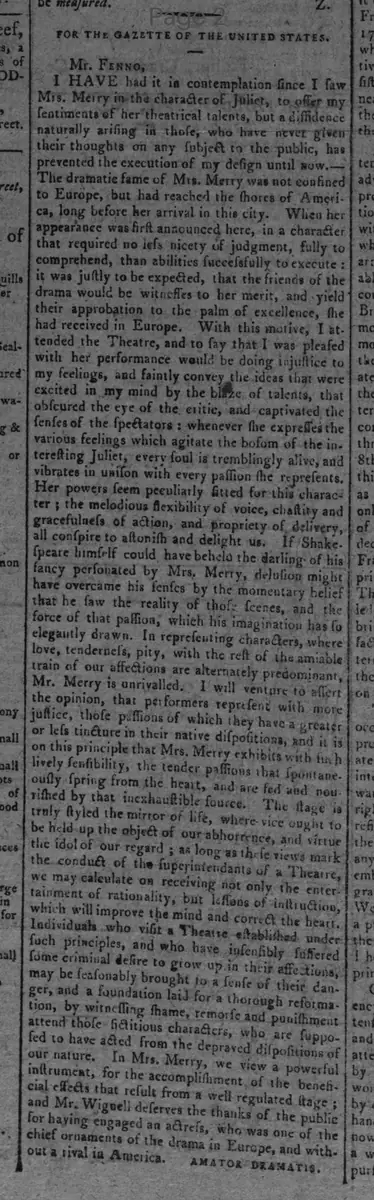
I HAVE had it in contemplation since I saw Mrs. Merry in the character of Juliet, to offer my sentiments of her theatrical talents, but a diffidence naturally arising in those, who have never given their thoughts on any subject to the public, has prevented the execution of my design until now.-- The dramatic fame of Mrs. Merry was not confined to Europe, but had reached the shores of America, long before her arrival in this city. When her appearance was first announced here, in a character that required no less nicety of judgment, fully to comprehend, than abilities successfully to execute: it was justly to be expected, that the friends of the drama would be witnesses to her merit, and yield their approbation to the palm of excellence, she had received in Europe. With this motive, I attended the Theatre, and to say that I was pleased with her performance would be doing injustice to my feelings, and faintly convey the ideas that were excited in my mind by the blaze of talents, that obscured the eye of the critic, and captivated the senses of the spectators: whenever she expresses the various feelings which agitate the bosom of the interesting Juliet, every soul is tremblingly alive, and vibrates in union with every passion she represents. Her powers seem peculiarly fitted for this character; the melodious sensibility of voice, chastity and gracefulness of action, and propriety of delivery, all conspire to astonish and delight us. If Shakespeare himself could have beheld the darling of his fancy personated by Mrs. Merry, delusion might have overcame his senses by the momentary belief that he saw the reality of those scenes, and the force of that passion, which his imagination has so elegantly drawn. In representing characters, where love, tenderness, pity, with the rest of the amiable train of our affections are alternately predominant, Mrs. Merry is unrivalled. I will venture to assert the opinion, that performers represent with more justice, those passions of which they have a greater or less tincture in their native dispositions, and it is on this principle that Mrs. Merry exhibits with so lively sensibility, the tender passions that spontaneously spring from the heart, and are fed and nourished by that inexhaustible source. The stage is truly styled the mirror of life, where vice ought to be held up the object of our abhorrence, and virtue the idol of our regard; as long as these views mark the conduct of those superintendents of a Theatre, we may calculate on receiving not only the entertainment of rationality, but lessons of instruction, which will improve the mind and correct the heart. Individuals who visit a Theatre established under such principles, and who have insensibly suffered some criminal desire to grow up in their affections, may be reasonably brought to a sense of their danger, and a foundation laid for a thorough reformation, by witnessing shame, remorse and punishment attend those fictitious characters, who are supposed to have acted from the depraved dispositions of our nature. In Mrs. Merry, we view a powerful instrument, for the accomplishment of the beneficial effects that result from a well regulated stage; and Mr. Wignell deserves the thanks of the public for having engaged an actress, who was one of the chief ornaments of the drama in Europe, and without a rival in America.
AMATOR DRAMATIS.
Mr. FENNO,
I HAVE had it in contemplation since I saw Mrs. Merry in the character of Juliet, to offer my sentiments of her theatrical talents, but a diffidence naturally arising in those, who have never given their thoughts on any subject to the public, has prevented the execution of my design until now.-- The dramatic fame of Mrs. Merry was not confined to Europe, but had reached the shores of America, long before her arrival in this city. When her appearance was first announced here, in a character that required no less nicety of judgment, fully to comprehend, than abilities successfully to execute: it was justly to be expected, that the friends of the drama would be witnesses to her merit, and yield their approbation to the palm of excellence, she had received in Europe. With this motive, I attended the Theatre, and to say that I was pleased with her performance would be doing injustice to my feelings, and faintly convey the ideas that were excited in my mind by the blaze of talents, that obscured the eye of the critic, and captivated the senses of the spectators: whenever she expresses the various feelings which agitate the bosom of the interesting Juliet, every soul is tremblingly alive, and vibrates in union with every passion she represents. Her powers seem peculiarly fitted for this character; the melodious sensibility of voice, chastity and gracefulness of action, and propriety of delivery, all conspire to astonish and delight us. If Shakespeare himself could have beheld the darling of his fancy personated by Mrs. Merry, delusion might have overcame his senses by the momentary belief that he saw the reality of those scenes, and the force of that passion, which his imagination has so elegantly drawn. In representing characters, where love, tenderness, pity, with the rest of the amiable train of our affections are alternately predominant, Mrs. Merry is unrivalled. I will venture to assert the opinion, that performers represent with more justice, those passions of which they have a greater or less tincture in their native dispositions, and it is on this principle that Mrs. Merry exhibits with so lively sensibility, the tender passions that spontaneously spring from the heart, and are fed and nourished by that inexhaustible source. The stage is truly styled the mirror of life, where vice ought to be held up the object of our abhorrence, and virtue the idol of our regard; as long as these views mark the conduct of those superintendents of a Theatre, we may calculate on receiving not only the entertainment of rationality, but lessons of instruction, which will improve the mind and correct the heart. Individuals who visit a Theatre established under such principles, and who have insensibly suffered some criminal desire to grow up in their affections, may be reasonably brought to a sense of their danger, and a foundation laid for a thorough reformation, by witnessing shame, remorse and punishment attend those fictitious characters, who are supposed to have acted from the depraved dispositions of our nature. In Mrs. Merry, we view a powerful instrument, for the accomplishment of the beneficial effects that result from a well regulated stage; and Mr. Wignell deserves the thanks of the public for having engaged an actress, who was one of the chief ornaments of the drama in Europe, and without a rival in America.
AMATOR DRAMATIS.
What sub-type of article is it?
Informative
Reflective
Ethical Moral
What themes does it cover?
Morality
Education
What keywords are associated?
Mrs Merry
Juliet Performance
Theatrical Talents
Moral Instruction
Shakespeare
Theater Reform
European Actress
What entities or persons were involved?
Amator Dramatis.
Mr. Fenno,
Letter to Editor Details
Author
Amator Dramatis.
Recipient
Mr. Fenno,
Main Argument
mrs. merry's performance as juliet showcases exceptional talent in portraying tender passions, making her unrivaled, and well-regulated theater serves as a moral mirror to promote virtue and reformation.
Notable Details
References Shakespeare's Juliet
Compares To European Fame
Praises Mr. Wignell For Engaging Her