Thank you for visiting SNEWPapers!
Sign up free
Story
December 20, 1851
New England Religious Herald
Hartford, Hartford County, Connecticut
What is this article about?
In New York, amid recent business failures like Cheeseborough, Stearns & Co., an old merchant recounts losing his fortune in the Great Fire, paying creditors fully including his home, yet being despised for his poverty, while dishonest bankrupts who saved assets now prosper in wealth.
Clipping
OCR Quality
95%
Excellent
Full Text
MISCELLANEOUS.
Honesty at a Discount.
We find the following in the New York correspondence of the New Orleans Commercial Bulletin:—
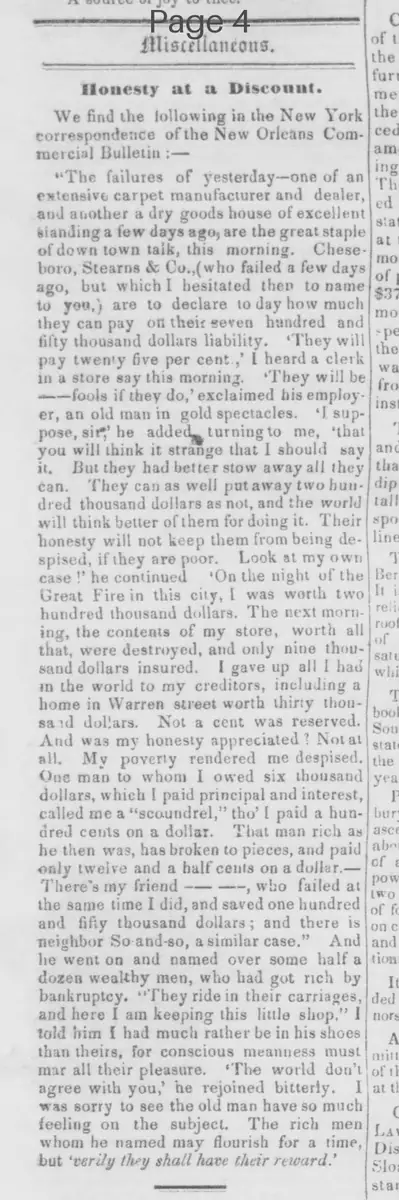
"The failures of yesterday—one of an extensive carpet manufacturer and dealer, and another a dry goods house of excellent standing a few days ago, are the great staple of down town talk, this morning. Cheeseborough, Stearns & Co., (who failed a few days ago, but which I hesitated then to name to you, are to declare to day how much they can pay on their seven hundred and fifty thousand dollars liability. 'They will pay twenty five per cent,' I heard a clerk in a store say this morning. 'They will be—fools if they do,' exclaimed his employer, an old man in gold spectacles. 'I suppose, sir,' he added turning to me, 'that you will think it strange that I should say it. But they had better stow away all they can. They can as well put away two hundred thousand dollars as not, and the world will think better of them for doing it. Their honesty will not keep them from being despised, if they are poor. Look at my own case,' he continued. On the night of the Great Fire in this city, I was worth two hundred thousand dollars. The next morning, the contents of my store, worth all that, were destroyed, and only nine thousand dollars insured, I gave up all I had in the world to my creditors, including a home in Warren street worth thirty thousand dollars. Not a cent was reserved. And was my honesty appreciated? Not at all. My poverty rendered me despised. One man to whom I owed six thousand dollars, which I paid principal and interest, called me a "scoundrel," tho' I paid a hundred cents on a dollar. That man rich as he then was, has broken to pieces, and paid only twelve and a half cents on a dollar. There's my friend — — , who failed at the same time I did, and saved one hundred and fifty thousand dollars; and there is neighbor So and-so, a similar case." And he went on and named over some half a dozen wealthy men, who had got rich by bankruptcy. "They ride in their carriages, and here I am keeping this little shop," I told him I had much rather be in his shoes than theirs, for conscious meanness must mar all their pleasure. The world don't agree with you,' he rejoined bitterly. I was sorry to see the old man have so much feeling on the subject. The rich men whom he named may flourish for a time but 'verily they shall have their reward.'
Honesty at a Discount.
We find the following in the New York correspondence of the New Orleans Commercial Bulletin:—
"The failures of yesterday—one of an extensive carpet manufacturer and dealer, and another a dry goods house of excellent standing a few days ago, are the great staple of down town talk, this morning. Cheeseborough, Stearns & Co., (who failed a few days ago, but which I hesitated then to name to you, are to declare to day how much they can pay on their seven hundred and fifty thousand dollars liability. 'They will pay twenty five per cent,' I heard a clerk in a store say this morning. 'They will be—fools if they do,' exclaimed his employer, an old man in gold spectacles. 'I suppose, sir,' he added turning to me, 'that you will think it strange that I should say it. But they had better stow away all they can. They can as well put away two hundred thousand dollars as not, and the world will think better of them for doing it. Their honesty will not keep them from being despised, if they are poor. Look at my own case,' he continued. On the night of the Great Fire in this city, I was worth two hundred thousand dollars. The next morning, the contents of my store, worth all that, were destroyed, and only nine thousand dollars insured, I gave up all I had in the world to my creditors, including a home in Warren street worth thirty thousand dollars. Not a cent was reserved. And was my honesty appreciated? Not at all. My poverty rendered me despised. One man to whom I owed six thousand dollars, which I paid principal and interest, called me a "scoundrel," tho' I paid a hundred cents on a dollar. That man rich as he then was, has broken to pieces, and paid only twelve and a half cents on a dollar. There's my friend — — , who failed at the same time I did, and saved one hundred and fifty thousand dollars; and there is neighbor So and-so, a similar case." And he went on and named over some half a dozen wealthy men, who had got rich by bankruptcy. "They ride in their carriages, and here I am keeping this little shop," I told him I had much rather be in his shoes than theirs, for conscious meanness must mar all their pleasure. The world don't agree with you,' he rejoined bitterly. I was sorry to see the old man have so much feeling on the subject. The rich men whom he named may flourish for a time but 'verily they shall have their reward.'
What sub-type of article is it?
Biography
What themes does it cover?
Moral Virtue
Misfortune
Fortune Reversal
What keywords are associated?
Bankruptcy
Honesty
Great Fire
Business Failure
New York
What entities or persons were involved?
Cheeseborough, Stearns & Co.
The Old Man
Where did it happen?
New York
Story Details
Key Persons
Cheeseborough, Stearns & Co.
The Old Man
Location
New York
Event Date
Night Of The Great Fire In This City
Story Details
An old merchant, ruined by the Great Fire, paid all creditors fully but was despised for his poverty, while others who hid assets during bankruptcy now live wealthy lives.