Thank you for visiting SNEWPapers!
Sign up free
The New Hampshire Gazette
Portsmouth, Rockingham County, New Hampshire
What is this article about?
Detailed record of U.S. House of Representatives sessions from April 4 to 12, discussing mail routes, direct taxes, public debt, treaties, naval frigates, military establishment, Tennessee statehood, and embargo on corn exports.
Clipping
OCR Quality
Full Text
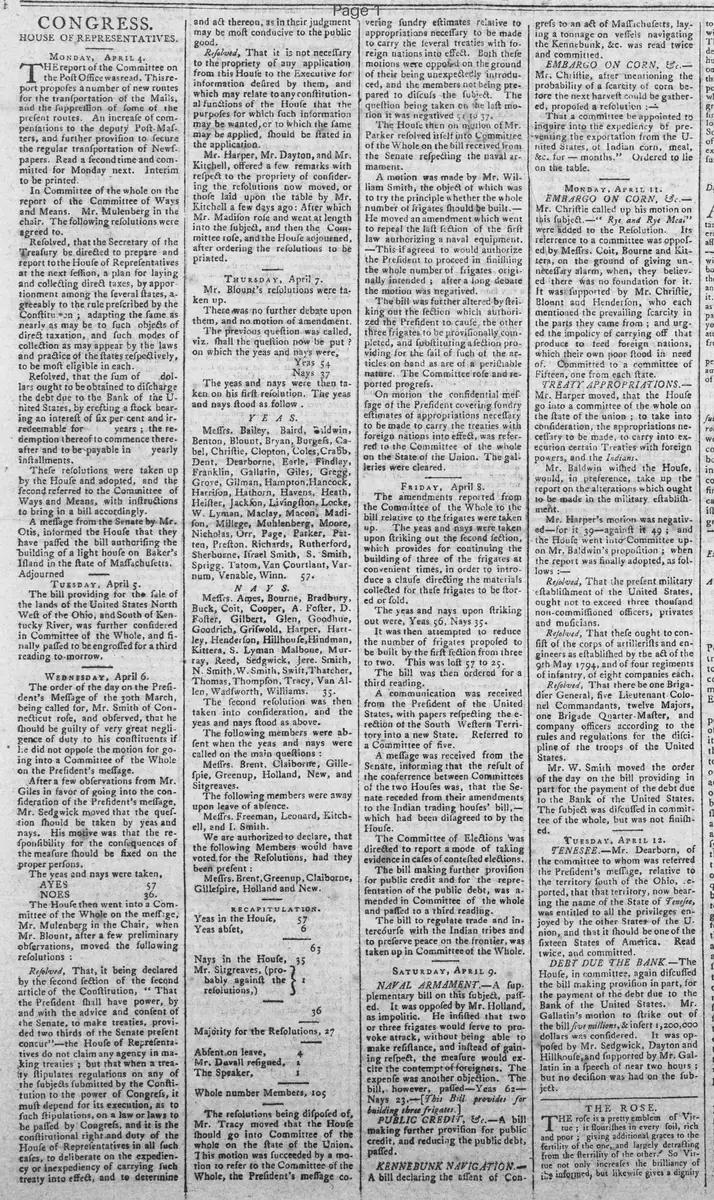
HOUSE OF REPRESENTATIVES.
Monday, April 4.
The Post Master General proposes a number of new routes for the transportation of the Mails, and the suppression of some of the present routes. An increase of compensations to the deputy Post-Masters, and further provision to secure the regular transportation of Newspapers. Read a second time and committed for Monday next. Ordered to be printed.
In Committee of the whole on the report of the Committee of Ways and Means. Mr. Muhlenberg in the chair. The following resolutions were agreed to.
Resolved, that the Secretary of the Treasury be directed to prepare and report to the House of Representatives at the next session, a plan for laying and collecting direct taxes, by apportionment among the several states, agreeably to the rule prescribed by the Constitution; adapting the same as nearly as may be to such objects of direct taxation, and such modes of collection as may appear by the laws and practice of the states respectively, to be most eligible in each.
Resolved, that the sum of two millions of dollars ought to be obtained to discharge the debt due to the Bank of the United States, by erecting a stock bearing an interest of six per cent and irredeemable for twenty years; the redemption thereof to commence thereafter and to be payable in yearly installments.
These resolutions were taken up by the House and adopted, and the second referred to the Committee of Ways and Means, with instructions to bring in a bill accordingly.
A message from the Senate by Mr. Otis, informed the House that they have passed the bill authorizing the building of a light house on Baker's Island in the state of Massachusetts.
Adjourned
Tuesday, April 5.
The bill providing for the sale of the lands of the United States North West of the Ohio, and South of Kentucky River, was further considered in Committee of the Whole, and finally passed to be engrossed for a third reading to-morrow.
Wednesday, April 6.
The order of the day on the President's Message of the 20th March, being called for, Mr. Smith of Connecticut rose, and observed, that he should be guilty of very great negligence of duty to his constituents if he did not oppose the motion for going into a Committee of the Whole on the President's message.
After a few observations from Mr. Giles in favor of going into the consideration of the President's message, Mr. Sedgwick moved that the question should be taken by yeas and nays. His motive was that the responsibility for the consequences of the measure should be fixed on the proper persons.
The yeas and nays were taken,
AYES 57
NOES 36.
The House then went into a Committee of the Whole on the message, Mr. Muhlenberg in the Chair, when Mr. Blount, after a few preliminary observations, moved the following resolutions:
Resolved, That, it being declared by the second section of the second article of the Constitution, "That the President shall have power, by and with the advice and consent of the Senate, to make treaties, provided two thirds of the Senate present concur" -- the House of Representatives do not claim any agency in making treaties; but that when a treaty stipulates regulations on any of the subjects submitted by the Constitution to the power of Congress, it must depend for its execution, as to such stipulations, on a law or laws to be passed by Congress, and it is the constitutional right and duty of the House of Representatives in all such cases, to deliberate on the expediency or inexpediency of carrying such treaty into effect, and to determine and act thereon, as in their judgment may be most conducive to the public good.
Resolved, That it is not necessary to the propriety of any application from this House to the Executive for information desired by them, and which may relate to any constitutional functions of the House that the purposes for which such information may be wanted, or to which the same may be applied, should be stated in the application.
Mr. Harper, Mr. Dayton, and Mr. Kitchell, offered a few remarks with respect to the propriety of considering the resolutions now moved, or those laid upon the table by Mr. Kitchell a few days ago: After which Mr. Madison rose and went at length into the subject, and then the Committee rose, and the House adjourned, after ordering the resolutions to be printed.
Thursday, April 7.
Mr. Blount's resolutions were taken up.
There was no further debate upon them, and no motion of amendment.
The previous question was called, viz. shall the question now be put? on which the yeas and nays were,
Yeas 54
Nays 37.
The yeas and nays were then taken on his first resolution. The yeas and nays stood as follow.
YEAS.
Messrs. Bailey, Baird, Baldwin, Benton, Blount, Bryan, Borges, Cabell, Christie, Clopton, Coles, Crabb, Dent, Dearborne, Earle, Findlay, Franklin, Gallatin, Giles, Gregg, Grove, Gilman, Hampton, Hancock, Harrison, Hathorn, Havens, Heath, Heister, Jackson, Livingston, Locke, W. Lyman, Maclay, Macon, Madison, Milledge, Muhlenberg, Moore, Nicholas, Orr, Page, Parker, Patton, Preston, Richards, Rutherford, Sherburne, Israel Smith, S. Smith, Sprigg, Tatom, Van Courtlandt, Varnum, Venable, Winn. 57.
NAYS.
Messrs. Ames, Bourne, Bradbury, Buck, Coit, Cooper, A. Foster, D. Foster, Gilbert, Glen, Goodhue, Goodrich, Griswold, Harper, Hartley, Henderson, Hillhouse, Hindman, Kittera, S. Lyman, Malbone, Murray, Reed, Sedgwick, Jere. Smith, N. Smith, W. Smith, Swift, Thatcher, Thomas, Thompson, Tracy, Van Allen, Wadsworth, Williams. 35.
The second resolution was then taken into consideration, and the yeas and nays stood as above.
The following members were absent when the yeas and nays were called on the main questions:
Messrs. Brent, Claiborne, Gillespie, Greenup, Holland, New, and Sitgreaves.
The following members were away upon leave of absence.
Messrs. Freeman, Leonard, Kitchell, and I. Smith.
We are authorized to declare, that the following Members would have voted for the Resolutions, had they been present:
Messrs. Brent, Greenup, Claiborne, Gillespie, Holland and New.
Recapitulation
Yeas in the House,
Yeas absent;
Nays in the House;
Mr. Sitgreaves, (probably against the resolutions)
Majority for the Resolutions,
Absent, on leave
Mr. Davall resigned
The Speaker,
Whole number Members, 106
The resolutions being disposed of. Mr. Tracy moved that the House should go into Committee of the whole on the state of the Union.
This motion was succeeded by a motion to refer to the Committee of the Whole, the President's message covering sundry estimates relative to appropriations necessary to be made to carry the several treaties with foreign nations into effect. Both these motions were opposed on the ground of their being unexpectedly introduced, and the members not being prepared to discuss the subject. The question being taken on the last motion it was negatived 51 to 37.
The House then on motion of Mr. Parker resolved itself into Committee of the Whole on the bill received from the Senate respecting the naval armament.
A motion was made by Mr. William Smith, the object of which was to try the principle whether the whole number of frigates should be built.
He moved an amendment which went to repeal the last section of the first law authorizing a naval equipment. --This if agreed to would authorize the President to proceed in finishing the whole number of frigates originally intended; after a long debate the motion was negatived. 45 to 37.
The bill was further altered by striking out the section which authorized the President to cause the other three frigates to be provisionally completed, and substituting a section providing for the sale of such of the articles on hand as are of a perishable nature. The Committee rose and reported progress.
On motion the confidential message of the President covering sundry estimates of appropriations necessary to be made to carry the treaties with foreign nations into effect, was referred to the Committee of the whole on the State of the Union. The galleries were cleared.
Friday, April 8.
The amendments reported from the Committee of the Whole to the bill relative to the frigates were taken up. The yeas and nays were taken upon striking out the second section, which provides for continuing the building of three of the frigates at convenient times, in order to introduce a clause directing the materials collected for these frigates to be stored or sold.
The yeas and nays upon striking out were, Yeas 56, Nays 35.
It was then attempted to reduce the number of frigates proposed to be built by the first section from three to two. This was lost 57 to 25.
The bill was then ordered for a third reading.
A communication was received from the President of the United States, with papers respecting the erection of the South Western Territory into a new State. Referred to a Committee of five.
A message was received from the Senate, informing that the result of the conference between Committees of the two Houses was, that the Senate receded from their amendments to the Indian trading houses' bill, -- which had been disagreed to by the House.
The Committee of Elections was directed to report a mode of taking evidence in cases of contested elections.
The bill making further provision for public credit and for the representation of the public debt, was amended in Committee of the whole and passed to a third reading.
The bill to regulate trade and intercourse with the Indian tribes and to preserve peace on the frontier, was taken up in Committee of the Whole.
Saturday, April 9.
NAVAL ARMAMENT.--A supplementary bill on this subject, passed. It was opposed by Mr. Holland, as impolitic. He insisted that two or three frigates would serve to provoke attack, without being able to make resistance, and instead of gaining respect, the measure would excite the contempt of foreigners. The expense was another objection. The bill, however, passed-- Yeas 62-- Nays 23. This Bill provides for building three frigates.
PUBLIC CREDIT, &c.--A bill making further provision for public credit, and reducing the public debt, passed.
KENNEBUNK NAVIGATION.--
A bill declaring the assent of Congress to an act of Massachusetts, laying a tonnage on vessels navigating the Kennebunk, &c. was read twice and committed.
EMBARGO ON CORN. &C.
Mr. Christie, after mentioning the probability of a scarcity of corn before the next harvest could be gathered, proposed a resolution:
That a committee be appointed to inquire into the expediency of preventing the exportation from the United States, of Indian corn, meal, &c. for 6 months." Ordered to lie on the table.
Monday, April 11.
EMBARGO ON CORN. &c.
Mr. Christie called up his motion on this subject.--"as Rye and Rye Meal" were added to the Resolution. Its reference to a committee was opposed by Messrs. Coit, Bourne and Kittera, on the ground of giving unnecessary alarm, when, they believed there was no foundation for it.
It was supported by Mr. Christie, Blount and Henderson, who each mentioned the prevailing scarcity in the parts they came from; and urged the impolicy of carrying off that produce to feed foreign nations, which their own poor stood in need of. Committed to a committee of Fifteen, one from each state.
TREATY APPROPRIATIONS.
Mr. Harper moved, that the House go into a committee of the whole on the state of the union; to take into consideration, the appropriations necessary to be made, to carry into execution certain Treaties with foreign powers, and the Indians.
Mr. Baldwin wished the House, would, in preference, take up the report on the alterations which ought to be made in the military, establishment.
Mr. Harper's motion was negatived--for it 39--against it 49; and the House went into Committee upon Mr. Baldwin's proposition; when the report was finally adopted, as follows:--
Resolved, That the present military establishment of the United States, ought not to exceed three thousand non-commissioned officers, privates and musicians.
Resolved, That these ought to consist of the corps of artillerists and engineers as established by the act of the 9th May 1794, and of four regiments of infantry, of eight companies each.
Resolved, That there be one Brigadier General, five Lieutenant Colonels Commandants, twelve Majors, one Brigade Quarter-Master, and company officers according to the rules and regulations for the discipline of the troops of the United States.
Mr. W. Smith moved the order of the day on the bill providing in part for the payment of the debt due to the Bank of the United States.
The subject was discussed in committee of the whole, but was not finished.
Tuesday, April 12.
TENNESSEE.--Mr. Dearborn, of the committee to whom was referred the President's message, relative to the territory south of the Ohio, reported, that that territory, now bearing the name of the State of Tennessee, was entitled to all the privileges enjoyed by the other States of the Union, and that it should be one of the sixteen States of America. Read twice, and committed.
DEBT DUE THE BANK.--The House, in committee, again discussed the bill making provision in part, for the payment of the debt due to the Bank of the United States. Mr. Gallatin's motion to strike out of the bill five millions, & insert 1,200,000 dollars was considered. It was opposed by Mr. Sedgwick, Dayton and Hillhouse, and supported by Mr. Gallatin in a speech of near two hours; but no decision was had on the subject.
What sub-type of article is it?
What keywords are associated?
What entities or persons were involved?
Where did it happen?
Story Details
Key Persons
Location
House Of Representatives
Event Date
April 4 To April 12
Story Details
Proceedings include proposals for mail routes, resolutions on direct taxes and public debt to the Bank of the United States, debates on President's message regarding treaties, votes on Mr. Blount's resolutions affirming House role in treaty execution, discussions on naval armament and building frigates, military establishment reductions, Tennessee statehood, public credit bills, and embargo on corn exports.