Thank you for visiting SNEWPapers!
Sign up free
Martinsburgh Gazette
Martinsburg, Berkeley County, West Virginia
What is this article about?
In the British House of Commons on June 5, MPs debated the Orders in Council and their impact on trade with America. Mr. Whitbread criticized the policy for causing manufacturing distress and urged repeal, citing broken negotiations with U.S. ambassador Mr. Pinkney. The Lord Chancellor defended the orders, doubting the repeal of French Berlin and Milan Decrees. Mr. A. Baring also opposed the orders.
Clipping
OCR Quality
Full Text
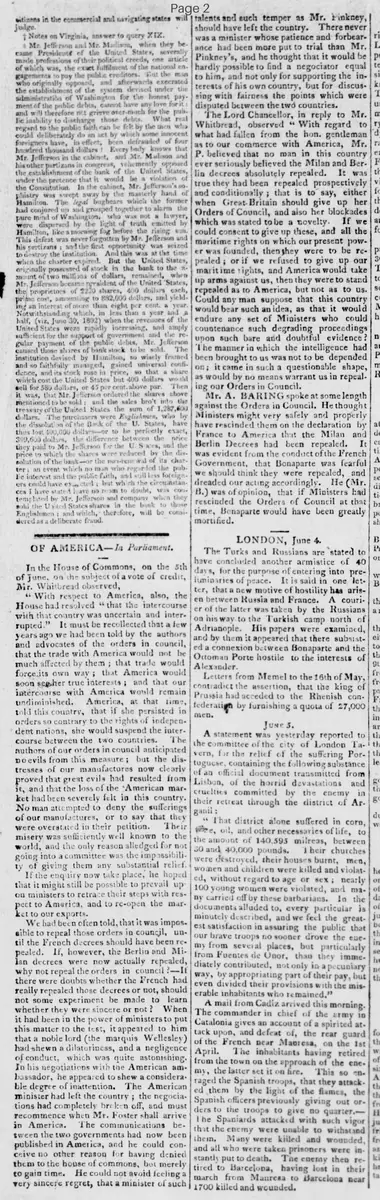
In the House of Commons, on the 5th of June, on the subject of a vote of credit, Mr. Whitbread observed, "With respect to America, also, the House had resolved that the intercourse with that country was uncertain and interrupted." It must be recollected that a few years ago we had been told by the authors and advocates of the orders in council, that the trade with America would not be much affected by them; that trade would force its own way; that America would soon see her true interests; and that our intercourse with America would remain undiminished. America, at that time, told this country, that if she persisted in orders so contrary to the rights of independent nations, she would suspend the intercourse between the two countries. The authors of our orders in council anticipated no evils from this measure; but the distresses of our manufactures now clearly proved that great evils had resulted from it, and that the loss of the American market had been severely felt in this country. No man attempted to deny the sufferings of our manufactures, or to say that they were overstated in their petition. Their misery was sufficiently well known to the world, and the only reason alledged for not going into a committee was the impossibility of giving them any substantial relief. If the enquiry now take place, he hoped that it might still be possible to prevail upon ministers to retrace their steps with respect to America, and to re-open the market to our exports. We had been often told, that it was impossible to repeal those orders in council, until the French decrees should have been repealed. If, however, the Berlin and Milan decrees were now actually repealed, why not repeal the orders in council?—If there were doubts whether the French had really repealed those decrees or not, should not some experiment be made to learn whether they were sincere or not? When it had been in the power of ministers to put this matter to the test, it appeared to him that a noble lord (the marquis Wellesley) had shewn a dilatoriness, and a negligence of conduct, which was quite astonishing. In his negotiations with the American ambassador, he appeared to shew a considerable degree of inattention. The American minister had left the country; the negotiations had completely broken off, and must recommence when Mr. Foster shall arrive in America. The communications between the two governments had now been published in America, and he could conceive no other reason for having denied them to the house of commons, but merely to gain time. He could not avoid feeling a very sincere regret, that a minister of such talents and such temper as Mr. Pinkney, should have left the country. There never was a minister whose patience and forbearance had been more put to trial than Mr. Pinkney's, and he thought that it would be hardly possible to find a negociator equal to him, and not only for supporting the interests of his own country, but for discussing with fairness the points which were disputed between the two countries.
The Lord Chancellor, in reply to Mr. Whitbread, observed "With regard to what had fallen from the hon. gentleman as to our commerce with America, I believe that no man in this country ever seriously believed the Milan and Berlin decrees absolutely repealed. It was true they had been repealed prospectively and conditionally: that is to say, either when Great Britain should give up her Orders of Council, and also her blockades which was stated to be a novelty. If we could consent to give up these, and all the maritime rights on which our present power was founded, then they were to be repealed; or if we refused to give up our maritime rights, and America would take up arms against us, then they were to stand repealed as to America, but not as to us. Could any man suppose that this country would bear such an idea, as that it would endure any set of Ministers who could countenance such degrading proceedings upon such bare and doubtful evidence? The manner in which the intelligence had been brought to us was not to be depended on; it came in such a questionable shape, as would by no means warrant us in repealing our Orders in Council."
Mr. A. BARING spoke at some length against the Orders in Council. He thought Ministers might very safely and properly have rescinded them on the declaration by France to America that the Milan and Berlin Decrees had been repealed. It was evident from the conduct of the French Government, that Bonaparte was fearful we should think they were repealed, and dreaded our acting accordingly. He (Mr. B.) was of opinion, that if Ministers had rescinded the Orders of Council at that time, Bonaparte would have been greatly mortified.
What sub-type of article is it?
What keywords are associated?
What entities or persons were involved?
Where did it happen?
Foreign News Details
Primary Location
America
Event Date
5th Of June
Key Persons
Outcome
intercourse with america uncertain and interrupted; distresses of manufactures from loss of american market; negotiations broken off; american minister left the country; doubts on repeal of french decrees.
Event Details
Debate in House of Commons on vote of credit regarding America. Mr. Whitbread criticized Orders in Council for affecting trade, causing manufacturing sufferings, and urged repeal and reopening market. He regretted departure of Mr. Pinkney and criticized Marquis Wellesley's handling of negotiations. Lord Chancellor defended orders, doubting absolute repeal of Berlin and Milan decrees by France, which were conditional. Mr. A. Baring opposed orders, suggesting safe rescission based on French declaration to America.