Thank you for visiting SNEWPapers!
Sign up free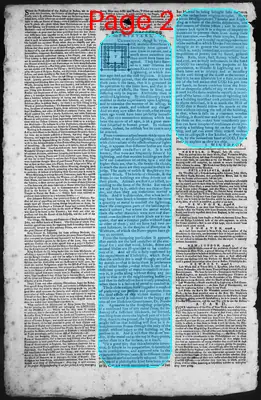
The New Hampshire Gazette And Historical Chronicle
Portsmouth, Greenland, Rockingham County, New Hampshire
What is this article about?
In a 1770 letter from Cambridge, J. Winthrop explains the connection between electricity and lightning based on modern discoveries. He praises Dr. Franklin's lightning rod invention for safely conducting lightning away from buildings and addresses religious scruples, arguing it complies with divine providence through natural laws.
Merged-components note: These two components are the continuation of the same letter to the editor on electricity, lightning, and Franklin's invention, signed by J. Winthrop at the end.
Clipping
OCR Quality
Full Text
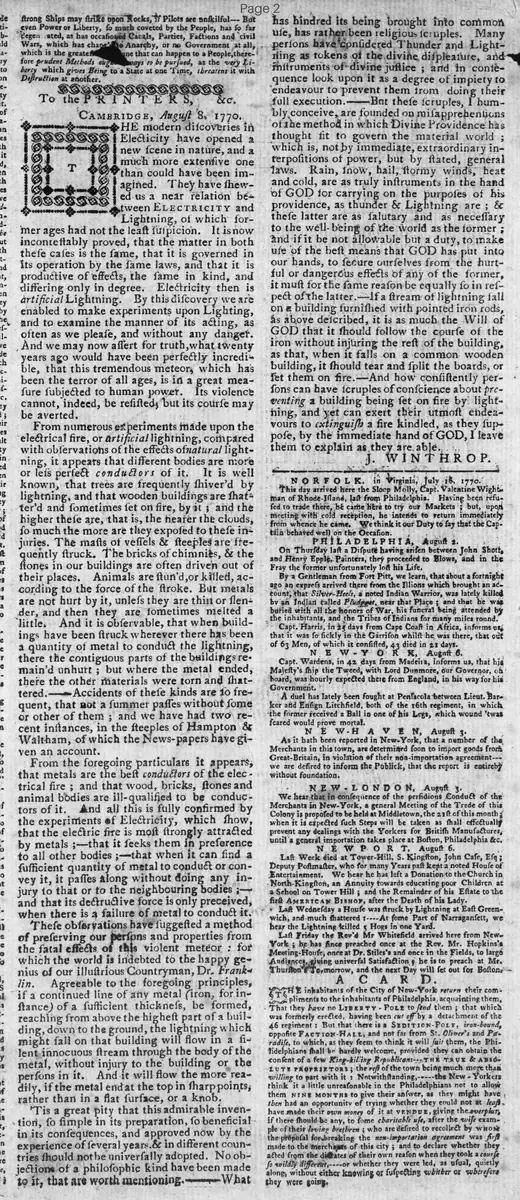
CAMBRIDGE, August 8. 1770.
THE modern discoveries in Electricity have opened a new scene in nature, and a much more extensive one than could have been imagined. They have shewed us a near relation between Electricity and Lightning, of which former ages had not the least suspicion. It is now incontestably proved, that the matter in both these cases is the same. that it is governed in its operation by the same laws, and that it is productive of effects, the same in kind, and differing only in degree. Electricity then is artificial Lightning. By this discovery we are enabled to make experiments upon Lightning, and to examine the manner of its acting. as often as we please, and without any danger. And we may now assert for truth, what twenty years ago would have been perfectly incredible. that this tremendous meteor, which has been the terror of all ages, is in a great measure subjected to human power. Its violence cannot, indeed, be resisted; but its course may be averted.
From numerous experiments made upon the electrical fire. or artificial lightning. compared with observations of the effects of natural lightning, it appears that different bodies are more or less perfect conductors of it. It is well known, that trees are frequently shivered by lightning. and that wooden buildings are shattered and sometimes set on fire, by it ; and the higher these are, that is, the nearer the clouds. so much the more are they exposed to these injuries. The masts of vessels & steeples are frequently struck. The bricks of chimneys, & the stones in our buildings are often driven out of their places. Animals are stunned.or killed, according to the force of the stroke. But metals are not hurt by it, unless they are thin or slender, and then they are sometimes melted a little. And it is observable, that when buildings have been struck wherever there has been a quantity of metal to conduct the lightning, there the contiguous parts of the buildings remained unhurt ; but where the metal ended, there the other materials were torn and shattered.- Accidents of these kinds are so frequent, that not a summer passes without some or other of them ; and we have had two recent instances, in the steeples of Hampton & Waltham, of which the News-papers have given an account.
From the foregoing particulars it appears; that metals are the best conductors of the electrical fire ; and that wood. bricks. stones and animal bodies are ill-qualified to be conductors of it. And all this is fully confirmed by the experiments of Electricity, which show, that the electric fire is most strongly attracted by metals ;--that it seeks them in preference to all other bodies ;-that when it can find a sufficient quantity of metal to conduct or convey it, it passes along without doing any injury to that or to the neighbouring bodies ; and that its destructive force is only perceived. when there is a failure of metal to conduct it.
These observations have suggested a method of preserving our persons and properties from the fatal effects of this violent meteor : for which the world is indebted to the happy genius of our illustrious Countryman, Dr. Franklin. Agreeable to the foregoing principles, if a continued line of any metal (iron, for instance) of a sufficient thickness, be formed, reaching from above the highest part of a building, down to the ground, the lightning which might fall on that building will flow in a silent innocuous stream through the body of the metal, without injury to the building or the persons in it. And it will flow the more readily, if the metal ends at the top in sharp points, rather than in a flat surface, or a knob. Tis a great pity that this admirable invention, so simple in its preparation, so beneficial in its consequences, and approved now by the experience of several years.& in different countries should not be universally adopted. No objections of a philosophic kind have been made to it, that are worth mentioning.
What has hindered its being brought into common use, has rather been religious scruples. Many persons have considered Thunder and Lightning as tokens of the divine displeasure, and instruments of divine justice ; and in consequence look upon it as a degree of impiety to endeavour to prevent them from doing their full execution.---But these scruples, I humbly conceive, are founded on misapprehensions of the method in which Divine Providence has thought fit to govern the material world : which is, not by immediate, extraordinary interpositions of power, but by stated, general laws. Rain, Snow, hail, stormy winds, heat and cold, are as truly instruments in the hand of GOD for carrying on the purposes of his providence, as thunder & Lightning are ; & these latter are as salutary and as necessary to the well- being of the world as the former ; and if it be not allowable but a duty, to make use of the best means that GOD has put into our hands, to secure ourselves from the hurtful or dangerous effects of any of the former. it must for the same reason be equally so in respect of the latter.-If a stream of lightning fall on a building furnished with pointed iron rods, as above described, it is as much the Will of GOD that it should follow the course of the iron without injuring the rest of the building, as that, when it falls on a common wooden building, it should tear and split the boards, or set them on fire.--And how consistently persons can have scruples of conscience about preventing a building being set on fire by. lightning, and yet can exert their utmost endeavours to extinguish a fire kindled, as they suppose, by the immediate hand of GOD, I leave them to explain as they are able..
J. WINTHROP.
What sub-type of article is it?
What themes does it cover?
What keywords are associated?
What entities or persons were involved?
Letter to Editor Details
Author
J. Winthrop
Recipient
To The Printers, &C.
Main Argument
modern discoveries prove electricity is artificial lightning, and dr. franklin's lightning rod invention allows safe conduction of lightning through metal to protect buildings. religious objections to its use are misguided, as it operates within divine natural laws, similar to mitigating other weather effects.
Notable Details