Thank you for visiting SNEWPapers!
Sign up free
The Daily Missoulian
Missoula, Missoula County, Montana
What is this article about?
Sir Henry May, officiating governor of Hong Kong, formally opened the British section of the Kowloon-Canton railway at Kowloon, highlighting its benefits for colonial prosperity and relations with China. The 22-mile line connects Hong Kong to the Chinese border, built after securing a concession in 1898.
Clipping
OCR Quality
Full Text
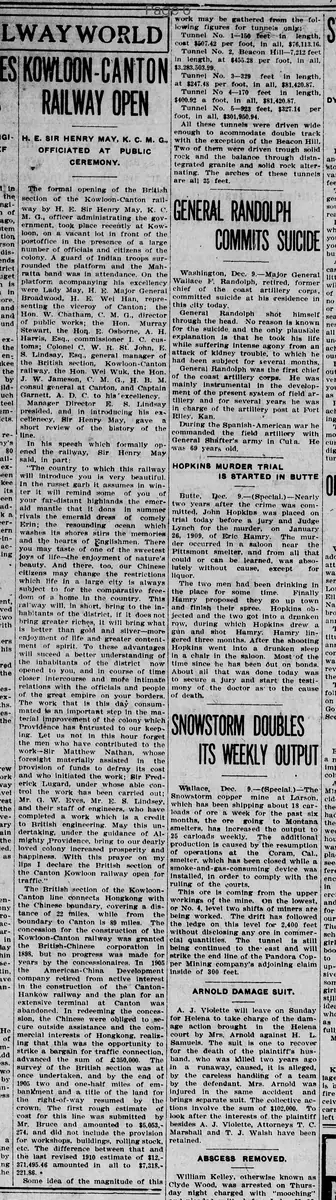
The formal opening of the British section of the Kowloon-Canton railway by H. E. Sir Henry May, K. C. M. G., officer administrating the government, took place recently at Kowloon, on a vacant lot in front of the postoffice in the presence of a large number of officials and citizens of the colony. A guard of Indian troops surrounded the platform and the Mahratta band was in attendance. On the platform accompanying his excellency were Lady May, H. E. Major General Broadwood, H. E. Wei Han, representing the viceroy of Canton; the Hon. W. Chatham, C. M. G., director of public works; the Hon. Murray Stewart, the Hon. E. Osborne, A. H. Harris, Esq., commissioner I. C. customs; Colonel C. W. R. St. John, E. S. Lindsay, Esq., general manager of the British section, Kowloon-Canton railway, the Hon. Wei Wuk, the Hon. J. W. Jameson, C. M. G., H. B. M. consul general at Canton, and Captain Garnett, A. D. C. to his excellency.
Manager Director E. S. Lindsay presided, and in introducing his excellency, Sir Henry May, gave a short review of the history of the line.
In his speech which formally opened the railway, Sir Henry May said, in part:
"The country to which this railway will introduce you is very beautiful. In the russet garb it assumes in winter it will remind some of you of your far-distant highlands; the emerald mantle that it dons in summer rivals the emerald dress of comely Erin; the resounding ocean which washes its shores stirs the memories and the hearts of Englishmen. There you may taste of one of the sweetest joys of life—the enjoyment of nature's beauty. And there, too, our Chinese citizens may change the restrictions which life in a large city is always subject to for the comparative freedom of a home in the country. This railway will, in short, bring to the inhabitants of the district, if it does not bring greater riches, it will bring what is better than gold and silver—more enjoyment of life and greater contentment of spirit. To these advantages will succeed a better understanding of the inhabitants of the district now opened to you, and in course of time closer intercourse and more intimate relations with the officials and people of the great empire on your borders.
The work that is this day consummated is an important step in the material improvement of the colony which Providence has entrusted to our keeping. Let us not in this hour forget the men who have contributed to the work—Sir Matthew Nathan, whose foresight materially assisted in the provision of funds to defray its cost and who initiated the work; Sir Frederick Lugard, under whose able control the work has been carried out; Mr. G. W. Eves, Mr. E. S. Lindsay, and their staff of engineers, who have completed a work which is a credit to British engineering. May this undertaking, under the guidance of Almighty Providence, bring to our dearly loved colony increased prosperity and happiness. With this prayer on my lips I declare the British section of the Canton Kowloon railway open for traffic."
The British section of the Kowloon-Canton line connects Hongkong with the Chinese boundary, covering a distance of 22 miles, while from the boundary to Canton is 89 miles. The concession for the construction of the Kowloon-Canton railway was granted the British-Chinese corporation in 1898, but no progress was made for years by the concessionaires. In 1905 the American-China Development company retired from active interest in the construction of the Canton-Hankow railway and the plan for an extensive terminal at Canton was abandoned. In redeeming the concession, the Chinese were obliged to secure outside assistance and the commercial interests of Hongkong, realizing that this was the opportunity to strike a bargain for traffic connection, advanced the sum of £350,000. The survey of the British section was at once undertaken, and by the end of 1905 two and one-half miles of embankment and a title of the land for the right-of-way resumed by the crown. The first rough estimate of cost for this line was submitted by Mr. Bruce and amounted to $5,053,274, and did not include the provision for workshops, buildings, rolling stock, etc. The difference between that and the last revised 1910 estimate of $12,371,495.46 amounted in all to $7,318,221.86.
Some idea of the magnitude of this work may be gathered from the following figures for tunnels only:
Tunnel No. 1—150 feet in length, cost $507.42 per foot, in all, $76,113.16.
Tunnel No. 2, Beacon Hill—7,212 feet in length, at $455.28 per foot, in all, $3,283,503.99.
Tunnel No. 3—329 feet in length, at $247.48 per foot, in all, $81,420.87.
Tunnel No. 4—170 feet in length, $400.92 a foot, in all, $68,156.40.
Tunnel No. 5—923 feet, $327.14 per foot, in all, $301,950.94.
All these tunnels were driven wide enough to accommodate double track with the exception of the Beacon Hill. Two of them were driven through solid rock and the balance through disintegrated granite and solid rock alternating. The arches of these tunnels are all 35 feet.
What sub-type of article is it?
What keywords are associated?
What entities or persons were involved?
Where did it happen?
Foreign News Details
Primary Location
Kowloon
Event Date
Recently
Key Persons
Outcome
the british section of the kowloon-canton railway, 22 miles long, declared open for traffic, expected to bring prosperity, enjoyment, and closer relations with china.
Event Details
Formal opening ceremony at Kowloon attended by officials and citizens, with Sir Henry May delivering a speech on the railway's benefits for nature enjoyment, rural life, and colonial improvement. Historical background includes 1898 concession, 1905 funding by Hong Kong interests, and construction details with cost estimates and tunnel specifications.