Thank you for visiting SNEWPapers!
Sign up free
Virginia Argus
Richmond, Virginia
What is this article about?
In March 1798, U.S. envoys Pinckney, Marshall, and Gerry in Paris report to Secretary Pickering on diplomatic talks with Talleyrand. France demands a secret loan as proof of U.S. friendship and neutrality compliance, but envoys refuse, citing exceeded powers and neutrality risks, leading to negotiation impasse.
Merged-components note: Continuation of the same dispatch from the American envoys in Paris, split across pages due to page boundary.
Clippings
1 of 2
OCR Quality
Full Text
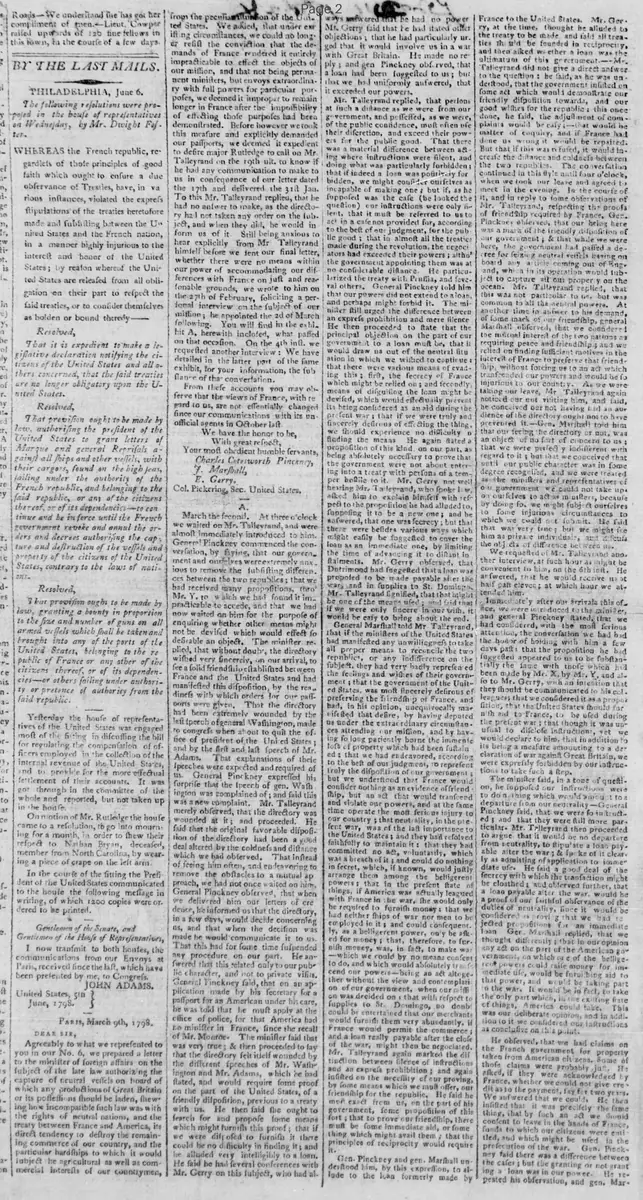
DEAR SIR,
Agreeably to what we represented to
you in our No. 6, we prepared a letter
to the minister of foreign affairs on the
subject of the late law authorizing the
capture of neutral vessels on board of
which any productions of Great Britain
or its possessions should be laden, showing
how incompatible such law was with
the rights of neutral nations, and the
treaty between France and America, its
direct tendency to destroy the remaining
commerce of our country, and the
particular hardships to which it would
subject the agricultural as well as commercial
interests of our countrymen,
from the peculiar situation of the United
States. We added, that under existing
circumstances, we could no longer
remain with the conviction that the demands
of France rendered it entirely
impracticable to effect the objects of
our mission, and that not being permanent
ministers, but envoys extraordinary
with full powers for particular purposes,
we deemed it improper to remain
longer in France after the impossibility
of effecting those purposes had been
demonstrated. Before however we took
this measure and explicitly demanded
our passports, we deemed it expedient
to desire major Rutledge to call on Mr.
Talleyrand on the 20th ult. to know if
he had any communication to make to
us in consequence of our letter dated
the 17th and delivered the 31st Jan.
To this Mr. Talleyrand replied, that he
had no answer to make, as the directory
had not taken any order on the subject,
and when they did, he would inform
us of it. Still being anxious to
hear explicitly from Mr Talleyrand
himself before we sent our final letter,
whether there were no means within
our power of accommodating our differences
with France on just and reasonable
grounds, we wrote to him on
the 27th of February, soliciting a personal
interview on the subject of our
mission; he appointed the 2d of March
following. You will find in the exhibit
A, herewith enclosed, what passed
on that occasion. On the 4th inst. we
requested another interview: We have
detailed in the latter part of the same
exhibit, for your information, the substance
of that conversation.
From these accounts you may observe
that the views of France, with regard
to us, are not essentially changed
since our communications with its unofficial
agents in October last.
We have the honor to be,
With great respect,
Your most obedient humble servants,
Charles Cotesworth Pinckney,
J. Marshall,
Elbridge Gerry.
Col. Pickering, Sec. United States.
A.
March the second, At three o'clock
we waited on Mr. Talleyrand, and were
almost immediately introduced to him.
General Pinckney commenced the conversation,
by saying, that our government
and our lives were extremely anxious
to remove the subsisting differences
between the two republics: that we
had received many propositions, through
Mr. X. to which we had found it impracticable
to accede, and that we had
now waited on him for the purpose of
enquiring whether other means might
not be devised which would effect so
desirable an object. The minister replied,
that without doubt, the directory
wished very sincerely, on our arrival, to
see a solid friendship established between
France and the United States and had
manifested this disposition, by the readiness
with which orders for Our passports
were given, That the directory
had been extremely wounded by the
last speech of general Washington, made
to congress when about to quit the office
of president of the United States :
and by the first and last speech of Mr.
Adams. That explanations of these
speeches were expected and required of
us. General Pinckney expressed his
surprise that the speech of gen. Washington
was complained of; and said this
was a new complaint. Mr. Talleyrand
merely observed, that the directory was
wounded at it; and proceeded. He
said that the original favorable disposition
of the directory had been a good
deal altered by the coldness and distance
which we had observed, That instead
of seeing him often, and endeavoring to
remove the obstacles to a mutual approach,
we had not once waited on him.
General Pinckney observed, that when
we delivered him our letters of credence,
he informed us that the directory,
in a few days, would decide concerning
us, and that when the decision was
made he would communicate it to us.
That this had for some time suspended
any procedure on our part. He answered
that this related only to our public
character, and not to private visits.
General Pinckney said, that on an application
made by his secretary for a
passport for an American under his care,
he was told that he must apply at the
office of police, for that America had
no minister in France, since the recall
of Mr. Monroe. The minister said that
was very true: & then proceeded to say
that the directory felt itself wounded by
the different speeches of Mr. Washington
and Mr. Adams, which he had
stated, and would require some proof
on the part of the United States, of a
friendly disposition, previous to a treaty
with us. He then said she ought to
search for and propose some means
which might furnish this proof; that if
we were duly owed to furnish it there
could be no difficulty in finding it; and
he alluded very intelligibly to a loan.
He said he had several conferences with
Mr. Gerry on this subject, who had always
agreed with him. He had no power
Mr. Gerry said that he had stated other
objections ; that he had particularly urged
that it would involve us in a war
with Great Britain— He made no reply :
and gen Pinckney observed, that
a loan had been suggested to us; but
that we had uniformly answered, that
it exceeded our powers.
Mr. Talleyrand replied, that persons
at such a distance as we were from our
government, and possessed, as we were,
of the public confidence, must often use
their discretion, and exceed their powers
for the public good. That there
was a material difference between acting
where instructions were silent, and
doing what was particularly forbidden;
that if indeed a loan was positively forbidden,
we might consider ourselves as
incapable of making one : but if, as he
supposed was the case (he looked the
question) our instructions were only silent,
that it must be referred to us to
act in a case not provided for, according
to the best of our judgment, for the public
good : that in almost all the treaties
made during the revolution, the negotiators
had exceeded their powers ; altho'
the government appointing them was at
no considerable distance. He particularized
the treaty with Prussia, and several
others. General Pinckney told him
that our powers did not extend to a loan,
and perhaps might forbid it. The minister
still urged the difference between
an express prohibition and mere silence
He then proceeded to state that the
principal objection on the part of our
government to a loan must be, that it
would draw us out of the neutral situation
in which we wished to continue:
that there were various means of evading
this: first, the secrecy of France
which might be relied on : and secondly
means of disguising the loan might be
devized, which would effectually prevent
its being considered as an aid during the
present war : that if we were truly and
sincerely desirous of effecting the thing,
we should experience no difficulty in
finding the means He again stated a
proposition of this kind, on our part, as
being absolutely necessary to prove that
the government were not about entering
into a treaty with persons of a temper
hostile to it. Mr. Gerry not well
hearing Mr. Talleyrand, who spoke low,
asked him to explain himself with respect
to the proposition he had alluded to,
supposing it to be a new one; and he
answered, that one was secrecy : but that
there were besides various ways which
might easily be suggested to cover the
loan as an immediate one, by limiting
the time of advancing it to distant installments.
Mr. Gerry observed, that
Haudrimont had suggested that a loan was
proposed to be made payable after the
war, and in supplies to St. Domingo—
Mr. Talleyrand Signified, that that might
be one of the means used ; and said that
if we were only sincere in our wish, it
would be easy to bring about the end.
General Marshall told Mr Talleyrand,
that if the ministers of the United States
had manifested any unwillingness to take
all proper means to reconcile the two
republics, or any indifference on the
subject, they had very badly represented
the feelings and wishes of their government ;
that the government of the United
States, was most sincerely desirous of
preserving the friendship of France, and
had, in his opinion, unequivocally manifested
that desire, by having deputed
us under the extraordinary circumstances
attending our mission, and by having
so long patiently borne the immense
loss of property which had been sustained:
that we had endeavored, according
to the best of our judgment, to represent
truly the disposition of our government;
but we understood that France would
consider nothing as an evidence of friendship,
but an act that would transcend
and violate our powers, and at the same
time operate the most serious injury to
our country ; that neutrality, in the present
war, was of the last importance to
the United States : and they had resolved
faithfully to maintain it : that they had
committed no act, voluntarily, which
was a breach of it ; and could do nothing
in secret, which, if known, would justly
arrange them among the belligerent
powers: that in the present state of
things, if America was actually leagued
with France in the war, She would only
be required to furnish money : that we
had neither ships of war nor men to be
employed in it ; and could consequently,
as a belligerent power, only be asked
for money ; that, therefore, to furnish
money, was, in fact, to make war
—which we could by no means consent
to do, and which would absolutely transcend
our powers—being an act altogether
without the view and contemplation
of our government, when our mission
was decided on : that with respect to
supplies to St. Domingo, no doubt
could be entertained that our merchants
would furnish them very abundantly, if
France would permit the commerce;
and a loan really payable after the close
of the war, might then be negotiated.
Mr. Talleyrand again marked the difference
between silence of instructions
and an express prohibition ; and again
insisted on the necessity of our proving,
by some means which we must offer, our
friendship for the republic. He said he
must exact from us, on the part of his
government, some proposition of this
sort ; that to prove our friendship, there
must be some immediate aid, or some
thing which might avail them; that the
principles of reciprocity would require
it.
Gen. Pinckney and gen. Marshall understood
him, by this expression, to allude
to the loan formerly made by
France to the United States. Mr. Gerry,
at the time, thought he alluded to
the treaty to be made and said all treaties
they'd be founded in reciprocity.
and then asked whether a loan was the
ultimatum of this government.—Mr.
Talleyrand did not give a direct answer
to the question : he said, as he was understood,
that the government insisted on
some act which would demonstrate our
friendly disposition towards, and our
good wishes for the republic : this once
done, he said, the adjustment of complaints
would be easy—that would be
matter of inquiry, and if France had
done us wrong it would be repaired.
But that if this was refused, it would increase
the distance and coldness between
the two republics. The conversation
continued in this style until four o'clock,
when we took our leave and agreed to
meet in the evening. In the course
of it, and in reply to some observations of
Mr. Talleyrand, respecting the proofs
of friendship required by France, Gen.
Pinckney observed, that our being here
was a mark of the friendly disposition of
our government; & that while we were
here, the government had passed a decree
for seizing neutral vessels having on
board any article coming out of England,
wherein its operation would subject
to capture all our property on the
ocean. Mr. Talleyrand replied, that
this was not particular to us, but was
common to all the neutral powers. At
another time in answer to his demand.
of some mark of our friendship, general
Marshall observed, that we considered
the mutual interest of the two nations as
requiring peace and friendship ; and we
relied on finding sufficient motives in the
interest of France to preserve that friendship,
without forcing us to an act which
transcended our powers and would be so
injurious to our country. As we were
taking our leave, Mr Talleyrand again
noticed our not visiting him, and said,
he conceived our not having had an audience
of the directory ought not to have
prevented it.—Gen. Marshall told him
that our seeing the directory or not. was
an object of no sort of concern to us ;
that we were perfectly indifferent with
regard to it ; but that we conceived that
until our public character was in some
degree recognised, and we were treated
so—the ministers and representatives of
our government could not take upon
ourselves to act as ministers, because
by doing so. we might subject ourselves
to some injurious circumstances to
which we could not submit. He said
that was very true; but we might see
him as private individuals, and discuss
the objects of difference between us.
We requested of Mr. Talleyrand another
interview, at such hour as might be
convenient to him, on the 6th inst. He
answered, that he would receive us at
half past eleven; at which hour we attended
him.
Immediately after our arrival this afternoon,
we were introduced to the minister,
and general Pinckney stated, that we
had considered, with the most serious
attention, the conversation we had had
the honor of holding with him a few
days past: that the proposition he had
suggested appeared to us to be substantially
the same with those which had
been made by Mr. X, by Mr. Y, and also
to Mr. Gerry, with an intention that
they should be communicated to his colleagues;
that we considered it as a proposition,
that the United States should furnish
aid to France, to be used during
the present war ; that though it was unusual
to disclose instructions, yet we
would declare to him, that in addition to
its being a measure amounting. to a declaration
of war against Great Britain, we
were expressly forbidden by our instructions
to take such a step.
The minister said, in a tone of question,
he supposed our instructions were
to do nothing which would amount to a
departure from our neutrality—General
Pinckney said, that we were so instructed:
and that they were still more particular.
Mr. Talleyrand then proceeded
to argue. that it would be no departure
from neutrality, to stipulate a loan payable
after the war : & spoke of it clearly
as admitting of application to immediate
use. He said a good deal of the
secrecy with which the transaction might
be cloathed: and observed further, that
a loan payable after the war, would be
a proof of our faithful observance of the
duties of neutrality, since it would be
considered as proving that we had rejected
propositions for an immediate
loan Gen. Marshall replied, that we
thought differently ; (but in our opinion
any act on the part of the American government,
on which one of the belligerent
powers could raise money for immediate
use, would be furnishing aid to
that power, and would be taking part
in the war. It would' be in fact, to take
the only part which, in the existing state
of things, America could take, This
was our deliberate opinion, and in addition
to it we considered our instructions
as conclusive on this point.
He observed, that we had claims on
the French government for property
taken from American citizens. Some of
those claims were probably just. He
asked, if they were acknowledged by
France, whether we could not give credit
as to the payment, say for two years.
We answered that we could He then
insisted that it was precisely the same
thing, that by such an act we should
consent to leave in the hands of France,
funds to which our citizens were entitled,
and which might be used in the
prosecution of the war. Gen. Pinckney
said there was a difference betweeen
the cases; but the granting or not granting
a loan was in our power. te repeated
his observation, and gen. Marshall
Shall (as the property for which money was due to American citizens from the French government, was taken into possession of that government without any co-operation on the part of the United States.
No act of any sort was performed by our government, which in any degree contributed to place those funds in the hands of France, nor was there any consent towards it: but in the case proposed the act would be the act of the government; the government could itself place funds in the hands of France, and thereby furnish means which might be employed in the prosecution of the war.
This was the distinction between the cases, and in a question of neutrality it appeared to us to be all important.
The minister proceeded to state the case of assuming the debt of our citizens, and of paying the debt in that manner; but General Pinckney and Mr. Gerry told him we were positively forbidden to assume to our own the debts of citizens, even if we were to pay the money directly to them. He seemed surprised at this. General Pinckney observed, contrary to the usage, we had deemed it proper, in the existing state of things, to state candidly our powers to him, that he might know certainly that we could not secretly, or under any disguise whatever, make a loan which might be used during the war.
Mr. Talleyrand said he must resume his position that there was a difference, which he must insist upon, between a loan payable immediately, and a loan payable in future; and he still insisted there was no difference between a loan payable in future and a credit for the money which might be due to our citizens. Mr. Gerry observed that his colleagues had just illustrated the distinction between the debt which will be due to the citizens of the United States from France, in case of recognizing the claims which we shall make in their behalf, and a debt which might arise from a loan by the government of the United States to that of France, during the war. The one is the result of an arrest of their property without their consent, the other would be a voluntary act of the government of the United States, and a breach of their neutrality. There is an additional objection to the latter; if the United States should make such a loan it would give too much reason to suppose that their government had consented, in a collusive manner, to the capture of the vessels of their citizens, and had thus been furnishing France with supplies thereupon on the war. Our instructions are express, not to stipulate for any aids to France, either directly or indirectly during the war.
With respect to a secret stipulation, a loan cannot be made without an act of the legislature; but if the executive were adequate to it, we have an instance of an injunction of secrecy on members of the senate, on an important subject, which one of the members thought himself warranted in publishing in the news papers; and of frequent instances of secrets which have otherwise escaped: secrecy, in this instance, might therefore be considered, if the measure was in itself admissible, as being impracticable. General Marshall observed, that we had considered the subject with great solicitude, and were decidedly of opinion, that we could not under any form, make a loan which could be used during the war; that he could not tell what our government would do, if on the spot; our were perfectly clear, that without additional orders, we could not do what France requested. Mr. Gerry, observed, that the government & nation of the U. States, as well as ourselves, were carefully solicitous to restore friendship between the two republics: as Gen. Marshall had stated, we could not say what our government would do, if on the spot; but if this proposition met the wishes of the government of France, general Marshall and himself had agreed immediately to embark for the United States, and lay before our government the existing state of things here, as it respected our nations, to enable them to determine whether any, and what other measure on their part were necessary. Mr. Talleyrand made no observation on this proposition; but enquired whether we expected soon to receive orders. Mr. Gerry mentioned an answer he had received to a letter sent by him in November: and general Marshall stated that our last dispatches were sent on board two vessels at Amsterdam, on the 20th of November, from which Mr. Talleyrand could form as just an idea as we could, when an answer might be expected; nor did he think it probable one would arrive before a month to come. General Marshall told him, we knew that our government had not received our dispatches on the 8th of January; and we could not tell when they might be received. He asked whether our intelligence came through England. General Marshall answered that it did not; and general Pinckney said, that American papers as late as the 8th of January mentioned the fact.
There was some conversation about the time when these instructions might be expected; and general Marshall suggested a doubt whether our government might give any instructions. He asked, with some surprise, whether we had not written for instruction: And we answered, that we had not: and Mr. Gerry said that we had stated facts to our government, and conceived that nothing more was necessary. General Pinckney observed, that the government knowing the facts, would do what was proper; and that our applying for instructions or not would not alter their conduct. Mr. Talleyrand then enquired whether we had not sent any one to the United States. General Pinckney said no: and Mr. Gerry added, that soon after our arrival we had made propositions to send one of our number, which were not accepted. And general Marshall further added, that those who had communicated with us, had told us we should be ordered out of France immediately; and we had supposed that we should be ordered out before our letters could reach the government. Mr. Gerry then observed, that the government of France must judge for itself, but that it appeared to him, that a treaty on liberal principles, such as those on which the treaty of commerce between the two nations was first established, would be infinitely more advantageous to France than the trifling advantages she could derive from a loan. Such a treaty would produce a friendship and attachment, on the part of the United States to France, which would be solid and permanent, and produce benefits far superior to those of a loan, if we had powers to make it. To this observation M. Talleyrand made no reply. We parted without any sentiment delivered by the minister on the subject of our going home to consult our government.
As we were taking our leave of Mr. Talleyrand, we told him that two of us would return immediately, to receive the instructions of our government, if that would be agreeable to the directory: if it was not, we would wait some time in the expectation of receiving instructions.
What sub-type of article is it?
What keywords are associated?
What entities or persons were involved?
Where did it happen?
Foreign News Details
Primary Location
Paris
Event Date
March 1798
Key Persons
Outcome
negotiations reach impasse; france insists on u.s. loan as proof of friendship, envoys refuse citing exceeded powers and neutrality violation; envoys consider departing france.
Event Details
U.S. envoys report on meetings with French Foreign Minister Talleyrand on February 2 and March 4-6, 1798, where France demands a secret loan payable after the war as evidence of U.S. friendship and neutrality, alluding to prior unofficial propositions; envoys argue it violates instructions, neutrality, and risks war with Britain; propose returning to U.S. for further instructions if agreeable.