Thank you for visiting SNEWPapers!
Sign up free
Gazette Of The United States And Daily Evening Advertiser
Philadelphia, Philadelphia County, Pennsylvania
What is this article about?
Empress Catherine II of Russia's official declaration, read on December 1, 1794, in St. Petersburg, justifying Russian intervention in Poland. It recounts historical grievances, the 1794 Kosciusko uprising, partitions with Prussia, and Russian military victories suppressing the rebellion, culminating in Kosciusko's capture and advances on Warsaw.
Clipping
OCR Quality
Full Text
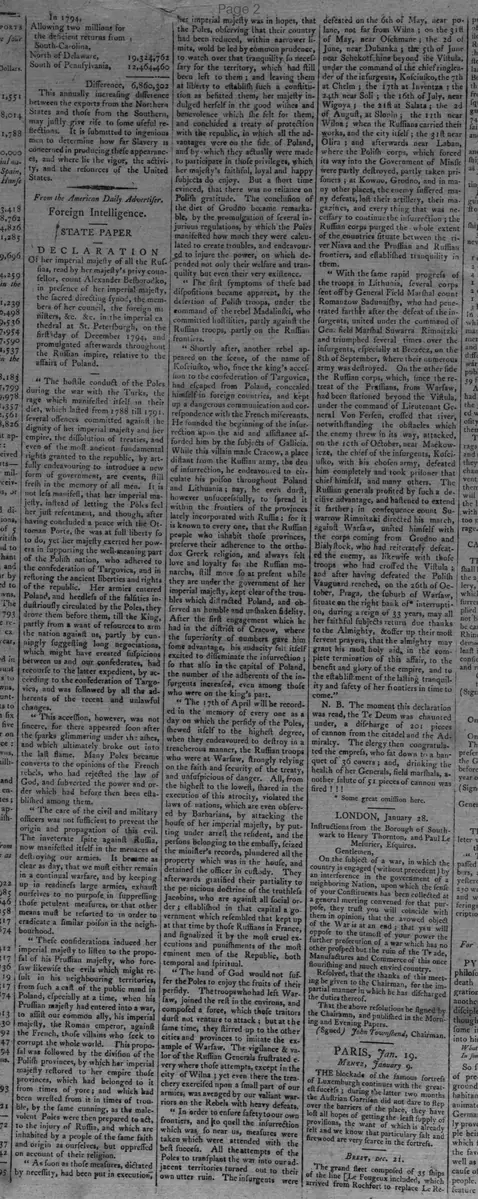
Foreign Intelligence.
STATE PAPER
DECLARATION
Of her imperial majesty of all the Russias, read by her majesty's privy counsellor, count Alexander Beborodko, in presence of her imperial majesty, the sacred directing synod, the members of her council, the foreign ministers, &c. &c. in the imperial cathedral at St. Peterburgh, on the first day of December 1794, and promulgated afterwards throughout the Russian empire, relative to the affairs of Poland.
"The hostile conduct of the Poles during the war with the Turks, the rage which manifested itself in their diet, which lasted from 1788 till 1791, several offences committed against the dignity of her imperial majesty and her empire, the dissolution of treaties, and even of the most ancient fundamental rights granted to the republic, by artfully endeavouring to introduce a new form of government, are events still fresh in the memory of all men. It is not less manifest, that her imperial majesty, instead of letting the Poles feel her just resentment, and though, after having concluded a peace with the Ottoman Porte, she was at full liberty so to do, yet her majesty exerted her powers in supporting the well-meaning part of the Polish nation, who adhered to the confederation of Targovica, and in restoring the ancient liberties and rights of the republic. Her armies entered Poland, and heedless of the falsities industriously circulated by the Poles, they drove them before them, till the King, partly from a want of resources to arm the nation against us, partly by cunningly suggesting long negociations, which might have created suspicions between us and our confederates, had recourse to the latter expedient, by acceding to the confederation of Targovica, and was followed by all the adherents of the recent and unlawful changes.
"This accession, however, was not sincere, for there appeared soon after the sparks glimmering under the ashes, and which ultimately broke out into the last flame. Many Poles became converts to the opinions of the French rebels, who had rejected the law of God, and subverted the power and order which had before then been established among them.
"The care of the civil and military officers was not sufficient to prevent the origin and propagation of this evil. The inveterate spite against Russia, now manifested itself in the menaces of destroying our armies. It became as clear as day, that we must either remain in a continual warfare, and by keeping up in readiness large armies, exhaust ourselves to no purpose in suppressing those petulant measures, or that other means must be resorted to in order to eradicate a similar poison in the neighbourhood.
"These considerations induced her imperial majesty to listen to the proposal of his Prussian majesty, who foresaw likewise the evils which might result in his neighbouring territories, from such a cast of the public mind in Poland, especially at a time, when his Prussian majesty had entered into a war, to aid our common ally, his imperial majesty, the Roman emperor, against the French, those villains who seek to corrupt the whole world. This proposal was followed by the division of the Polish provinces, by which her imperial majesty restored to her empire those provinces, which had belonged to it from times of yore; and which had been wrested from it in times of trouble, by the same cunning, as the malevolent Poles were then prepared to act, to the injury of Russia, and which are inhabited by a people of the same faith and origin as ourselves, but oppressed on account of their religion.
"As soon as those measures, dictated by necessity, had been put in execution, her imperial majesty was in hopes, that the Poles, observing that their country had been reduced, within narrower limits, would be led by common prudence to watch over that tranquility so necessary for the territory, which had still been left to them; and leaving them at liberty to establish such a constitution as befitted them, her majesty indulged herself in the good wishes and benevolence which she felt for them; and concluded a treaty of protection with the republic, in which all the advantages were on the side of Poland, and by which they actually were made to participate in those privileges, which her majesty's faithful, loyal and happy subjects do enjoy. But a short time evinced, that there was no reliance on Polish gratitude. The conclusion of the diet of Grodno became remarkable, by the promulgation of several injurious regulations, by which the Poles manifested how much they were calculated to create troubles, and endeavoured to injure the power, on which depended not only their welfare and tranquility but even their very existence.
"The first symptoms of these bad dispositions became apparent, by the desertion of Polish troops, under the command of the rebel Madalinski, who committed hostilities, partly against the Russian troops, partly on the Russian frontiers.
"Shortly after, another rebel appeared on the scene, of the name of Kosciusko, who, since the king's accession to the confederation of Targovica, had escaped from Poland, concealed himself in foreign countries, and kept up a dangerous communication and correspondence with the French miscreants. He founded the beginning of the insurrection upon the aid and assistance afforded him by the subjects of Gallicia. While this villain made Cracow, a place distant from the Russian army, the den of insurrection, he endeavoured to circulate his poison throughout Poland and Lithuania; nay, he even durst, however unsuccessfully, to spread it within the frontiers of the provinces lately incorporated with Russia: for it is known to every one, that the Russian people who inhabit those provinces, preserve their adherence to the orthodox Greek religion, and always felt love and loyalty for the Russian monarchs, still more so at present while they are under the government of her imperial majesty, kept clear of the troubles which distracted Poland, and observed an humble and unshaken fidelity.
After the first engagement which he had in the district of Cracow, where the superiority of numbers gave him some advantage, his audacity felt itself excited to disseminate the insurrection; so that also in the capital of Poland, the number of the adherents of the insurgents increased, even among those who were on the king's part.
"The 17th of April will be recorded in the memory of every one as a day on which the perfidy of the Poles, shewed itself to the highest degree, when they endeavoured to destroy in a treacherous manner, the Russian troops who were at Warsaw, strongly relying on the faith and security of the treaty, and unsuspicious of danger. All, from the highest to the lowest, shared in the execution of this atrocity, violated the laws of nations, which are even observed by Barbarians, by attacking the house of her imperial majesty, by putting under arrest the resident, and the persons belonging to the embassy, seized the minister's records, plundered all the property which was in the house, and detained the officer in custody. They afterwards gratified their partiality to the pernicious doctrine of the truthless Jacobins, who are against all social order; established in that capital a government which resembled that kept up at that time by those ruffians in France, and signalized it by the most cruel executions and punishments of the most eminent men of the Republic, both temporal and spiritual.
"The hand of God would not suffer the Poles to enjoy the fruits of their perfidy. The troops who had left Warsaw, joined the rest in the environs, and composed a force, which those traitors durst not venture to attack; but at the same time, they stirred up to the other cities and provinces to imitate the example of Warsaw. The vigilance & valor of the Russian Generals frustrated every where those attempts, except in the city of Wilna; yet even there the treachery exercised upon a small part of our armies, was avenged by our valiant warriors on the Rebels with heavy defeats.
"In order to ensure safety to our own frontiers, and to quell the insurrection which was so near us, measures were taken which were attended with the best success. All the attempts of the Poles to transplant the war into our adjacent territories turned out to their own utter ruin. The insurgents were defeated on the 6th of May, near Polang, not far from Wilna; on the 31st of May, near Ochmiana; the 2d of June, near Dubenka: the 5th of June near Szczekociny beyond the Vistula, under the command of the chief ringleader of the insurgents, Kosciusko, the 7th at Chelm; the 17th at Iwentza: the 24th near Solki; the 16th of July, near Wigra; the 21st at Salaty; the 2d of August, at Slonim; the 11th near Wilna; when the Russians carried their works, and the city itself; the 31st near Olita; and afterwards near Labana, where the Polish corps, which forced its way into the Government of Minsk were partly destroyed, partly taken prisoners; at Kowno, Grodno, and in many other places, the enemy suffered many defeats, lost their artillery, their magazines, and every thing that was necessary to continue the insurrection; the Russian corps purged the whole extent of the countries situate between the river Niemen and the Prussian and Russian frontiers, and established tranquility in them.
"With the same rapid progress of the troops in Lithuania, several corps sent off by General Field Marshal count Romanzow Sadunaisky, who had penetrated farther after the defeat of the insurgents, united under the command of Gen. field Marshal Suwarrow Rimnitzki and triumphed several times over the insurgents, especially at Brezecz, on the 8th of September, where their numerous army was destroyed. On the other side the Russian corps, which, since the retreat of the Prussians, from Warsaw, had been stationed beyond the Vistula, under the command of Lieutenant General Von Fersen, crossed that river, notwithstanding the obstacles which the enemy threw in its way, attacked, on the 16th of October, near Mackowice, the chief of the insurgents, Kosciusko, with his chosen army, defeated him completely and took prisoner that chief himself, and many others. The Russian generals profited by such a decisive advantage, and hastened to extend it farther; in consequence count Suwarrow Rimnitzki directed his march, against Warsaw, united himself with the corps coming from Grodno and Bialystok, who had reiterately defeated the enemy, as likewise with those troops who had crossed the Vistula; and after having defeated the Polish Vanguard reached, on the 26th of October, Praga, the suburb of Warsaw, situate on the right bank of the Vistula.
P her faithful subjects return due thanks to the Almighty, & offer up their most fervent prayers, that the almighty may grant his most holy aid, in the complete termination of this affair, to the benefit and glory of the empire, and to the establishment of the lasting tranquility and safety of her frontiers in time to come."
What sub-type of article is it?
What keywords are associated?
What entities or persons were involved?
Where did it happen?
Foreign News Details
Primary Location
Poland
Event Date
First Day Of December 1794
Key Persons
Outcome
insurgents defeated in multiple battles from may to october 1794; kosciusko captured; polish forces lost artillery, magazines, and suffered heavy defeats; russian troops advanced to praga suburb of warsaw; insurrection suppressed with tranquility established in affected regions.
Event Details
The declaration details Russian grievances against Poland, including historical hostilities, the insincere accession to Targovica confederation, French revolutionary influences, the 1793 partition with Prussia, the Grodno diet's injurious regulations, desertions by Madalinski and Kosciusko's uprising starting April 1794 with aid from Galicia, the treacherous attack on Russian troops in Warsaw on April 17, establishment of a Jacobin-like government, and subsequent Russian military victories quelling the insurrection across Poland and Lithuania, leading to advances on Warsaw.