Thank you for visiting SNEWPapers!
Sign up free
The National Intelligencer And Washington Advertiser
Washington, District Of Columbia
What is this article about?
Impeachment trial proceedings against U.S. District Judge John Pickering in 1804, detailing his 1802 refusal to allow an appeal in the ship Eliza forfeiture case and his intoxication on the bench, supported by witness testimonies from Sherburne, Chadbourn, Steele, and others.
Merged-components note: Continuation of the trial of John Pickering story across pages 1 and 2, indicated by '[Continued.]' and seamless text flow.
Clippings
1 of 2
OCR Quality
Full Text
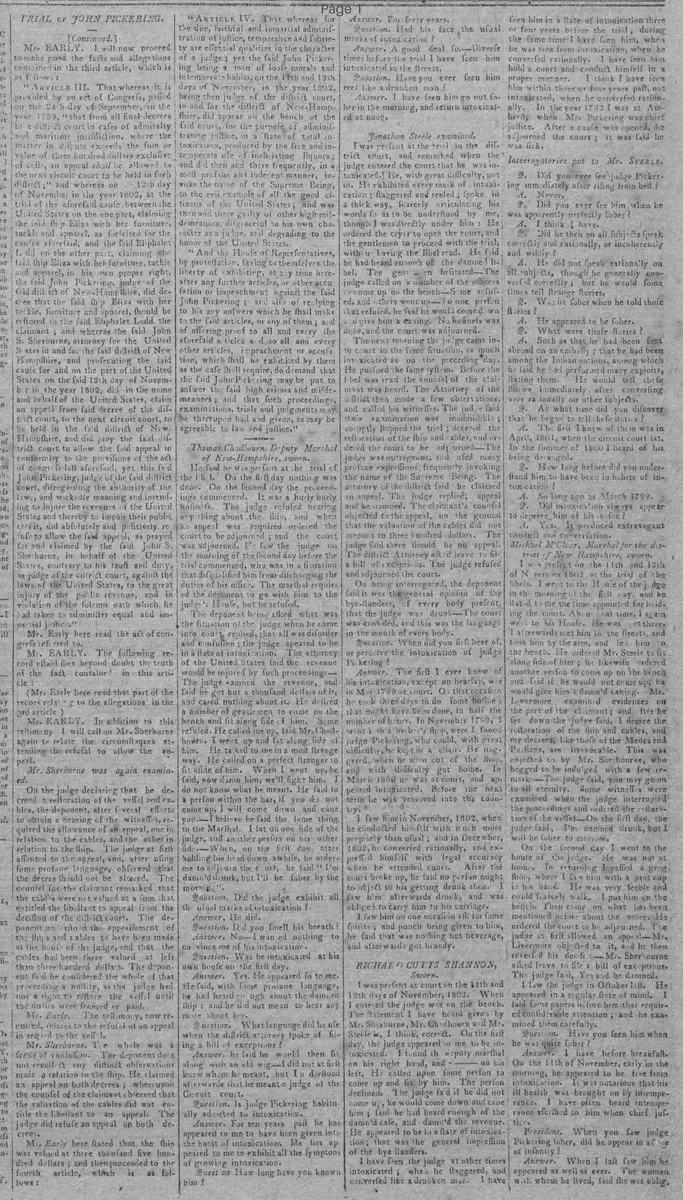
[Continued.]
Mr. EARLY. I will now proceed to make good the facts and allegations contained in the third article, which is as follows:
"ARTICLE III. That whereas it is provided by an act of Congress, passed on the 24th day of September, in the year 1789, 'that from all final decrees in a district court in cases of admiralty and maritime jurisdiction, where the matter in dispute exceeds the sum or value of three hundred dollars exclusive of costs, an appeal shall be allowed to the next circuit court to be held in such district;' and whereas on the 12th day of November in the year 1803, at the trial of the aforesaid cause between the United States on the one part, claiming the said ship Eliza with her furniture, tackle and apparel, as forfeited for the causes aforesaid, and the said Eliphalet Ladd on the other part, claiming the said ship Eliza with her furniture, tackle and apparel, in his own proper right, the said John Pickering, judge of the said district court of New-Hampshire, did decree that the said ship Eliza with her tackle, furniture and apparel, should be restored to the said Eliphalet Ladd the claimant; and whereas the said John S. Sherburne, attorney for the United States in and for the said district of New Hampshire, and prosecuting the said cause for and on the part of the United States on the said 12th day of November in the year 1802, did in the name and behalf of the United States, claim an appeal from said decree of the district court, to the next circuit court, to be held in the said district of New-Hampshire, and did pray the said district court to allow the said appeal in conformity to the provisions of the act of Congress last aforesaid, yet this said John Pickering, judge of the said district court, disregarding the authority of the law, and wickedly meaning and intending to injure the revenues of the United States and thereby to impair their public credit, did absolutely and positively refuse to allow the said appeal, as prayed for and claimed by the said John S. Sherburne, in behalf of the United States, contrary to his trust and duty as judge of the district court, against the laws of the United States, to the great injury of the public revenue, and in violation of the solemn oath which he had taken to administer equal and impartial justice."
Mr. Early here read the Act of Congress referred to.
Mr. EARLY. The following record establishes beyond doubt the truth of the fact contained in this article:
(Mr. Early here read that part of the record relating to the allegations in the 3rd article)
Mr. EARLY. In addition to this testimony I will call on Mr. Sherburne again to relate the circumstances attending the refusal to allow the appeal.
Mr. Sherburne was again examined.
On the judge declaring that he decreed a restoration of the vessel seized cables, the deponent, after several efforts to obtain a hearing of the witnesses, required the allowance of an appeal, one in relation to the cables, and the other in relation to the ship. The judge at first assented to the appeal, and, after using some profane language, observed that the decree should not be altered. The counsel for the claimant remarked that the cables were not valued at a sum that entitled the libellant to appeal from the decision of the district Court. The deponent understood the appraisement of the ship's and cables to have been made at the house of the judge, and that the cables had been there valued at less than three hundred dollars. The deponent had he considered the whole of that proceeding a nullity, as the judge had not a right to restore the vessel until the duties were secured or paid.
Mr. Early. The testimony, now required, relates to the refusal of an appeal in regard to the vessel.
Mr. Sherburne. The whole was a case of confusion. The deponent does not recollect any distinct observations made in relation to the ship. He claimed an appeal on both decrees; whereupon the counsel of the claimant observed that the valuation of the cables did not entitle the libellant to an appeal. The judge did refuse an appeal on both decrees.
Mr. Early here stated that the ship was valued at three thousand five hundred dollars; and then proceeded to the fourth article, which is as follows:
"ARTICLE IV. That whereas for the due, faithful and impartial administration of justice, temperance and sobriety are essential qualities in the character of a judge; yet the said John Pickering being a man of loose morals and intemperate habits, on the 11th and 12th days of November, in the year 1802, being then judge of the district court, in and for the district of New-Hampshire, did appear on the bench of the said court, for the purpose of administering justice, in a state of total intoxication, produced by the free and intemperate use of inebriating liquors; and did then and there frequently, in a most profane and indecent manner, invoke the name of the Supreme Being, to the evil example of all the good citizens of the United States; and was then and there guilty of other high misdemeanors, disgraceful to his own character as a judge, and degrading to the honor of the United States.
"And the House of Representatives, by protestation, saving to themselves the liberty of exhibiting, at any time hereafter, any further articles, or other accusation or impeachment against the said John Pickering; and also of replying to his any answers which he shall make to the said articles, or any of them: and of offering proof to all and every the aforesaid articles and to all and every other articles, impeachment or accusation, which shall be exhibited by them as the case shall require, do demand that the said John Pickering may be put to answer the said high crimes and misdemeanors; and that such proceedings, examinations, trials and judgments may be thereupon had and given, as may be agreeable to law and justice."
Thomas Chadbourn, Deputy Marshal of New-Hampshire, sworn.
He said he was present at the trial of the libel. On the first day nothing was done. On the second day the proceedings commenced. It was a hurly burly business. The judge refused hearing any thing about the ship, and when an appeal was required ordered the court to be adjourned; and the court was adjourned. He saw the judge on the morning of the second day before the trial commenced, who was in a situation that disqualified him from discharging the duties of his office. The marshal requested the deponent to go with him to the judge's house, but he refused.
The deponent being asked what was the situation of the judge when he came into Court, replied, that all was disorder and confusion; the judge appeared to be in a state of intoxication. The attorney of the United States said the revenue would be injured by such proceeding:— The judge damned the revenue, and said he got but a thousand dollars of it, and cared nothing about it. He desired a number of gentlemen to come on the bench and sit along side of him. Some refused. He called me up, said Mr. Chadbourn. I went up and sat along side of him. He talked to me in a most strange way. He called on a perfect stranger to sit aside of him. When I went up, he said, now damn him, we'll fight him. I do not know what he meant. He said to a person within the bar, if you do not come up, I will come down and cane you.—I believe he said the same thing to the Marshal. I sat on one side of the judge, and another person on his other side.—When, on the first day, after holding his head down awhile, he ordered me to adjourn the court, he said "I'm damn'd drunk, but I'll be sober by the morning".
Question. Did the judge exhibit all the usual marks of intoxication?
Answer. He did.
Question. Did you smell his breath?
Answer. No—I wanted nothing to convince me of his intoxication.
Question. Was he intoxicated at his own house on the first day.
Answer. Yes. He appeared so to me.
He said, with some profane language, he had heard enough about the damned ship: and he did not mean to hear any more about her.
Question. What language did he use when the district attorney spoke of filing a bill of exceptions?
Answer. He said he would sit it along with an old wig—I did not at first know whom he meant, but I understood afterwards that he meant a judge of the Circuit court.
Question. Is judge Pickering habitually addicted to intoxication.
Answer. For ten years past he has appeared to me to have been given into the habit of intoxication. He has appeared to me to exhibit all the symptoms of growing intoxication.
Question. How long have you known him?
Answer. For forty years.
Question. Had his face the usual marks of intoxication?
Answer. A good deal so.—Diverse times before the trial I have seen him intoxicated in the streets,
Question. Have you ever seen him reel like a drunken man?
Answer. I have seen him go out sober in the morning, and return intoxicated at noon.
Jonathon Steele examined.
I was present at the trial in the district court, and remarked when the judge entered the court that he was intoxicated. He, with great difficulty, got in. He exhibited every mark of intoxication; staggered and reeled; spoke in a thick way, scarcely articulating his words so as to be understood by me, though I was directly under him: He ordered the crier to open the court, and the gentlemen to proceed with the trial, without having the libel read. He said he had heard enough of the damned libel. The gentlemen hesitated. The judge called on a number of the officers to come up on the bench—Some refused, and others went up—to one person that refused, he said he would come down and give him a caning. No business was done, and the court was adjourned,
The next morning the judge came into court in the same situation, as much intoxicated as on the preceding day— He pursued the same style. Before the libel was read the counsel of the claimant was heard. The Attorney of the district then made a few observations, and called his witnesses. The judge said their examination was inadmissible; abruptly stopped the trial; decreed the restoration of the ship and cables, and ordered the court to be adjourned. The judge was outrageous, and used many profane expressions, frequently invoking the name of the Supreme Being. The attorney of the district said he claimed an appeal. The judge replied, appeal and be crammed. The claimant's counsel objected to the appeal, on the ground that the valuation of the cables did not amount to three hundred dollars. The judge said there should be no appeal. The district Attorney asked leave to file a bill of exceptions. The judge refused and adjourned the court.
On being interrogated, the deponent said it was the general opinion of the by-standers, of every body present, that the judge was drunk—The court was crowded, and this was the language in the mouth of every body.
Question. When did you first hear of, or perceive the intoxication of judge Pickering?
Answer. The first I ever knew of his intoxication, except on hearsay, was in May 1799 at court. On that occasion he took three days to do some business that might have been done, in half the number of hours. In November 1799, I went into a barber's shop, where I found judge Pickering, who could, with great difficulty, be kept in a chair. He staggered, when he went out of the shop, and with difficulty got home. In March 1800 he was at court, and appeared intoxicated. Before the next term he was removed into the country..
I saw him in November, 1801, when he conducted himself with much more propriety than usual; and in December, 1802, he conversed rationally, and expressed himself with legal accuracy when he attended court. After the court broke up, he said no person ought to object to his getting drunk then. I saw him afterwards drunk, and was obliged to carry him to his carriage.
I saw him on one occasion ask for some spirits; and punch being given to him, he said that was nothing but beverage. and afterwards got brandy.
RICHARD CUTTS SHANNON, Sworn.
I was present at court on the 11th and 12th days of November, 1802. When I entered the judge was on the bench. The statement I have heard given by Mr. Sherburne, Mr. Chadbourn and Mr. Steele is, I think, correct. On the first day, the judge appeared to me to be intoxicated. I found the deputy marshal on his right hand, and --- on his left. He called upon some person to come up and sit by him. The person declined. The judge said if he did not come up, he would come down and cane him; said he had heard enough of the damn'd case, and damn'd the revenue. He appeared to be in a state of intoxication; that was the general impression of the by-standers.
I have seen the judge at other times intoxicated; when he staggered, and conversed like a drunken man.
I have seen him in a state of intoxication three or four years before the trial, during the same time I have seen him, when he was free from intoxication, when he conversed rationally. I have seen him hold a court and conduct himself in a proper manner. I think I have seen him within three or four years past, not intoxicated, when he conversed rationally. In the year 1792 I was at Amherst, when Mr. Pickering was chief justice. After a cause was opened, he adjourned the court; it was said he was sick.
Interrogatories put to Mr. STEELE.
Q. Did you ever see judge Pickering immediately after rising from bed?
A. Never.
Q. Did you ever see him when he was apparently perfectly sober?
A. I think I have.
Q. Did he then on all subjects speak correctly and rationally, or incoherently and wildly?
A. He did not speak rationally on all subjects, though he generally conversed correctly: but he would some times tell strange stories.
Q. Was he sober when he told those stories?
A. He appeared to be sober.
Q. What were those stories?
A. Such as that he had been sent abroad on an embassy: that he had been among the Indian nations, among which he said he had performed many exploits, stating them. He would tell these stories immediately after conversing very rationally on other subjects.
Q. At what time did you discover that he began to tell these stories?
A. The first I knew of them was in April, 1801, when the circuit court sat. In the summer of 1800 I heard of his being deranged.
Q. How long before did you understand him to have been in habits of intoxication?
A. So long ago as March 1799.
Q. Did intoxication always appear to deprive him of his reason?
A. Yes. It produced extravagant conduct and conversation.
Michael McClear, Marshal for the district of New Hampshire, sworn.
I was present on the 11th and 12th of November 1802 at the trial of the libels. I went to the house of the judge in the morning of the first day, and he stated to me the time appointed for holding the court. About that time, I again went to his house. He was not there— I afterwards met him in the street, and took him by the arm, and led him on to the bench. He ordered Mr. Steele to sit along side of him; he likewise ordered another person to come up on the bench and said if he would not come up, he would give him a damn'd caning. Mr. Livermore examined evidences on the part of the claimant: and after he sat down the judge said, I decree the restoration of the ship and cables, and my decrees, like those of the Medes and Persians, 'are irrevocable.' This was objected to by Mr. Sherburne, who begged to be indulged with a few remarks—The judge said, you may go on to all eternity. Some witnesses were examined, when the judge interrupted the proceedings and ordered the restoration of the vessel. On the first day, the judge said, 'I'm damned drunk, but I will be sober to morrow.'
On the second day I went to the house of the judge. He was not at home. In returning I passed a grog shop, where I saw him with a pint cup in his hand. He was very feeble and could scarcely walk. I put him on the bench. Then came on what has been mentioned before about the decree. He ordered the court to be adjourned. The judge at first allowed an appeal—Mr. Livermore objected to it, and he then reversed his decision—Mr. Sherburne asked leave to file a bill of exceptions. The judge said, Yes and be damned.
I saw the judge in October last. He appeared in a regular state of mind. I laid some papers before him that required considerable attention: and he examined them carefully.
Question. Have you seen him when he was quite sober?
Answer. I have before breakfast.
On the 11th of November, early in the morning, he appeared to be free from intoxication. It was notorious that his ill health was brought on by intemperance. I have often heard intemperance ascribed to him when chief justice.
President. When you saw judge Pickering sober, did he appear in a state of insanity?
Answer. When I last saw him he appeared as well as ever. The woman with whom he lived, said she was obliged.
President. How long have you been marshal?
Answer. Two years last May.
President. Had judge Pickering the general character of drunkenness before he was appointed District judge?
Answer. He had the character of intemperance when Chief Justice.
Mr. Steele examined.
Being interrogated, he said that he had been clerk of the court since the year 1789, and that it was generally understood that judge Pickering's irregularities proceeded from intoxication; that was the general opinion.
President. Has judge Pickering any property?
Answer. I do not know. He had a house in Portsmouth which was burnt. He also had a farm.
Question. Who manages his property?
Answer. I am unable to say whether he or some other person manages it.
Question. Do you know any thing about his salary?
Answer. I have not the least knowledge as to his salary.
Question. When was his house burnt?
Answer. After the trial of the Eliza.
Mr. SHANNON examined.
He said the prevailing opinion of the inhabitants of New-Hampshire, and of those acquainted with judge Pickering, was, that he was for some time past in the habits of intoxication. He had never heard of any body having expressed an opinion that he was deranged longer than four years ago. He frequently saw him, and never conversed with him when he thought him deranged from any other cause than liquor. He did not himself believe him deranged. He believed it was so said that he might be kept in office.
This judge had a house in Portsmouth, which was burnt in December, 1802. He had also another house in the country, in right, the witness believes, of his wife.
Being further interrogated, the witness said, he had known judge Pickering for thirty five years; though he was not so well acquainted with him as to visit at his house.
He said judge Pickering was formerly very temperate. For eight or ten years past he was, by general reputation, in habits of intoxication.
The witness never saw the judge when he thought him insane.
Mr. Steele being asked how long he had been acquainted with judge Pickering—answered, for fifteen years.
Mr. Nicholson here addressed the court. He said he wished, in case it should be deemed proper by the court, to ask one of the witnesses whether he had conversed with the family physician of judge Pickering, and what his opinion was as to the origination of his insanity.
Mr. Nicholson observed that he had doubts of the propriety of this question, and therefore in the first instance stated it to the court.
The court decided the question inadmissible.
EBENEZER CHADWICK—SWORN.
The deponent has been acquainted, though not intimately, with judge Pickering, about twenty two years. He was deputy sheriff, when Mr. Pickering was chief justice of New-Hampshire.
He thinks he discovered habits of intoxication in him while a state judge.—The first instance he knew was in 1791, when he was chief justice. He has frequently seen him intoxicated since he was judge of the district court. He has seen him stagger, and be obliged to take hold of the fence to support himself. It is near three years since he discovered these symptoms. The general impression of his neighbours is, that he has been a long time in the habit of drinking too freely.
EDWARD HART—sworn.
I have known judge Pickering for twenty-five or thirty years—I was deputy sheriff when he was judge of the supreme court of New-Hampshire. I have never but once before the trial, ten or eleven years ago, seen in him any symptoms of intemperance. On that occasion he was on the bench, and appeared to be sick; he left the court, when I went to him, and then I concluded that he was intoxicated. I have frequently seen him since. There was a report of his being in habits of intoxication, but I never saw him so.
I was present at the trial of the Eliza. I cannot say more of the proceedings on that occasion than has been said by other gentlemen. Whether his conduct arose from insanity or drunkenness I cannot say. It was generally thought at Portsmouth that liquor was the cause of his insanity.
Mr. Whipple, being interrogated, said that he had known judge Pickering for thirty years; and that about eight years ago, from the age and general appearance of judge Pickering he was led to suppose that he was in the habit of intoxication.
[Mr. Whipple was here going on to state some conversation he had with judge Pickering's family physician at this time, which he was induced to ask in consequence of his solicitude to gain true information as to the reported intemperance of the judge; when he was interrupted by the court, and informed that this species of testimony had been already decided to be inadmissible.]
Question. What was the general opinion respecting judge Pickering?
Answer. The general opinion was, that he was in habits of intoxication.
Enquiry being made of the witness, as to the knowledge he had of the management of the property of judge Pickering, and the mode in which he received his salary: he said, he had seen some post notes within the last four months issued in the name of judge Pickering's and endorsed by his son, and he understood that he had drawn his salary by the transmission of those notes. The witness had never seen such notes till within these four months past—Six months ago he had seen them endorsed by himself.
Mr. Nicholson informed the court, that the managers here close the testimony they had to offer. Whereupon they withdrew, and the court adjourned until the next day.
FRIDAY, March 9.
On the suggestion of Mr. Tracy, Simeon Olcott, and William Plumer, Senators from New-Hampshire, were respectively sworn and affirmed.
Mr. OLCOTT. I have had an acquaintance with judge Pickering for more than thirty years last past, but more intimately for about the last 13 or 14 years last past, we being justices of the Supreme Court for New-Hampshire, for about that time, until he was removed to the District Court, during which time we were together, on the Circuits about five months in each year, and generally lodged and travelled together, while on the Circuits, and during that term I never knew, heard or suspected, that said Pickering was at any time intoxicated with, or made excessive use of spirituous liquor—He was often afflicted with a nervous complaint, or what was called the sick head-ache, which sometimes produced extraordinary effects, but he never saw the effect of spirituous liquors, which he thinks he should have noticed, if true, as his seat was, generally next to said Pickering, while on the bench— As to the testimony of Mr. Hart I am certain it is in part a mistake, as he says, what he testifies happened before I was on the bench—whereas in fact, I was a justice of said court before said Pickering, and continued so after his removal to the district court ; As to the fact, as related by said Hart, he has no perfect recollection, but has an idea that said Pickering did once leave the court at Portsmouth and went home, under a complaint of sickness, but he did not think any such cause existed as alleged by said Hart, nor does he believe the charge well founded.—As to the testimony of Mr. Shannon, so far as it relates to what occurred at the Supreme Court at Amherst, I have a full and perfect recollection of what then took place as the particular circumstances made a deep impression on my mind, it may be noticed, the Supreme Court of New-Hampshire consists of four justices, three of whom were necessary to make a quorum to do business, at the court mentioned by said Shannon, three justices only, attended, which were Pickering, Farrar and myself—after the court had proceeded in business, I think for one or two days, said Pickering, while at our lodgings and before the opening the court, or that day complained of being very unwell, and objected against going into court, for that reason—but as the court could not form a quorum. for business without him, he was persuaded. ed to make the attempt,—after being in court a short time, and having made some progress in business, said Pickering complained of being so unwell as not to be able to keep his seat longer, on which the court adjourned to the next day, hoping he might then be able to attend. but that not happening, it was further adjourned, and this for three several times, if my recollection serves me, where from the opinion of the Physicians who attended judge Pickering, there was no probability he would be able to attend (in the court-house) that term, the court was adjourned to his lodgings, in order to complete the business as far as they proceeded, which having done, the court was adjourned without day. The disorder with which said Pickering was afflicted at that time was a violent dysentery, and his life was thought to be in much danger—and I never heard, or thought, (before said Shannon's testimony) that any person suspected it to be the effect of intemperance, and from every circumstance by which I can judge, am convinced, said testimony is altogether incorrect and erroneous.
Mr. PLUMER, I have been intimately acquainted with judge Pickering for near twenty years, within that term he held some of the most important offices in the state and discharged the duties thereof with great propriety. From 1785 to 1790, I spent much time in company with him, particularly during his attendance in the legislature, and at the courts of law; and frequently lodged with him at the same house. In 1790, he was appointed Chief justice of the Supreme Court of judicature in New Hampshire, and continued until February 1795, when he was appointed District judge. When he was chief justice, I was much in company with him, attending the same court, and travelling and lodging with him. During all the time aforesaid, and, I think, until 1800, he was very temperate—and I have no recollection of seeing him once disguised with intoxicating liquors. His reputation for temperance and sobriety, were fair and general. I never heard a suggestion of his being intemperate, until after I was informed of his insanity, which was about four years since. I have seen him many times within the last four years—sometimes he was intoxicated. at other times he was sober: but when wholly free from intoxication he appeared to me to be in a state of insanity. On some subjects he conversed more rationally than on others; but on particular subjects he was wild and incoherent. He was formerly remarkable for the chastity and delicacy of his language, but in the last four years he was often profane and sometimes obscene.
I saw him twice within a week after the trial of the libels mentioned in the impeachment. At the first time he was sober, but quite insane; at the second. he appeared intoxicated.
I saw him two days before I left the state (the 30th September last) at Newington where he then lived. He was then altogether free from intoxication, although he had spirituous liquors at his command, and took some from a closet and urged me to drink. He then conversed on some subjects rationally, but on others was incoherent, wild and extravagant. He appeared weak, emaciated, and from bodily infirmities, was then, in my opinion, unable to bear the fatigues of a journey to this place.
The judge for many years has been subject to nervous and hypochondriac complaints, and these have increased till they have produced what, I think, is a state of confirmed insanity. I believe (for I am required to give my opinion) that his insanity was the cause of his intemperance. Though I think it not improbable that after his insanity had produced a degree of intemperance. the insanity and intemperance might then act mutually as cause and effect; but I have no doubt that the insanity preceded the intemperance.
Mr. Shannon, on being interrogated, said that the first he had heard of Judge Pickering being in habits of intoxication was in the year 1792—About four or five years ago he saw him intoxicated, and he has frequently seen him drunk since.
Mr. Hart deposed that judge Pickering in 1792, had not been in court more than half an hour before he appeared intoxicated; when he left the bench. He was induced to believe his sickness arose from intoxication from his having smelt his breath, which clearly smelt of liquor. The deponent at the time communicated the circumstance to Mr. Chadwick.
Mr. Chadwick said he recollected that about nine or ten years ago there had been a laugh raised against the judge on that account.
Mr. Steele said he had been clerk of the court ever since 1789. The first he had heard of the intoxication of judge Pickering was about seven years ago.
In October 1799 he was so intoxicated that he could not get into court. He never heard of his insanity till April 1800. His conjecture was that the report of insanity was raised as a cover to his intoxication. He thinks he heard the report of insanity from the connections of judge Pickering—The general report was that he was intoxicated.
Mr. Nicholson observed that the managers would withdraw for a few minutes.
The managers having in a short time returned.
Mr. Nicholson in their behalf, addressed the court, and said the managers of the House of Representatives considered the testimony offered in support of the articles of impeachment to be conclusive and pointed, as to render it impossible for them to elucidate or enforce it by any observations in their power to make. He was, therefore, directed by the managers to inform the court that they submitted the articles on the evidence offered, entertaining no doubt of full justice being done by the decision of the Senate.
Whereupon the managers retired.
Mr. Tracy offered the following motion.
Resolved, As the opinion of this court, that the proceedings on the articles of impeachments exhibited by the House of Representatives, against John Pickering be postponed to the day of next.
Passed in the negative, Yeas 10— Nays 20.
Those who voted in the affirmative, are
YEAS. Mess. Adams, Bradley, Dayton, Hillhouse, Olcott, Pickering, Plumer, Tracy, Wells, White.
Those who voted in the negative, are
NAYS.—Messrs. Anderson, Baldwin, Breckenridge, Cocke, Ellery, Franklin, Jackson, Logan, Maclay, Nicholas, Potter, I. Smith, J. Smith, of Ohio. J. Smith, of N. Y. S. Smith, Stone, Sumter, Venable, Worthington, Wright.
The court then adjourned to the next day.
[To be continued.]
What sub-type of article is it?
What themes does it cover?
What keywords are associated?
What entities or persons were involved?
Where did it happen?
Story Details
Key Persons
Location
District Court Of New Hampshire, Portsmouth
Event Date
November 11 12, 1802
Story Details
During the 1802 trial of the ship Eliza, Judge John Pickering refused to allow an appeal to the U.S. attorney, decreed restoration to claimant Eliphalet Ladd despite forfeiture claims, and appeared intoxicated on the bench, using profane language and exhibiting erratic behavior, as testified in his 1804 impeachment proceedings.