Thank you for visiting SNEWPapers!
Sign up free
The Liberator
Boston, Suffolk County, Massachusetts
What is this article about?
Opinion piece from Dundee Advertiser on tensions between Britain and the US over alleged British cruiser attacks on American ships involved in the slave trade. Defends the British Preventive Squadron's efforts to suppress the traffic, criticizes American profiteers, and dismisses war threats.
Clipping
OCR Quality
Full Text
From the Dundee Advertiser.
THE AMERICAN DIFFICULTY.
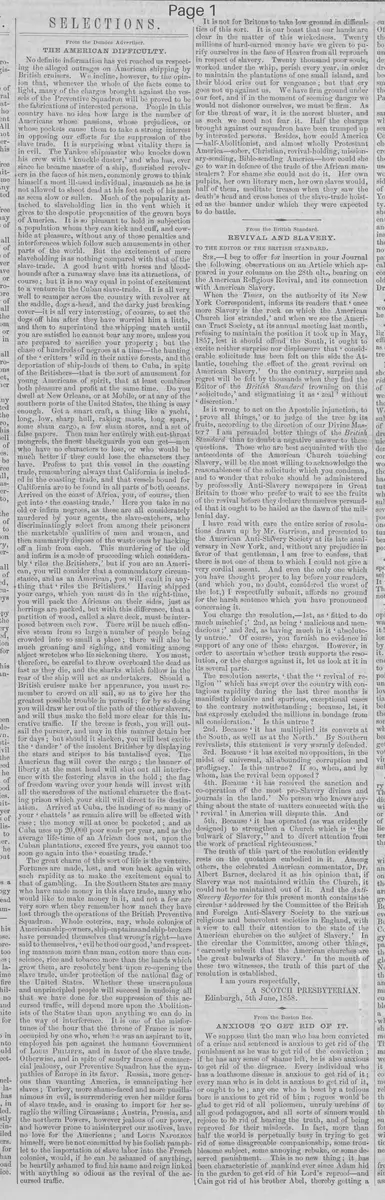
No definite information has yet reached us respecting the alleged outrages on American shipping by British cruisers. We incline, however, to the opinion that, whenever the whole of the facts come to light, many of the charges brought against the vessels of the Preventive Squadron will be proved to be the fabrications of interested persons. People in this country have no idea how large is the number of Americans whose passions, whose prejudices, or whose pockets cause them to take a strong interest in opposing our efforts for the suppression of the slave trade. It is surprising what vitality there is in evil. The Yankee shipmaster who knocks down his crew with knuckle duster,' and who has, ever since he became master of a ship, flourished revolvers in the faces of his men, commonly grows to think himself a most ill-used individual, inasmuch as he is not allowed to shoot dead at his feet such of his men as seem slow or sullen. Much of the popularity attached to slaveholding lies in the vent which it gives to the despotic propensities of the grown boys of America. It is so pleasant to hold in subjection a population whom they can kick and cuff, and cowhide at pleasure, without any of those penalties and interferences which follow such amusements in other parts of the world. But the excitement of mere slaveholding is as nothing compared with that of the slave-trade. A good hunt with horses and bloodhounds after a runaway slave has its attractions, of course; but it is no way equal in point of excitement to a venture in the Cuban slave-trade. It is all very well to scamper across the country with revolver at the saddle, dogs a-head, and the darky just breaking cover—it is all very interesting, of course, to set the dogs off him after they have worried him a little, and then to superintend the whipping match until you are satisfied he cannot bear any more, unless you are prepared to sacrifice your property; but the chase of hundreds of negroes at a time—the hunting of the ' critters' wild in their native forests, and the deportation of ship-loads of them to Cuba, in spite of the Britishers—that is the sort of amusement for young Americans of spirit, that at least combines both pleasure and profit at the same time. Do you dwell at New Orleans, or at Mobile, or at any of the southern ports of the United States, the thing is easy enough. Get a smart craft, a thing like a yacht, long, low, sharp hull, raking masts, long spars, some sham cargo, a few sham stores, and a set of false papers. Then man her entirely with cut-throat mongrels, the finest blackguards you can get—men who have no characters to lose, or who would be much better if they could lose the characters they have. Profess to put this vessel in the coasting trade, remembering always that California is included in the coasting trade, and that vessels bound for California are to be found in all parts of both oceans. Arrived on the coast of Africa, you, of course, then get into 'the coasting trade.' Here you take in no old or infirm negroes, as these are all considerately murdered by your agents, the slave-catchers, who discriminatingly select from among their prisoners the marketable qualities of men and women, and then summarily dispose of the waste ones by hacking off a limb from each. This murdering of the old and infirm is a mode of proceeding which considerably 'riles the Britishers,' but if you are an American, you will consider that a commendatory circumstance, and as an American, you will exult in anything that 'riles the Britishers.' Having shipped your cargo, which you must do in the night-time, you will pack the Africans on their sides, just as herrings are packed, but with this difference, that a partition of wood, called a slave deck, must be interposed between each row. There will be much offensive steam from so large a number of people being crowded into so small a place; there will also be much groaning and sighing, and vomiting among abject wretches who lie sickening there. You must, therefore, be careful to throw overboard the dead as fast as they die, and the sharks which follow in the rear of the ship will act as undertakers. Should a British cruiser make her appearance, you must remember to crowd on all sail, so as to give her the greatest possible trouble in pursuit ; for by so doing you will draw her out of the path of the other slavers, and will thus make the field more clear for this lucrative traffic. If the breeze is fresh, you will outsail the pursuer, and may in this manner detain her for days; but should it slacken, you will best excite the ' dander ' of the insolent Britisher by displaying the stars and stripes to his tantalised eyes. The American flag will cover the cargo; the banner of liberty at the mast head will shut out all interference with the festering slaves in the hold; the flag of freedom waving over your heads will invest with all the sacredness of the national character the floating prison which your skill will direct to its destination. Arrived at Cuba, the landing of so many of your ' chattels' as remain alive will be effected with ease; the money will at once be pocketed; and as Cuba uses up 20,000 poor souls per year, and as the average life-time of an African does not, upon the Cuban plantations, exceed five years, you cannot too soon go again into the 'coasting trade.
The great charm of this sort of life is the venture. Fortunes are made, lost, and won back again with such rapidity as to make the excitement equal to that of gambling. In the Southern States are many who have made money in this slave trade, many who would like to make money in it, and not a few are very sore when they remember how much they have lost through the operations of the British Preventive Squadron. Whole coteries, nay, whole colonies of American ship-owners, ship-captains and ship-brokers have persuaded themselves that wrong is right—have said to themselves, 'evil be thou our good,' and respecting mammon more than man, cotton more than conscience, rice and tobacco more than the hands which grow them, are resolutely bent upon re-opening the slave trade, under protection of the national flag of the United States. Whether these unscrupulous and unprincipled people will succeed in undoing all that we have done for the suppression of this accursed traffic, will depend more upon the Abolitionists of the States than upon anything we can do in the way of interference. It is one of the misfortunes of the hour that the throne of France is now occupied by one who, when he was an aspirant to it, employed his pen against the humane Government of Louis Philippe, and in favor of the slave trade. Otherwise, and in spite of sundry traces of commercial jealousy, our Preventive Squadron has the sympathies of Europe in its favor. Russia, more generous than vaunting America, is emancipating her slaves ; Turkey, more shame-faced and more pusillanimous in evil, is surrendering even her milder form of slave trade, and is ceasing to import for her seraglio the willing Circassians; Austria, Prussia, and the northern Powers, however jealous of our power, and however prone to misinterpret our motives, have no love for the Americans; and Louis Napoleon himself, were he not committed by his foolish pamphlet to the importation of slave labor into the French colonies, would, if he can be ashamed of anything, be heartily ashamed to find his name and reign linked with anything so odious as the revival of the accursed traffic.
It is not for Britons to take low ground in difficulties of this sort. It is our boast that our hands are clear in the matter of this wickedness. Twenty millions of hard-earned money have we given to purify ourselves in the face of Heaven from all reproach in respect of slavery. Twenty thousand poor souls, worked under the whip, perish every year, in order to maintain the plantations of one small island, and their blood cries out for vengeance; but that cry goes not up against us. We have firm ground under our feet, and if in the moment of seeming danger we would not dishonor ourselves, we must be firm. As for the threat of war, it is the merest bluster, and as such we need not fear it. Half the charges brought against our squadron have been trumped up by interested persons. Besides, how could America—half-Abolitionist, and almost wholly Protestant America—sober, Christian, revival-holding, missionary-sending, Bible-sending America—how could she go to war in defence of the trade of the African man-stealers? For shame she could not do it. Her own pulpits, her own literary men, her own slaves would, half of them, meditate treason when they saw the death's head and cross bones of the slave-trade hoisted as the banner under which they were expected to do battle.
What sub-type of article is it?
What keywords are associated?
What entities or persons were involved?
Where did it happen?
Foreign News Details
Primary Location
United States
Key Persons
Outcome
ongoing british suppression of slave trade despite us complaints; no war expected.
Event Details
Alleged outrages by British Preventive Squadron on American shipping involved in slave trade to Cuba; article defends British actions, details American slave trading methods from African coast to Cuba, criticizes US interests, notes European sympathy for suppression efforts.