Thank you for visiting SNEWPapers!
Sign up free
Editorial
June 5, 1897
The Jamesburg Record
Jamesburg, Middlesex County, New Jersey
What is this article about?
Editorial criticizing the Dingley tariff bill for benefiting the Sugar Trust through rising prices and higher duties, quoting Champ Clark on elevated rates compared to prior bills, and sarcastically noting price increases with foreigners unlikely to pay taxes.
Clipping
OCR Quality
98%
Excellent
Full Text
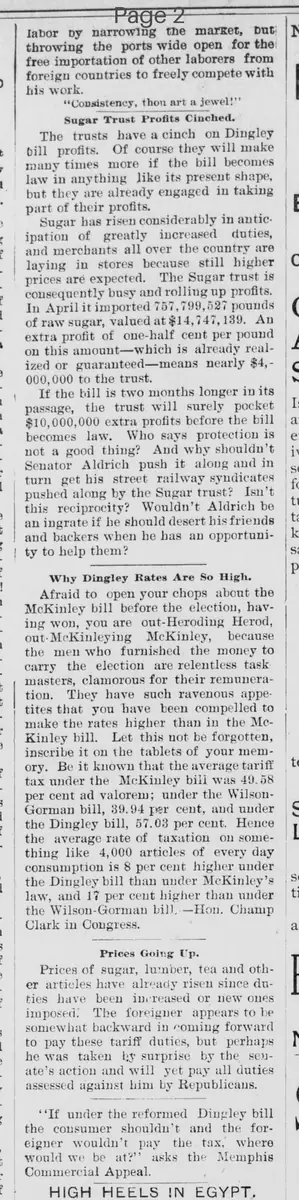
Sugar Trust Profits Cinched.
The trusts have a cinch on Dingley bill profits. Of course they will make many times more if the bill becomes law in anything like its present shape, but they are already engaged in taking part of their profits. Sugar has risen considerably in anticipation of greatly increased duties, and merchants all over the country are laying in stores because still higher prices are expected. The Sugar trust is consequently busy and rolling up profits. In April it imported 757,799,527 pounds of raw sugar, valued at $14,747,139. An extra profit of one-half cent per pound on this amount—which is already realized or guaranteed—means nearly $4,000,000 to the trust. If the bill is two months longer in its passage, the trust will surely pocket $10,000,000 extra profits before the bill becomes law. Who says protection is not a good thing? And why shouldn't Senator Aldrich push it along and in turn get his street railway syndicates pushed along by the Sugar trust? Isn't this reciprocity? Wouldn't Aldrich be an ingrate if he should desert his friends and backers when he has an opportunity to help them?
Why Dingley Rates Are So High.
Afraid to open your chops about the McKinley bill before the election, having won, you are out-Heroding Herod, out-McKinleying McKinley, because the men who furnished the money to carry the election are relentless task masters, clamorous for their remuneration. They have such ravenous appetites that you have been compelled to make the rates higher than in the McKinley bill. Let this not be forgotten, inscribe it on the tablets of your memory. Be it known that the average tariff tax under the McKinley bill was 49.58 per cent ad valorem; under the Wilson-Gorman bill, 39.94 per cent, and under the Dingley bill, 57.03 per cent. Hence the average rate of taxation on something like 4,000 articles of every day consumption is 8 per cent higher under the Dingley bill than under McKinley's law, and 17 per cent higher than under the Wilson-Gorman bill. -Hon. Champ Clark in Congress.
Prices Going Up.
Prices of sugar, lumber, tea and other articles have already risen since duties have been increased or new ones imposed. The foreigner appears to be somewhat backward in coming forward to pay these tariff duties, but perhaps he was taken by surprise by the senate's action and will yet pay all duties assessed against him by Republicans.
"If under the reformed Dingley bill the consumer shouldn't and the foreigner wouldn't pay the tax, where would we be at?" asks the Memphis Commercial Appeal.
The trusts have a cinch on Dingley bill profits. Of course they will make many times more if the bill becomes law in anything like its present shape, but they are already engaged in taking part of their profits. Sugar has risen considerably in anticipation of greatly increased duties, and merchants all over the country are laying in stores because still higher prices are expected. The Sugar trust is consequently busy and rolling up profits. In April it imported 757,799,527 pounds of raw sugar, valued at $14,747,139. An extra profit of one-half cent per pound on this amount—which is already realized or guaranteed—means nearly $4,000,000 to the trust. If the bill is two months longer in its passage, the trust will surely pocket $10,000,000 extra profits before the bill becomes law. Who says protection is not a good thing? And why shouldn't Senator Aldrich push it along and in turn get his street railway syndicates pushed along by the Sugar trust? Isn't this reciprocity? Wouldn't Aldrich be an ingrate if he should desert his friends and backers when he has an opportunity to help them?
Why Dingley Rates Are So High.
Afraid to open your chops about the McKinley bill before the election, having won, you are out-Heroding Herod, out-McKinleying McKinley, because the men who furnished the money to carry the election are relentless task masters, clamorous for their remuneration. They have such ravenous appetites that you have been compelled to make the rates higher than in the McKinley bill. Let this not be forgotten, inscribe it on the tablets of your memory. Be it known that the average tariff tax under the McKinley bill was 49.58 per cent ad valorem; under the Wilson-Gorman bill, 39.94 per cent, and under the Dingley bill, 57.03 per cent. Hence the average rate of taxation on something like 4,000 articles of every day consumption is 8 per cent higher under the Dingley bill than under McKinley's law, and 17 per cent higher than under the Wilson-Gorman bill. -Hon. Champ Clark in Congress.
Prices Going Up.
Prices of sugar, lumber, tea and other articles have already risen since duties have been increased or new ones imposed. The foreigner appears to be somewhat backward in coming forward to pay these tariff duties, but perhaps he was taken by surprise by the senate's action and will yet pay all duties assessed against him by Republicans.
"If under the reformed Dingley bill the consumer shouldn't and the foreigner wouldn't pay the tax, where would we be at?" asks the Memphis Commercial Appeal.
What sub-type of article is it?
Economic Policy
Taxation
What keywords are associated?
Dingley Bill
Sugar Trust
Tariff Rates
Protectionism
Price Increases
Economic Policy
What entities or persons were involved?
Sugar Trust
Senator Aldrich
Dingley Bill
Mckinley Bill
Wilson Gorman Bill
Hon. Champ Clark
Republicans
Editorial Details
Primary Topic
Criticism Of Dingley Bill Benefiting Sugar Trust
Stance / Tone
Strongly Anti Protectionist And Anti Trust
Key Figures
Sugar Trust
Senator Aldrich
Dingley Bill
Mckinley Bill
Wilson Gorman Bill
Hon. Champ Clark
Republicans
Key Arguments
Trusts Profit From Anticipated Higher Duties On Sugar
Sugar Prices Risen, Merchants Stocking Up
Sugar Trust Imported Large Amounts, Gaining Extra Profits
Protection Benefits Trusts, Reciprocity With Politicians Like Aldrich
Dingley Rates Higher Than Mckinley Due To Election Funders' Demands
Average Tariff Rates: Mckinley 49.58%, Wilson Gorman 39.94%, Dingley 57.03%
Prices Of Goods Rising With Duties
Foreigners Not Paying Tariffs, Consumers Bear Burden