Thank you for visiting SNEWPapers!
Sign up free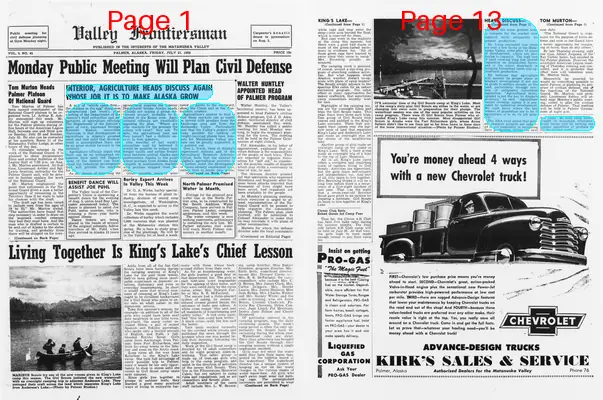
Valley Frontiersman
Palmer, Alaska
What is this article about?
Departments of Interior and Agriculture debated Alaska's development priorities in a joint meeting, with Interior advocating agricultural settlements like in Kenai for growth, while Agriculture stressed need for industrial markets first and supporting existing farms in areas like Matanuska Valley.
Merged-components note: Continuation of story from page 1 to page 13
Clippings
1 of 2
OCR Quality
Full Text
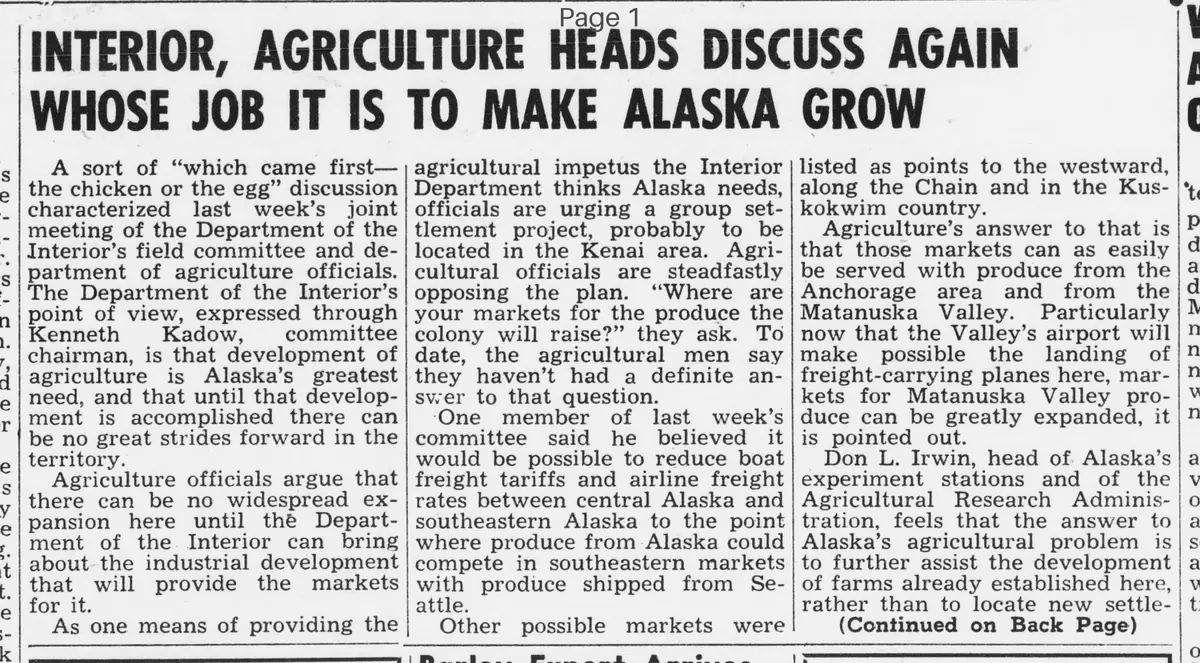
A sort of "which came first- the chicken or the egg" discussion characterized last week's joint meeting of the Department of the Interior's field committee and department of agriculture officials.
The Department of the Interior's point of view, expressed through Kenneth Kadow, committee chairman, is that development of agriculture is Alaska's greatest need, and that until that development is accomplished there can be no great strides forward in the territory.
Agriculture officials argue that there can be no widespread expansion here until the Department of the Interior can bring about the industrial development that will provide the markets for it.
As one means of providing the agricultural impetus the Interior Department thinks Alaska needs, officials are urging a group settlement project, probably to be located in the Kenai area. Agricultural officials are steadfastly opposing the plan.
"Where are your markets for the produce the colony will raise?" they ask.
To date, the agricultural men say they haven't had a definite answer to that question.
One member of last week's committee said he believed it would be possible to reduce boat freight tariffs and airline freight rates between central Alaska and southeastern Alaska to the point where produce from Alaska could compete in southeastern markets with produce shipped from Seattle.
Other possible markets were listed as points to the westward, along the Chain and in the Kuskokwim country.
Agriculture's answer to that is that those markets can as easily be served with produce from the Anchorage area and from the Matanuska Valley. Particularly now that the Valley's airport will make possible the landing of freight-carrying planes here, markets for Matanuska Valley produce can be greatly expanded, it is pointed out.
Don L. Irwin, head of Alaska's experiment stations and of the Agricultural Research Administration, feels that the answer to Alaska's agricultural problem is to further assist the development of farms already established here, rather than to locate new settlements.
(Continued on Back Page)
HEADS DISCUSS
(Continued from Page 1)
ments in the same general area, to compete for the market now supplied fairly adequately by present production.
Mr. Irwin reminded that there are only a few farms in the Matanuska Valley, even after 15 years of development, which are producing to capacity. The high cost of land clearing long has slowed expansion on established farms, and is the major drawback in bringing homestead lands into agricultural production.
He believes that agriculture will assume its proper place in Alaska's development if aid can be given to settlers already on the land, particularly through revision of antiquated homestead legislation.
"Agricultural development is not the key to Alaska's problems," he said. "Agriculture cannot develop, unless it is preceded by industrial development. We must know where the key centers of population are to be if agriculture is to do its job properly."
The ARA head added that present research projects are expected to aid materially in increasing farm production within the next few years. As each farm moves toward its maximum efficiency, fewer farms will be turning out greater quantities of produce to fill the market needs.
What sub-type of article is it?
What keywords are associated?
What entities or persons were involved?
Where did it happen?
Story Details
Key Persons
Location
Alaska
Event Date
Last Week
Story Details
Joint meeting debates agriculture vs. industrial development as priority for Alaska's growth; Interior proposes Kenai settlement project, Agriculture opposes without markets and favors aiding existing farms in Matanuska Valley.