Thank you for visiting SNEWPapers!
Sign up free
Letter to Editor
October 17, 1815
Daily National Intelligencer
Washington, District Of Columbia
What is this article about?
An anonymous writer, signing as 'INVESTIGATOR,' argues that subscribers to unchartered banks remain individually liable for the institution's debts, as only a legislative charter can exempt them. He critiques the error in assuming otherwise, uses hypotheticals and examples like the Hewitt case, and invites discussion while referencing Adam Smith.
Clipping
OCR Quality
98%
Excellent
Full Text
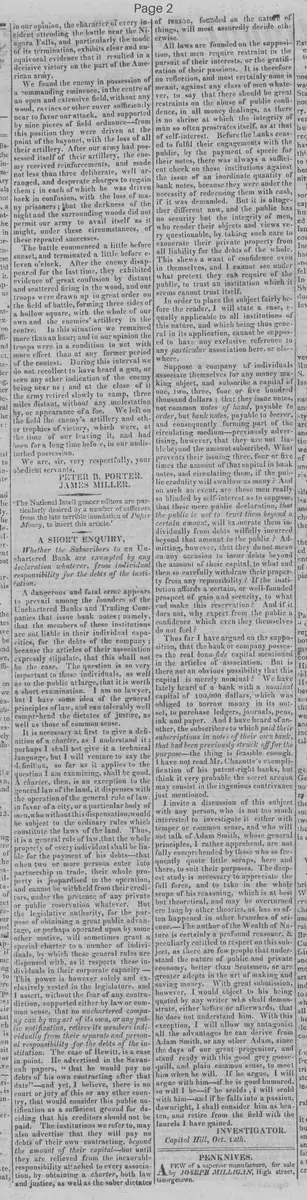
A SHORT ENQUIRY,
Whether the Subscribers to an Unchartered Bank are exempted by any declaration whatever, from individual responsibility for the debts of the institution.
A dangerous and fatal error appears to prevail among the founders of the Unchartered Banks and Trading Companies that issue bank notes; namely, that the members of these institutions are not liable in their individual capacities, for the debts of the company; because the articles of their association expressly stipulate, that this shall not be the case. The question is so very important to those individuals, as well as to the public at large, that it is worth a short examination. I am no lawyer, but I have some idea of the general principles of law, and can tolerably well comprehend the dictates of justice, as well as those of common sense.
It is necessary at first to give a definition of a charter, as I understand it: perhaps I shall not give it a technical language, but I will venture to say the definition, so far as it applies to the question I am examining, shall be good. A charter, then, is an exception to the general law of the land, it dispenses with the operation of the general rule of law, in favor of a city, or a particular body of men, who without this dispensation, would be subject to the ordinary rules which constitute the laws of the land. Thus, it is a general rule of law, that the whole property of every individual shall be liable for the payment of his debts--that when two or more persons enter into partnership in trade, their whole property is jeopardised in the operation, and cannot be withheld from their creditors, under the pretence of any private or public reservation whatever. But the legislative authority, for the purpose of obtaining a great public advantage, or perhaps operated upon by some other motive, will sometimes grant a special charter to a number of individuals, by which these general rules are dispensed with, as it respects these individuals in their corporate capacity-- This power is however solely and exclusively vested in the legislature, and I assert, without the fear of any contradiction, supported either by law or common sense, that no unchartered company can by any act of its own, or any public notification, relieve its members individually from their separate and personal responsibility: for the debts of the institution. The case of Hewitt, is a case in point. He advertised in the Savannah papers, "that he would pay no debts of his own contracting after that date" and yet, I believe, there is no court or jury of this or any other country, that would consider this public notification as a sufficient ground for deciding that his creditors should not be paid. The institutions we refer to, may also advertise that they will pay no debts of their own contracting, beyond the amount of their capital but until they are relieved from the inexorable responsibility attached to every association, by obtaining a charter, both law and justice, as well as the sober dictates of reason, founded on the nature of things, will most assuredly decide otherwise.
All laws are founded on the supposition, that men require restraint in the pursuit of their interests, or the gratification of their passions. It is therefore no reflection, and most certainly none is meant, against any class of men whatever, to say that there should be great restraints on the abuse of public confidence, in all money dealings, as there is no shrine at which the integrity of man so often prostrates itself, as at that of self-interest. Before the Banks ceased to fulfil their engagements with the public, by the payment of specie for their notes, there was always a sufficient check on these institutions against the issue of an inordinate quantity of bank notes, because they were under the necessity of redeeming them with cash, if it was demanded. But it is altogether different now, and the public has no security but the integrity of men, who render their objects and views very questionable, by taking such care to exonerate their private property from all liability for the debts of the whole. This shews a want of confidence even in themselves, and I cannot see under what pretext they can require of the public, to trust an institution which it seems cannot trust itself.
In order to place the subject fairly before the reader, I will state a case, equally applicable to all institutions of this nature, and which being thus general in its application, cannot be supposed to have any exclusive reference to any particular association here, or elsewhere.
Suppose a company of individuals associate themselves for any money making object, and subscribe a capital of one, two, three, four or five hundred thousand dollars ; that they issue notes, not common notes of hand, payable to order, but bank notes, payable to bearer, and consequently forming part of the circulating medium--previously advertising, however, that they are not liable beyond the amount subscribed. What prevents their issuing three, four or five times the amount of that capital in bank notes, and circulating them, if the public credulity will swallow as many ? And on such an event, are these men really so blinded by self-interest as to suppose, that their mere public declaration, that the public is not to trust them beyond a certain amount, will exonerate them individually from debts willfully incurred beyond that amount to the public ? Admitting, however, that they do not mean on any occasion to incur debts beyond the amount of their capital, to what end then so carefully withdraw their property from any responsibility ? If the institution affords a certain, or well-founded prospect of gain and security, to what end make this reservation? And if it does not, why expect from the public a confidence which even they themselves do not feel ?
Thus far I have argued on the supposition, that the bank or company possesses the real bona-fide capital mentioned in the articles of association. But is there not an obvious possibility that this capital is merely nominal ? We have lately heard of a bank with a nominal capital of 100,000 dollars, which was obliged to borrow money in its outset, to purchase ledgers, journals, pens, ink and paper. And I have heard of another, the subscribers to which paid their subscriptions in notes of their own bank, that had been previously struck off for the purpose--the thing is feasible enough.
I have not read Mr. Chazotte's exemplification of his patent-right banks, but think it very probable the secret arcana may consist in the ingenious contrivance just mentioned.
I invite a discussion of this subject with any person, who is not too much interested to investigate it either with temper or common sense, and who will not talk of Adam Smith, whose general principles, I rather apprehend, are not fully comprehended by those who so frequently quote little scraps, here and there, to suit their purposes. The deepest study is necessary to appreciate the full force, and to take in the whole scope of his reasoning, which is at best but theoretical, and may be overturned ere long by other theories, as has so often happened in other branches of science.--The author of the Wealth of Nations is certainly a profound reasoner, & peculiarly entitled to respect on this subject, as there are few people that understand the nature of public and private economy, better than Scotsmen, or are greater adepts in the art of making and saving money. With great submission, however, I would object to his being quoted by any writer who shall demonstrate, either before or afterwards, that he does not understand him. With this exception, I will allow my antagonist all the advantages he can derive from Adam Smith, or any other Adam, since the days of our great progenitor, and stand ready with this good grey goose-quill, and plain common sense, to meet him when he will. If he argue, I will argue with him--if he is good humored, so will I be--if he scolds, I will scold with him--and if he falls into a passion, downright, I shall consider him as beaten, and retire from the field with the laurels I have gained.
INVESTIGATOR.
Capitol Hill, Oct. 12th.
Whether the Subscribers to an Unchartered Bank are exempted by any declaration whatever, from individual responsibility for the debts of the institution.
A dangerous and fatal error appears to prevail among the founders of the Unchartered Banks and Trading Companies that issue bank notes; namely, that the members of these institutions are not liable in their individual capacities, for the debts of the company; because the articles of their association expressly stipulate, that this shall not be the case. The question is so very important to those individuals, as well as to the public at large, that it is worth a short examination. I am no lawyer, but I have some idea of the general principles of law, and can tolerably well comprehend the dictates of justice, as well as those of common sense.
It is necessary at first to give a definition of a charter, as I understand it: perhaps I shall not give it a technical language, but I will venture to say the definition, so far as it applies to the question I am examining, shall be good. A charter, then, is an exception to the general law of the land, it dispenses with the operation of the general rule of law, in favor of a city, or a particular body of men, who without this dispensation, would be subject to the ordinary rules which constitute the laws of the land. Thus, it is a general rule of law, that the whole property of every individual shall be liable for the payment of his debts--that when two or more persons enter into partnership in trade, their whole property is jeopardised in the operation, and cannot be withheld from their creditors, under the pretence of any private or public reservation whatever. But the legislative authority, for the purpose of obtaining a great public advantage, or perhaps operated upon by some other motive, will sometimes grant a special charter to a number of individuals, by which these general rules are dispensed with, as it respects these individuals in their corporate capacity-- This power is however solely and exclusively vested in the legislature, and I assert, without the fear of any contradiction, supported either by law or common sense, that no unchartered company can by any act of its own, or any public notification, relieve its members individually from their separate and personal responsibility: for the debts of the institution. The case of Hewitt, is a case in point. He advertised in the Savannah papers, "that he would pay no debts of his own contracting after that date" and yet, I believe, there is no court or jury of this or any other country, that would consider this public notification as a sufficient ground for deciding that his creditors should not be paid. The institutions we refer to, may also advertise that they will pay no debts of their own contracting, beyond the amount of their capital but until they are relieved from the inexorable responsibility attached to every association, by obtaining a charter, both law and justice, as well as the sober dictates of reason, founded on the nature of things, will most assuredly decide otherwise.
All laws are founded on the supposition, that men require restraint in the pursuit of their interests, or the gratification of their passions. It is therefore no reflection, and most certainly none is meant, against any class of men whatever, to say that there should be great restraints on the abuse of public confidence, in all money dealings, as there is no shrine at which the integrity of man so often prostrates itself, as at that of self-interest. Before the Banks ceased to fulfil their engagements with the public, by the payment of specie for their notes, there was always a sufficient check on these institutions against the issue of an inordinate quantity of bank notes, because they were under the necessity of redeeming them with cash, if it was demanded. But it is altogether different now, and the public has no security but the integrity of men, who render their objects and views very questionable, by taking such care to exonerate their private property from all liability for the debts of the whole. This shews a want of confidence even in themselves, and I cannot see under what pretext they can require of the public, to trust an institution which it seems cannot trust itself.
In order to place the subject fairly before the reader, I will state a case, equally applicable to all institutions of this nature, and which being thus general in its application, cannot be supposed to have any exclusive reference to any particular association here, or elsewhere.
Suppose a company of individuals associate themselves for any money making object, and subscribe a capital of one, two, three, four or five hundred thousand dollars ; that they issue notes, not common notes of hand, payable to order, but bank notes, payable to bearer, and consequently forming part of the circulating medium--previously advertising, however, that they are not liable beyond the amount subscribed. What prevents their issuing three, four or five times the amount of that capital in bank notes, and circulating them, if the public credulity will swallow as many ? And on such an event, are these men really so blinded by self-interest as to suppose, that their mere public declaration, that the public is not to trust them beyond a certain amount, will exonerate them individually from debts willfully incurred beyond that amount to the public ? Admitting, however, that they do not mean on any occasion to incur debts beyond the amount of their capital, to what end then so carefully withdraw their property from any responsibility ? If the institution affords a certain, or well-founded prospect of gain and security, to what end make this reservation? And if it does not, why expect from the public a confidence which even they themselves do not feel ?
Thus far I have argued on the supposition, that the bank or company possesses the real bona-fide capital mentioned in the articles of association. But is there not an obvious possibility that this capital is merely nominal ? We have lately heard of a bank with a nominal capital of 100,000 dollars, which was obliged to borrow money in its outset, to purchase ledgers, journals, pens, ink and paper. And I have heard of another, the subscribers to which paid their subscriptions in notes of their own bank, that had been previously struck off for the purpose--the thing is feasible enough.
I have not read Mr. Chazotte's exemplification of his patent-right banks, but think it very probable the secret arcana may consist in the ingenious contrivance just mentioned.
I invite a discussion of this subject with any person, who is not too much interested to investigate it either with temper or common sense, and who will not talk of Adam Smith, whose general principles, I rather apprehend, are not fully comprehended by those who so frequently quote little scraps, here and there, to suit their purposes. The deepest study is necessary to appreciate the full force, and to take in the whole scope of his reasoning, which is at best but theoretical, and may be overturned ere long by other theories, as has so often happened in other branches of science.--The author of the Wealth of Nations is certainly a profound reasoner, & peculiarly entitled to respect on this subject, as there are few people that understand the nature of public and private economy, better than Scotsmen, or are greater adepts in the art of making and saving money. With great submission, however, I would object to his being quoted by any writer who shall demonstrate, either before or afterwards, that he does not understand him. With this exception, I will allow my antagonist all the advantages he can derive from Adam Smith, or any other Adam, since the days of our great progenitor, and stand ready with this good grey goose-quill, and plain common sense, to meet him when he will. If he argue, I will argue with him--if he is good humored, so will I be--if he scolds, I will scold with him--and if he falls into a passion, downright, I shall consider him as beaten, and retire from the field with the laurels I have gained.
INVESTIGATOR.
Capitol Hill, Oct. 12th.
What sub-type of article is it?
Investigative
Persuasive
Philosophical
What themes does it cover?
Economic Policy
Commerce Trade
Morality
What keywords are associated?
Unchartered Banks
Individual Liability
Bank Notes
Corporate Charter
Economic Responsibility
Public Confidence
Adam Smith
What entities or persons were involved?
Investigator.
Letter to Editor Details
Author
Investigator.
Main Argument
subscribers to unchartered banks cannot exempt themselves from individual liability for the institution's debts through articles of association or public declarations; only a legislative charter can provide such protection, as per general principles of law and justice.
Notable Details
References The Hewitt Case In Savannah
Hypothetical Scenario Of Over Issuing Bank Notes
Critique Of Nominal Capital In Banks
Mentions Mr. Chazotte's Patent Right Banks
References Adam Smith's Wealth Of Nations
Invites Open Discussion With Temper And Common Sense